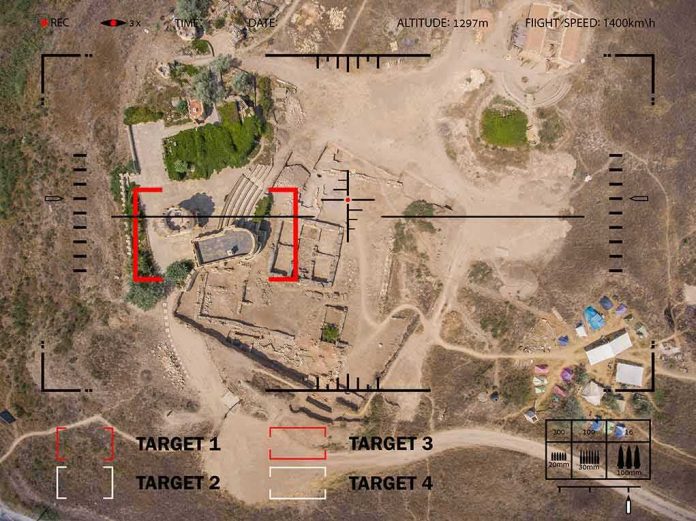
Satellite imagery can show you where concrete is poured and earth is moved; it cannot, by itself, tell you why. The most durable way to read the new pictures from Iran’s Parchin complex is through that lens: the images are strong evidence of significant reconstruction at Taleghan 2 — a location historically tied to weapons-relevant high-explosives work — but they are not dispositive proof of an active nuclear weaponization restart. What they do establish, however, is a test of verification: whether access and sampling follow the pixels.
At a Glance
- Commercial satellites show sustained reconstruction and fortification at Taleghan 2 inside Parchin, including remediation of strike damage and the addition of protective works.
- Independent analysts highlight features consistent with a high-explosives containment vessel — a key tool in past weaponization research — yet stop short of claiming definitive nuclear use.
- Tehran frames its obligations as conditional and points to broader military research at Parchin, keeping intent ambiguous and contesting any breach narrative.
- The evidentiary hinge now is inspection: without IAEA access to Parchin and sites like Pickaxe Mountain, interpretation will remain politicized and uncertain.
What the new imagery actually shows at Parchin’s Taleghan 2
High-resolution views released and analyzed since mid-year depict heavy repair activity at the bunkered Taleghan 2 complex, a facility within the Parchin military reservation southeast of Tehran. Analysts at the Institute for Science and International Security (ISIS) documented excavation around penetration points created by precision strikes, debris clearance, and the emplacement of reinforced concrete elements consistent with a permanent cap — standard steps to restore structural integrity and harden against follow-on attack. Subsequent frames captured re-covering with soil and protective layers, the telltale signatures of a refurbished underground structure rather than temporary patchwork. In parallel, open-source curators flagged follow-on strike scarring on the earth berms, indicating the site remained a target after initial rebuilding cycles.
ISIS’s separate technical note drew special attention to a roughly cylindrical object with proportions compatible with a high-explosives containment vessel — a thick-walled chamber used to confine blast and diagnostics during hydrodynamic experiments (tests that use high explosives to compress surrogates for fissile cores without causing nuclear yield). Their judgment is careful but pointed: possible presence, consistent with known past activities at Parchin under the AMAD program, yet not clinching by itself. That combination — observable reconstruction plus plausible test hardware — is what makes the Taleghan 2 imagery consequential rather than routine.
Why containment vessels matter in weaponization timelines
Containment vessels sit at the interface between materials science and weapons physics. They allow repeated, instrumented trials of implosion systems — the explosive lenses, detonators, and timing circuitry that must compress a core symmetrically. A state aiming to retain, refine, or reconstitute weaponization know-how without crossing enrichment or assembly red lines commonly protects this capability; it is the part of the enterprise least visible to standard nuclear safeguards. Thus, a site history that already includes allegations of such work, plus new imagery consistent with fortification and potential test infrastructure, reasonably elevates policy concern even in the absence of declared nuclear material on site.
The caution, though, is methodological. Satellite images infer shapes, textures, and sequencing — roofing appears, a berm thickens, a shaft is sealed — but cannot verify what is tested or measured indoors. That requires inspection, environmental sampling, and interviews. The IAEA has long emphasized the gap: pixels can prioritize leads, not close the loop.
The agreement question: breach or conditional defense?
One reason the current debate is overheated is that it doubles as a referendum on whether Tehran is violating a political freeze with Washington. Media accounts framed the reconstruction as occurring “while [the] deal remained in force,” an assertion that bites only if the accord was still operative and if Parchin-related works fell within its scope. Iranian officials have cast their commitments as contingent — null if hostilities resumed or certain sanctions snapped back — and they present Parchin as a military explosives and missile research zone rather than a nuclear site as such, implying that repairing a struck bunker is defensive maintenance, not a nuclear provocation.
This posture leaves a legalistic gray zone. If one side deems the understanding defunct after renewed strikes or sanctions steps, then “violation” loses precision; it becomes a political charge rather than an adjudicated fact. What is not gray is the safeguards baseline: whatever the status of any bilateral freeze, activities with a possible nuclear dimension are ultimately judged through the IAEA’s access to locations, people, and records — access that remains limited at the most sensitive sites.
Pickaxe Mountain and the limits of inference beyond Parchin
The same cycle of satellite-led suspicion and official opacity surrounds Kuh-e Kolang Gaz L — colloquially, Pickaxe Mountain — a deep-underground complex long rumored to host sensitive assembly work. Reports citing commercial providers describe vehicle traffic patterns and tunneling signatures suggestive of ongoing underground activity; yet absent on-site verification, analysts can only assign probabilities, not conclusions. The IAEA’s challenge is compounded by mandate and access: Parchin and Pickaxe sit within military reservations where Iran has historically circumscribed visits, and even when limited site access is granted, sampling scopes and revisit rights become the real battleground.
In short, the imagery beyond Parchin widens the circle of “sites of interest,” but does not, on its own, transform ambiguity into evidence. That conversion requires door-openers only Tehran can provide, or a chain of corroboration from independent laboratories if material traces are collected.
Where the analytic floor ends and policy risk begins
Several points are firmer than the surrounding politics. First, the reconstruction at Taleghan 2 is real and sustained; the work goes beyond cosmetic repair to include structural reinforcement and reburial typical of hardened facilities. Second, the configuration ISIS describes is compatible with the kind of high-explosives research that underpinned Iran’s pre-2003 AMAD activities, and that competence — if preserved — shortens any future weaponization dash even without parallel enrichment advances. Third, the absence of unusual signatures at well-known nuclear fuel-cycle sites such as Natanz, Isfahan, and Fordow argues against a program-wide reconstitution at this stage, and it underscores why Parchin-style weaponization infrastructure is both strategically valuable and verification-challenging.
What remains contested is intent and treaty posture. Tehran’s conditional framing of its obligations, coupled with partial cooperation announcements with the IAEA, keeps it within a space of plausible deniability: enough engagement to avoid formal censure, not enough transparency to neutralize suspicion. In that gap, outside actors lean on imagery because it is the one dataset they can access without permission — useful for cueing questions, insufficient for closing them.
The IAEA says inspections of Iranian nuclear facilities are expected to resume soon, though Tehran and Washington continue to disagree on the details.#IranWar #IranNews #NuclearDeal #IAEA #MiddleEastConflict #Breaking #GlobalPolitics #WorldAffairs #NewsUpdate #Iran pic.twitter.com/Tz7lH54ZId
— yasir ali (@YasirA80834) July 6, 2026
The verification path that would settle the question
The technical path to clarity is not exotic; it is the standard nonproliferation toolkit applied where it matters. Inspectors would need time-bound, repeated access to Taleghan 2 and adjacent Parchin structures; authority to take environmental swipes and bulk samples where reconstruction occurred; the ability to inspect, photograph, and, if present, measure any large cylindrical vessels and associated diagnostics; and structured interviews with site engineers responsible for the rebuild. If Iran’s claim is straightforward defensive repair at a conventional explosives facility, this sequence would generate a coherent negative: no nuclear-related residue, no incongruent procurement trails, and a documentation log that matches construction timelines.
Conversely, if the reconstruction is part of a strategy to maintain weaponization-relevant competence under the cover of military secrecy, the same process tends to surface inconsistencies — trace materials, equipment lineages, or testing patterns that do not fit a purely conventional explosives mission. The IAEA has asked, in various forums, for fuller re-engagement to “diminish” escalation risk; that is diplomatic phrasing for a technical imperative: ambiguity is itself destabilizing when a site’s history sits so close to the weapons threshold.
How to read the next tranche of images
More pixels are coming; commercial constellations refresh frequently, and conflict actors often telegraph their own narratives through curated releases. Treat the next sets with a disciplined rubric. Ask whether the imagery reveals new function, not merely form — e.g., added ventilation, power handling, diagnostics conduits, or logistics footprints specific to test cycles. Weigh single-source claims of specialized equipment against multi-epoch corroboration. And anchor interpretations to the only metric that matters for nonproliferation: do these developments increase, decrease, or hold steady the time and transparency required to turn know-how into a device? Imagery can move that clock in both directions — by exposing, it can deter; by hardening, it can conceal.
Bottom line
The case for concern at Taleghan 2 rests on concrete, literally and analytically: a hardened rebuild at a site with a weaponization-linked pedigree, plus features consistent with high-explosives testing infrastructure. The counter-case is not a forensic rebuttal so much as a legal and contextual one — conditional obligations, a military research setting, and gestures toward renewed IAEA cooperation. Until inspectors step past the berms with sampling kits, the argument will live in the gap between what satellites can see and what science can prove. That is precisely why access — not more adjectives about “possible” or “suspected” — is the hinge on which this story should turn.
Sources:
redstate.com, ynetnews.com, x.com, i24news.tv, facebook.com, isis-online.org, nuclearnetwork.csis.org, washingtoninstitute.org, iranwatch.org