

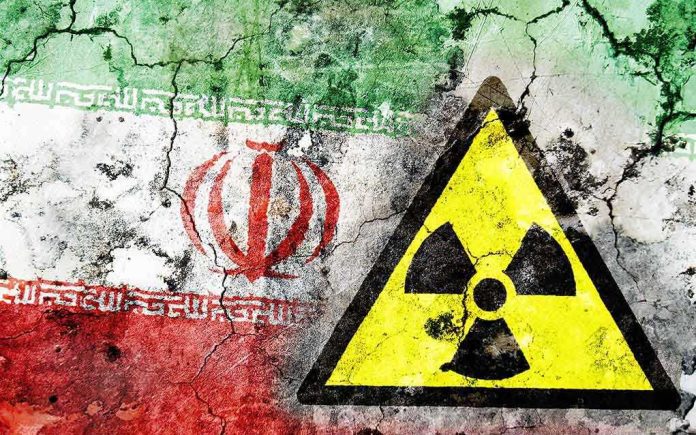
When a government airs how-to instructions for surviving a nuclear blast, it is doing more than teaching first aid for fallout; it is rehearsing society for crisis and broadcasting intent to adversaries. Iran’s recent, state-linked nuclear survival guidance sits squarely in that dual function: practical civil defense for citizens and strategic signaling in a period of acute tension.
At a Glance
- Iranian state-linked outlets aired an eight-minute nuclear survival video with specific, actionable guidance—shelter selection, ventilation control, decontamination, and food-and-water precautions.
- The instructions align with established nuclear-detonation doctrine—get inside, stay inside, minimize exposure—suggesting standard civil defense content deployed at a charged moment.
- Broadcast timing serves multiple audiences: it prepares civilians while signaling readiness and resolve to foreign adversaries.
- Crisis communications are a standing feature of Iranian statecraft—informational and propagandistic aims often travel together.
What Iran Broadcast—and Why the Details Matter
Iran’s official news agency IRNA published, and state channels reportedly aired, an approximately eight-minute nuclear survival video that dispensed granular advice rather than slogans. The guidance emphasized sheltering in basements or central interior rooms of sturdy buildings, distancing from windows and exterior walls, closing doors and windows, and shutting off air conditioners or ventilation systems that pull in outside air. It cautioned against remaining outdoors to film the blast, sheltering in vehicles, and consuming potentially contaminated food or water; it also directed citizens to plan for at least a day under shelter and to await official instructions before emerging.
These are not idiosyncratic Iranian notions. They mirror the canon of nuclear-detonation public guidance employed by emergency planners worldwide: maximize mass between yourself and fallout, minimize inhalation and ingestion pathways, and prioritize time under protection to allow radiation levels to decay. FEMA’s own “Get Inside, Stay Inside, Stay Tuned” framework—favoring basements or the dense cores of large buildings and maintaining shelter for roughly 12–24 hours—maps closely to the Iranian advice. The overlap signals that, on content, Tehran chose conventional civil defense doctrine.
Mechanism: How Civil Defense Instructions Reduce Harm
Nuclear detonations produce three distinct hazards: prompt effects (thermal flash and blast), early fallout (highly radioactive particles lofted and then deposited downwind over hours), and residual contamination. The survival calculus for civilians far from immediate ground zero hinges on reducing dose from fallout. Shelter choice is decisive: dense materials—earth, concrete, brick—absorb gamma radiation; even ordinary structures provide meaningful attenuation if one moves away from exterior walls and windows to interior spaces or underground. Shutting ventilation that draws outdoor air reduces inhalation of radioactive particulates. Decontamination—shedding outer clothing, showering with lukewarm water, sealing contaminated items—cuts internal and external exposure. These principles are universal; Iran’s guidance tracks them point for point.
Time also matters. Fallout radiation decays rapidly at first, dropping by about a factor of ten for every sevenfold increase in time after deposition—a heuristic emergency planners translate into guidance to remain sheltered through the first day unless lifesaving evacuation is necessary. Hence the Iranian recommendation to plan for at least 24 hours inside and rely on official channels before moving.
Why Now? Routine Preparedness Meets Strategic Signaling
Content alone cannot tell us motive, but context sharpens the picture. States often publish emergency guidance during tense periods to accomplish several goals at once: boost civilian readiness, inoculate against panic, and message capability and will to outside observers. Analyses of Iran’s strategic communications across recent crises describe an integrated approach that blends military posturing with information operations tailored to domestic, regional, and international audiences. In that frame, a sober civil defense tutorial is both prudent governance and a calibrated signal: Iran expects escalation, has planned for it, and wants that readiness visible.
Equally important, this broadcast does not, by itself, diagnose imminent nuclear use. Because the guidance mirrors mature international doctrine, it fits within the category of routine preparedness products that many governments maintain and occasionally resurface. The timing—amid heightened U.S.–Iran–Israel friction—imparts meaning, but the mechanism is conventional. That duality is precisely how strategic communication operates in practice: the same content can be both useful to citizens and legible deterrent theater to adversaries.
Iran’s Communication Playbook: Information and Influence
Understanding the medium helps interpret the message. Scholarship on Iranian political communication underscores a state apparatus that is simultaneously censor, patron, and narrator—managing domestic information flows while cultivating legitimacy and deterrence narratives at home and abroad. During past crises, including the COVID-19 wave and after high-profile security events, state media and affiliated channels engaged in coordinated messaging aimed at shaping public behavior and international perception.
Within that tradition, a civil defense broadcast is a versatile tool. Domestically, it instructs—reducing preventable harm should the worst occur—and it demonstrates stewardship, signaling that authorities are planning beyond rhetoric. Externally, it operates as cost-imposing communication: an adversary contemplating strikes must account for a population primed to endure initial shocks and sustain the polity. Research on Iran’s recent campaigns characterizes this as part of an integrated influence strategy—intimidation, reassurance, and narrative control fused across media.
Comparative Lens: How It Aligns With Best Practice
Set against established nuclear-response guidance, Iran’s advice is technically sound. It channels three pillars that matter most to survival outside the immediate blast zone: prompt sheltering in the best available structure, control of air pathways to reduce particulate intake, and disciplined, time-aware emergence guided by official updates. The admonitions to avoid cars as shelter, to stay away from windows and exterior walls, and to use sealed food and bottled water all track with best-practice checklists used by emergency managers in the United States and elsewhere.
Where states sometimes fail is in the operationalization: ensuring citizens know which buildings offer the best protection in their neighborhoods, how to improvise filters, and where to find official broadcasts if cellular networks are degraded. The Iranian video format—visual, stepwise, and focused on immediate actions—suggests an attempt to bridge that gap. Effectiveness, however, rests on repetition and integration into broader preparedness campaigns, not on a single airing.
BREAKING: Iran has released a rare broadcast on state TV this morning, preparing and instructing citizens to survive a nuclear strike, including sheltering for at least 24 hours, issued by Isfahan emergency services.
It comes amid Tucker Carlson's warning that Trump may be days…
— The world journal (@WorldJrnl) November 3, 2026
Implications: Readiness as Deterrence, and the Value of Practicality
For Iranian citizens, the practical takeaway is clear: nuclear survival starts with prompt, simple actions that dramatically cut radiation dose. That message, delivered ahead of any attack, can save lives in scenarios where seconds and minutes determine exposure. For outside observers, the broadcast is a reminder that in hard-power stand-offs, soft instruments—public health-style instructions, calm tone, procedural clarity—play into the deterrence mosaic by hardening society and complicating an adversary’s calculus.
The larger lesson travels well beyond Iran. Nuclear safety communication is most credible when it is concrete, technically orthodox, and stripped of hyperbole. In that sense, Iran’s guidance aligns with a global consensus refined over decades of civil defense research and emergency management practice. The content’s ordinariness is the point: in the unthinkable, ordinary steps—get inside, stay inside, stay tuned—are the difference between manageable exposure and avoidable catastrophe.
Sources:
lifesitenews.com, keralakaumudi.com, dnaindia.com, news.abplive.com, zoomnews.in, clashreport.com, poynter.org, academic.oup.com, public-pages-files-2025.frontiersin.org, fema.gov, tandfonline.com