

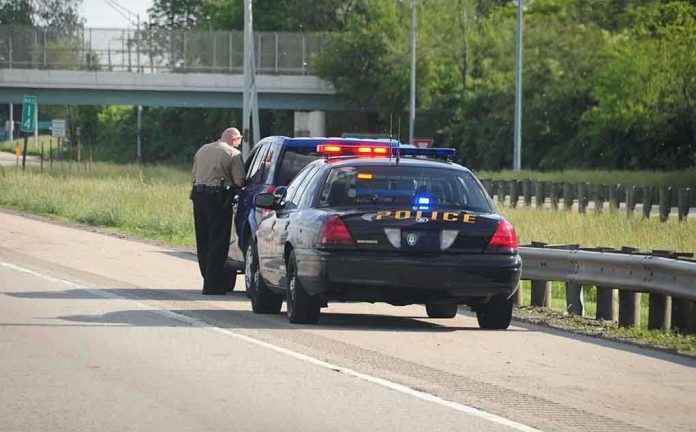
Police aviation turns a chaotic ground pursuit into a coordinated arrest; in Tampa, a suspected stolen box truck was tracked from above, guided to a stop, and the driver pulled into custody without reported bystander injuries—an illustration of how air support can shrink risk when large vehicles flee through dense urban corridors.
At a Glance
- Hillsborough County Sheriff’s Office says a suspected stolen box truck triggered a multi-agency pursuit through Tampa; one person was taken into custody.
- Deputies responded near I-275 and Fletcher Avenue around 8:30 p.m. and assisted Florida Highway Patrol as the truck moved across city streets.
- HCSO Aviation guided patrol units to the truck as it slowed on Dr. Martin Luther King Jr. Boulevard and stopped near Ridge Avenue; deputies broke the driver’s window and made the arrest, captured in agency video.
- The case spotlights a broader tension in pursuit policy: effective apprehension versus the risks of chasing heavy vehicles in urban traffic.
What Happened: Aerial guidance in an urban box-truck pursuit
According to contemporaneous local reporting citing the Hillsborough County Sheriff’s Office, a suspected stolen box truck initiated a pursuit sequence traversing parts of Tampa, ending with a single suspect taken into custody. Deputies responded to Interstate 275 and Fletcher Avenue at approximately 8:30 p.m. to assist the Florida Highway Patrol—an interagency posture that’s typical on multi-jurisdictional corridors where state highways blend into city arterials.
From there, the operational center of gravity moved to the air. HCSO’s Aviation Unit tracked and guided patrol units as the truck left the interstate grid and threaded through city streets—an approach designed to reduce risky close-in tailing by ground units while preserving continuous observation. The vehicle ultimately slowed along Dr. Martin Luther King Jr. Boulevard and came to a stop near Ridge Avenue. Deputies quickly contained the truck, smashed the driver’s window, opened the door, and removed the suspect; the sheriff’s office released video documenting that window-breach and extraction, standard tactics when a driver refuses commands and the cabin is secured from within.
How aviation changes the geometry of a pursuit
Air support turns a linear chase into a managed containment. With a helicopter or fixed-wing aircraft maintaining overwatch, ground units can flex between shadowing at a safer distance and surging for controlled stops when conditions allow. The cockpit’s stabilized optics, radio relay, and map overlays let a flight crew call turns, alert ahead to pinch points, and cue spikes or blocking units at predictable choke locations. In a city like Tampa, where interstate spurs, frontage roads, and broad arterials can let a heavy vehicle preserve momentum, the aerial vantage helps avoid the accordion effect—rapid compressions and expansions of speed that produce the worst collision risks for following patrol cars and cross traffic.
Box trucks add complexity. They carry high centers of gravity and long braking distances; they destroy passenger compartments when momentum becomes contact. They are also difficult to immobilize safely, as traditional PIT maneuvers are generally contraindicated on large vehicles, and spike strips can be less decisive if the truck continues on compromised tires. That is why aviation—able to keep a bead on a vehicle without pressuring it at the bumper—often becomes the deciding asset in bringing a heavy vehicle incident to a clean end.
Policy frame: justified pursuit and successful capture are not the same question
Florida law and national practice make a simple point that operational culture sometimes blurs: catching the driver and conducting a justified pursuit are analytically distinct. Courts have long recognized both the need to apprehend dangerous offenders and the duty to exercise due care while doing so. In Florida jurisprudence, cases from City of Miami v. Horne to City of Pinellas Park v. Brown map the boundaries of officer discretion and municipal exposure in high-speed chases, emphasizing reasonableness and the foreseeability of harm when weighing government liability.
The national risk picture explains the caution. Analyses drawing on federal crash data note that more than one person per day is killed in incidents involving police pursuits; hundreds died in 2020 and 2021, and a material share of those seriously injured were uninvolved bystanders. Policies that privilege air tracking, controlled following distances, and preplanned termination tactics aim to reap the incapacitation benefit—taking a noncompliant driver off the road—while minimizing the kinetic hazards that intensive bumper-to-bumper chases can generate.
Tactics at the stop: why a window breach is common in refusal-to-exit scenarios
When a driver locks doors and refuses commands, time works against officers and the surrounding public. The longer a noncompliant driver sits behind the wheel, the higher the risk of another flight attempt or the introduction of weapons. Agencies train window breaches on stationary vehicles as a fast, focused way to defuse that risk: break glass, defeat the lock, open the door, then control the driver’s arms and ignition area. The Tampa arrest sequence, as described and shown in the sheriff’s office video, follows that logic: surround, breach, extract, and secure the driver before the situation re-energizes.
For heavy vehicles, this approach also contains mechanical risk. Box trucks often have column shifters and robust transmissions; a sudden gear engagement can turn a static perimeter into a lethal crush hazard. Rapid entry reduces the chance that a last-second stomp on the accelerator transforms a contained operation into an uncontrolled rollback or lurch forward.
A stolen box truck pursuit through Tampa ended with the driver in custody thanks to a team effort from the air and on the ground.
On October 28, 2026, at approximately 8:30 p.m., #teamHCSO’s Aviation Unit responded to Interstate 275 and Fletcher Avenue to assist the Florida… pic.twitter.com/6nGMQz5GOU
— HCSO (@HCSOSheriff) October 29, 2026
Why aviation-first pursuit models will keep expanding
Departments that can afford flight hours and maintenance are leaning harder into aviation because it scales across scenarios. It helps when suspects run in vehicles that can shrug off routine interdiction techniques, as a box truck might. It also helps when pursuit corridors traverse school zones, dense shopping strips, or nighttime entertainment districts where cross traffic and pedestrians spike unpredictably—places where a tail car’s presence can exacerbate risk. The trade-off is budgetary and political: rotorcraft are expensive, and not every county can keep an aircraft on station during the evening window when many pursuits ignite. But where aviation is available, it consistently shifts officers from reactive chasing to deliberate containment.
The bottom line for this Tampa case
The public facts are straightforward: HCSO says a suspected stolen box truck moved through Tampa until aviation-led coordination funneled it to a stop near Ridge Avenue, where deputies broke the driver’s window and took one person into custody. The interagency response began around I-275 and Fletcher Avenue at approximately 8:30 p.m., with Florida Highway Patrol participation, and concluded without reported injuries to bystanders. One measured caveat is routine in early case stages: the agency had not publicly identified the driver at the time of reporting.