
Political theater turns perilous when it singles out a named candidate; a Halloween tableau with a guillotine and campaign flyer is not just seasonal macabre, it is a direct collision of protected expression, community norms, and statutes that draw a bright line at threats of violence.
At a Glance
- Reports described a Minnesota Halloween yard display depicting a guillotine scene linked to Republican Minnesota House candidate Jessica Johnson by a campaign flyer in the “victim’s” hand.
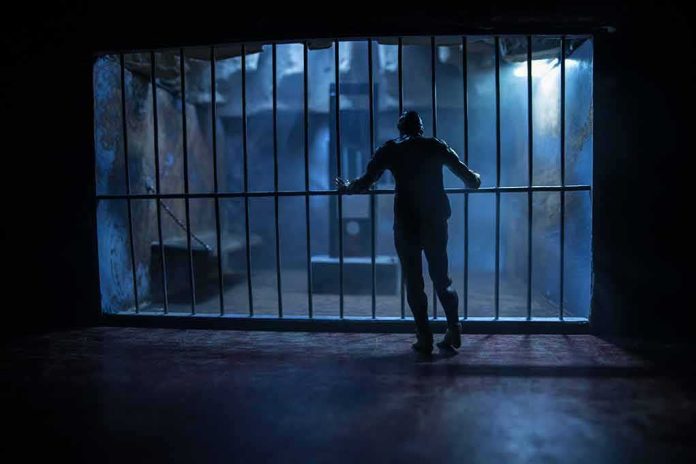
- The imagery included a cloaked figure operating the guillotine and a prone woman beneath the blade, creating a tableau critics construed as violent targeting.
- Minnesota’s threats-of-violence statute criminalizes indirect threats made with intent to terrorize or in reckless disregard of causing terror, a framework often cited in calls for review of such conduct.
- U.S. “true threats” doctrine protects caustic political speech but permits punishment of intimidation and serious expressions of intended violence; context and intent are decisive.
What Was Depicted and Why It Resonated
The reported display paired unmistakable execution imagery with an explicit political identifier. Accounts described a guillotine scene in a Minnesota yard with a cloaked figure poised at the lever and a woman positioned under the blade. In the woman’s hand, a campaign pamphlet reportedly read, “Jessica Johnson, for MN House,” identifying Johnson as a Republican candidate and linking the vignette to a specific political figure rather than a generic Halloween fright. That coupling of a named target with a staged beheading is what escalates the tableau from macabre décor to a political message with potentially intimidating overtones.
Guillotines are not subtle. They evoke punishment, retribution, and historically charged imagery of political executions. In a strictly seasonal context, a prop guillotine can pass as carnival-horror pastiche. When the “victim” holds a live candidate’s campaign flyer, the semiotics flip: the display is no longer an ambient scare but a pointed portrayal of violence against a recognizable person in public life.
Where Free Expression Ends and “True Threats” Begin
Two bodies of law frame the civic reaction. First, the First Amendment’s “true threats” doctrine. The Supreme Court has long shielded abrasive political hyperbole—most famously in Watts v. United States—but excludes from protection serious expressions of intent to commit unlawful violence against particular individuals. In Virginia v. Black, the Court underscored that intimidation intended to place a person in fear of bodily harm is outside the First Amendment, and more recently in Counterman v. Colorado it clarified that the state must show at least recklessness as to the threatening nature of the communication. In practice, fact-finders examine setting, language, target specificity, audience understanding, and the speaker’s mental state—context does the heavy lifting.
Second, Minnesota’s threats-of-violence statute provides a concrete state-law framework. Section 609.713 criminalizes directly or indirectly threatening to commit a crime of violence with the purpose of terrorizing another or with reckless disregard of that risk. While public art and political displays often fall comfortably within protected speech, the statute is routinely cited when conduct crosses from symbolism to targeted intimidation, particularly where a specific person is named or unmistakably depicted.
How We Got to a Guillotine on the Lawn
American politics has periodically flirted with violent symbolism—no party or decade is singularly responsible. What has changed is the speed with which stylized provocation is reframed as proof of menace. Social and partisan media ecosystems reward maximal moral clarity and sharp imagery; a striking yard display can become a totem for broader claims about violence in public life within hours. That amplification makes the choice of symbolism consequential: a guillotine is not mere edge; it is a historical metonym for political liquidation. When bound to a real candidate’s name, it becomes a message any reasonable observer will parse through the lens of contemporary threats and harassment.
Campaign seasons compound the sensitivity. Down-ballot candidates canvass neighborhoods, distribute flyers, and rely on volunteer energy—precisely the milieu where yard displays live. A visual that appears to celebrate violence against one of those candidates sits uncomfortably close to voter intimidation and campaign interference concerns addressed elsewhere in Minnesota law, even if the display does not itself violate those provisions.
Parsing Intent, Impact, and the Legal Threshold
Intent is the fulcrum separating a constitutionally distasteful display from prosecutable intimidation. The First Amendment line is exacting: the state must prove the speaker at least recklessly understood the threatening nature of the communication; mere offense or public outrage does not suffice. Minnesota’s statute mirrors that emphasis, asking whether the maker of the indirect threat acted with purpose to terrorize or in reckless disregard of causing terror. Applying those standards to a yard display requires granular facts—who created it, what they meant to convey, and how a reasonable person in the target’s position would interpret it.
Impact still matters, even absent charges. Public officials and candidates shoulder a nontrivial threat load; visuals of their execution contribute to a climate that exhausts volunteers, chills civic engagement, and deters everyday people from seeking office. Communities do not need a prosecutor to act before they exercise social judgment—homeowner conversations, neighborhood association norms, and campaign-led safety assessments are immediate, legitimate responses to the signal such a display sends.
Why Communities Should Treat Violent Political Imagery as a Governance Issue
Local political health is not only about laws; it is about the tacit agreements neighbors keep. Yard signs, door-knocking, and debates are democratic muscle memory. Introducing staged beheadings tied to a named candidate degrades that muscle. The consequences are structural: it narrows the pool of would-be public servants, forces campaigns to divert scarce funds to security, and hardens partisan identity around contempt rather than persuasion. Over time, the effect is measurable in candidate attrition, volunteer burnout, and lower-quality representation.
There is a durable, practical standard communities can adopt without censoring political speech: keep criticism sharp but nonviolent; argue platforms, not the death of your opponent. That norm is compatible with the First Amendment and supported by jurisprudence that protects robust dissent while permitting sanction of intimidation. It is also enforceable at the level of civic culture—through peer pressure, business sponsorship choices, neighborhood guidelines, and the simple refusal to valorize violent motifs as clever politics.
Listen up numbnuts. There is currently a Halloween display in Minnesota with a Republican getting the guillotine. I would consider shutting the hell up. We are done with your fake outrage.
— Blistering Barnacles (@jamesdturnham) October 29, 2026
How Law and Norms Can Work Together
Law is the backstop; norms are the frontline. If a display tied to a named candidate triggers fear or disrupts campaign operations, Minnesota’s threats statute gives law enforcement a tool to evaluate intent and effect within constitutional limits. Separately, campaigns can document incidents, brief staff and volunteers on safety protocols, and engage property owners directly in search of de-escalation. The point is not to criminalize Halloween; it is to insist that democratic competition is not staged with the iconography of execution.
Sources:
thegatewaypundit.com, dailywire.com, twincities.com, hometownsource.com, law.cornell.edu