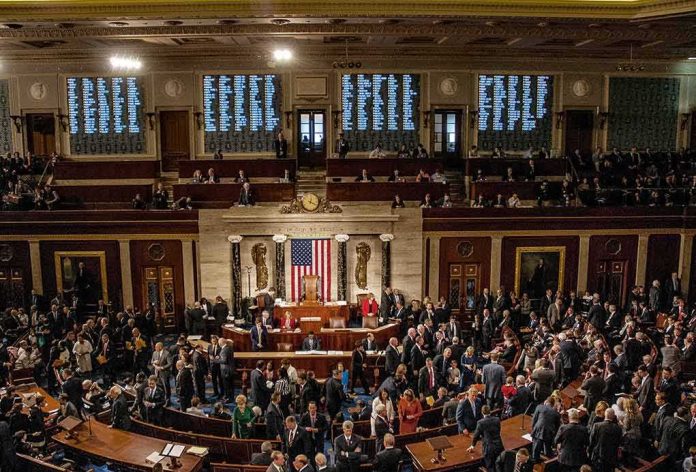
Congress’s periodic denunciations of “socialism” are not about changing statute; they are about fixing party identity in public view. The latest House vote condemning socialism functioned exactly as such a message instrument—decisive on the board, legally inert in effect, and deeply revealing about how each party wants to be seen.
At a Glance
- The House adopted H. Con. Res. 58 denouncing socialism with a clear majority; it is a concurrent resolution that does not change law.
- The text is categorical—opposing “socialism in all its forms”—and wrapped in historical claims linking socialism to authoritarianism.
- Democratic critics framed the vote as performative and a distraction from affordability legislation; some Democrats still supported it.
- The episode exemplifies “message legislation”: low-cost, high-visibility positioning that forces public roll calls on symbolic terrain.
What the House Actually Passed—and What It Does
The chamber approved H. Con. Res. 58, a concurrent resolution “denouncing the horrors of socialism” and opposing “the implementation of socialist policies in the United States.” It passed by a 285–98 margin, a result the Clerk’s roll call confirms. The instrument matters procedurally: a concurrent resolution expresses the sense of Congress but carries no force of law. No program is repealed, no agency is reoriented, no budget line is altered. The symbolic value is the point. The operative clause is striking in its sweep—“in all its forms”—and the preamble catalogs historical episodes to anchor the condemnation.
Republican sponsors pursued two interlocking aims. First, to make an affirmative statement of ideological boundary—individual liberty and market ordering on one side; collectivist planning and one-party rule on the other. Second, to force a recorded vote that sorts Democrats along that boundary. These aims are evident in the drafting choices (brief, categorical resolve clause), the reliance on familiar historical referents in the “whereas” findings, and the timing: the resolution moved when the majority could control floor time and frame the debate arc.
Why “Message Votes” Endure—and Why This One Fits the Pattern
Political scientists use “message legislation” to describe enactments designed to signal values rather than alter policy. Such measures are especially attractive in periods of divided government or tight partisan competition, when parties prize defining contrasts and discipline their brands. The literature is clear: leadership employs these votes to create televised moments, force the opposition into uncomfortable coalitions, and reassure core constituencies that the party’s creed is intact. The socialism resolution is textbook—short text, vivid label, easy-to-explain stakes, and little procedural risk. It generated an ideologically legible map of the House, with the bonus of bipartisan support to claim mainstream validation.
Why does the tactic persist? Because it works on multiple fronts. Internally, it tests party cohesion and reveals fissures in the other caucus. Externally, it gives campaigns a roll call to cite—“voted to condemn socialism” or “refused to do so”—in mailers and debates. And at a governance level, it allows the majority to show momentum without the transaction costs of complex policymaking. Frances Lee’s account of Congress as a perpetual campaign underscores this incentive structure; when the costs of legislating are high, parties shift effort to position-taking.
The Semantics Do the Heavy Lifting
In U.S. politics, “socialism” is not just a political-economic schema; it is a container for anxieties about state power, expropriation, and single-party dominance. The resolution leverages that semantic density. Its preamble links “socialist ideology” to authoritarian collapses; its resolve clause condemns “socialism in all its forms,” eliding schools of thought that range from command economies to social democracy. That categorical phrasing is deliberate: it minimizes definitional wriggle room on the floor, maximizes clarity in campaign usage, and anticipates objections by associating the term with twentieth-century atrocities rather than contemporary American policy debates.
This rhetorical compression produces predictable friction. Critics argue the term sweeps so broadly that it can be wielded against any redistributive policy, even those with long bipartisan pedigrees; proponents counter that the point is precisely to draw a bright normative line. The House text’s architecture—long historical “whereas” clauses culminating in a spare, universal condemnation—privileges the latter posture.
The Countercase: “A Distraction” from Material Policy
Democratic opponents did not dispute the vote tally or the nonbinding form; they attacked purpose. Representative Maxine Waters called the measure “an embarrassing distraction” and “a huge waste of time,” arguing it would not lower costs or solve practical problems; others echoed the affordability critique, casting the vote as theater after recess rather than legislating on prices, housing, or wages. That frame has antecedents: when a similar resolution advanced in a prior Congress, Democratic leadership labeled it “fake, phony, and fraudulent,” suggesting it was constructed for optics rather than policy.
Two points are worth disaggregating. First, as criticism of legislative priorities, the argument is coherent: a nonbinding condemnation displaces floor time that could host a bill with budgetary or regulatory consequence. Second, as a rebuttal to the majority’s stated aim, it largely concedes the field—the majority sought a symbolic stand, and the minority’s critique says it is symbolic. Symbolism, however, is not trivial in Congress; it is currency. Whether one views that currency as squandered or wisely invested depends on one’s weighting of persuasion versus policy throughput.
What This Means Going Forward
Expect more, not fewer, message votes. As long as parties compete in near-parity and media rewards binary conflict, leadership will schedule clean, high-salience roll calls on identity-laden terms. “Socialism” is a particularly durable label because it shortcuts a complex policy matrix into a single moral verdict. For Republicans, the upside is twofold: reaffirmation of an anti-statist brand and pressure on Democrats who identify with or refuse to repudiate democratic socialism. For Democrats, the risk is asymmetry—a no vote can be framed as tolerance for an unpopular ideology; a yes vote can alienate a vocal progressive flank. That is why these votes are engineered; they impose costs either way.
The governance challenge, as ever, is bandwidth. Floor hours spent on sense-of-Congress resolutions do not advance appropriations, reauthorizations, or oversight with statutory teeth. Yet signaling also lubricates coalition management: members return to districts with a crisp vote that aligns with constituent identity. The equilibrium Congress has found—high-frequency signaling interspersed with periodic bipartisan bargains—reflects these countervailing imperatives. The socialism resolution sits neatly in that groove: sweeping in language, narrow in formal effect, expansive in political utility.
Got them in a corner…
Tensions erupt in House hearing as GOP advances anti-socialism resolution while Dems rage: 'Silly season'https://t.co/0uWOrQl5Mp
— BREAKING NEWZ Alert (@MustReadNewz) September 1, 2026
How to Read the Next One
When the next ideologically vivid resolution arrives, parse three things. Mechanism: is it binding, and what levers would it pull if enacted? Text: does the operative clause make a specific claim or a universal one? Context: what coalition incentives does leadership face that day? Those answers will tell you almost everything about why the vote is happening and what its consequences will be. In an era of competitive nationalized elections, the most revealing legislation is often the kind that never becomes law—because it was never meant to.
Sources:
foxnews.com, congress.gov, clerk.house.gov, govinfo.gov, time.com