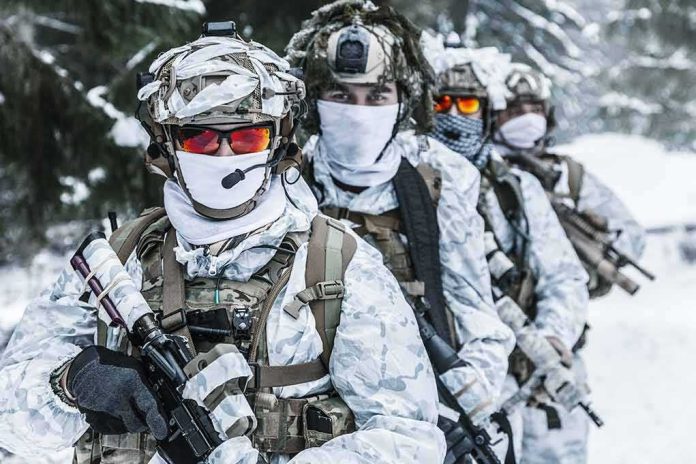
Denmark’s decision to rotate conscripts through Greenland is less a troop surge than a sovereignty instrument: in the Arctic, persistent presence, cold-weather competence, and credible reinforcement pathways matter more than massed formations—and Copenhagen has now built a mechanism to produce all three on a schedule.
At a Glance
- Denmark has deployed its first cohort of 11-month conscripts to Greenland—roughly a company-sized rotation in and around Nuuk and Kangerlussuaq—for training and operational tasks tied to Arctic Endurance exercises.
- The move operationalizes Denmark’s revamped conscription model: five months of basic training followed by six months of unit service designed for real missions, including in the Arctic.
- Danish officials explicitly link the scheme to deterrence and security in Greenland while building proficiency in Arctic terrain and climate.
- The rotation fits a broader pattern of Arctic statecraft: small, regular deployments and sensor/infrastructure upgrades to signal sovereignty and improve domain awareness rather than field large permanent garrisons.
What Denmark actually did: a conscript rotation with defined Arctic tasks
Denmark’s armed forces confirmed that the first group of 11-month conscripts arrived in Greenland and were posted to Nuuk and Kangerlussuaq for about a month, combining field exercises with defined operational duties. Multiple outlets, drawing on the military’s communications and unit briefings, reported a company-sized presence—more than 100 soldiers—from the Schleswig Foot Regiment participating in Arctic Endurance, the force’s cold-weather combat and survival training series. The aim is practical as well as symbolic: train conscripts to standard in an unfamiliar environment while providing visible Danish capacity in a vast, sparsely populated territory integral to NATO’s North Atlantic posture.
The operational description across sources is consistent even if the labels vary. Some reporting emphasizes “military exercises,” others “operational duties,” but the substance is the same: conscripts integrated into force packages, conducting tasks alongside professional cadres, and building unit-level Arctic proficiency. A Danish company commander publicly framed the rotation around continuing conscript training while gaining experience in Arctic terrain and climate—an objective aligned with the curriculum of Arctic Endurance.
Mechanism: how extended conscription became an Arctic tool
Denmark’s redesigned conscription model is the enabler. Extended from four to 11 months and broadened to include women, the system now produces cohorts with five months of basic training followed by six months in operational units—time enough to integrate, deploy, and meaningfully contribute to missions. The Greenland rotation is the policy’s proof-of-concept: placing citizen-soldiers into real Arctic tasking under professional leadership. Reuters’ contemporary reporting tied the August deployments directly to the longer-service framework and to a cohort of about 1,600 new conscripts then moving through the pipeline.
This is not a backdoor to conscript-heavy permanent garrisons. Instead, it generates repeatable, predictable presence. In Arctic security, where weather windows are short and logistics punishing, the capacity to field small, trained detachments—on time and with the right kit—often matters more than headline force size. Exercises like Arctic Endurance explicitly exist to convert that theory into muscle memory: movement in sub-zero conditions, survival, distributed operations, and reliable communications in a high-latitude environment.
Why Greenland, why now: sovereignty, surveillance, and deterrence
Greenland’s strategic value is geographic first, mythic second. It anchors North Atlantic sea lines, houses critical sensor infrastructure, and sits astride the GIUK (Greenland–Iceland–UK) gap. Denmark’s legal responsibility for defense and foreign affairs in the autonomous territory is longstanding; NATO collective defense overlays that baseline. The military problem has been chronic, not acute: an enormous area to monitor, limited assets, and high costs for everything from airlift to fuel staging. Danish defense priorities in the High North have historically centered on sovereignty patrols, search and rescue, fisheries enforcement, and maritime surveillance—not heavy ground forces.
That is changing at the margins as Copenhagen funds sensors, platforms, and command arrangements that harden Arctic domain awareness and response. Recent plans and announcements outline billions of dollars for Arctic and North Atlantic capability—coastal radars, additional aircraft, surface units, and organizational uplift—reflecting both allied expectations and Denmark’s own reading of risk. Within that build-out, rotating trained personnel through Greenland is the human capital piece: it ensures that when higher-end assets cue a response, there are small units acclimated to the environment to execute it.
Official rationale: train for real missions and strengthen deterrence
Danish defense leaders have been explicit: the extended conscription model is designed to feed operational tasks, including in Greenland, and to strengthen security and deterrence there. Public statements ahead of and during the initial rotation linked the policy directly to enhanced Arctic readiness—training in difficult conditions, practicing in unfamiliar terrain, and showing presence where it counts. The rotation’s association with Arctic Endurance further underlines the dual aim: elevate cold-weather competence while communicating that Denmark can field troops, however modest in number, on Greenlandic ground when required.
Scale here is a feature, not a flaw. A company in Greenland does not deter a great power by itself; it does something more relevant to the setting. It normalizes Danish deployments, tightens logistical playbooks, and multiplies trained alumni who can be recalled, upskilled, or embedded with allies. In Arctic security, that cumulative readiness signals both resolve and practicality.
Denmark has deployed conscripts to Greenland for the first time in recent history as Copenhagen strengthens its military presence in the Arctic. The troops are training for combat and survival in extreme conditions as strategic competition involving the U.S., Russia and China…
— S u y a s h P a c h a u r i (@suyashpachauri) September 2, 2026
How it fits the wider Arctic playbook
Across the region, states have favored incremental presence—rotations, exercises, radar fields, and upgraded airfields—over static mass. Denmark’s pattern matches that norm. The Arctic Endurance umbrella explicitly aims to demonstrate and sustain military presence in and around Greenland and the Faroe Islands, bridging the gap between episodic expeditions and the kind of routine that builds muscle memory and credibility. The United Kingdom has documented similar tasking for its high-north forces, emphasizing surveillance, constabulary functions, and readiness to scale if required; Denmark’s baseline tasks in Greenland have historically been comparable.
The investment track reinforces the logic. Reuters and the BBC chronicled Copenhagen’s stepped-up Arctic spending—several billion dollars for ships, aircraft, and command capability dedicated to the North Atlantic and Arctic theaters—bringing hardware in line with the posture that small rotations advertise. Doctrine and dollars are, for once, pointed in the same direction.
What to watch: from first rotation to steady cadence
The measure of success will be rhythm. If Denmark sustains annual or semiannual conscript rotations tied to a maturing Arctic Endurance syllabus, three effects will follow. First, a growing reservoir of Danes with first-hand Arctic service, easing mobilization and allied integration. Second, smoother logistics through Greenland’s limited hubs—Kangerlussuaq and Nuuk chief among them—under varied seasonal conditions. Third, sharper coordination between patrol aircraft, surface units, and ground detachments as sensors proliferate and command nodes bed in.
Expect modest adjustments to the mix of “training” and “operational” tasking as planners learn what yields the greatest return—more time on maritime-aviation integration, perhaps, or expanded survival and communications modules. But the core will endure because it matches the structural realities of Greenland: a big map, few people, expensive miles, and a premium on competence per soldier. Conscript rotations, properly run, are one of the few scalable levers Denmark controls.
Sources:
youtube.com, euractiv.com, reuters.com, english.news.cn, rt.com, whbl.com, militarnyi.com, ua.news, nordicdefencesector.com, pdfs.semanticscholar.org, bbc.com, forsvaret.dk