

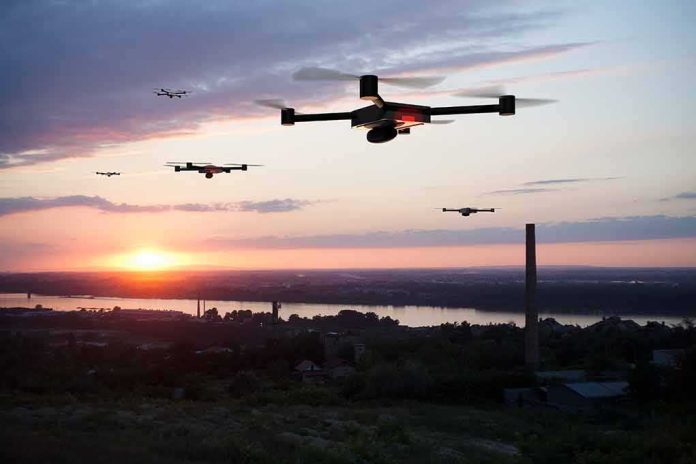
Base security is judged by outcomes, not headlines: at RAF Lakenheath, U.S. and UK forces executed a textbook protective response to suspected hostile drone activity—ordered personnel to shelter, coordinated defenses, and returned the installation to normal operations without injuries or damage.
At a Glance
- U.S. Air Force and UK authorities confirmed a joint security response to suspected unauthorized drones at RAF Lakenheath on Nov. 13, 2026; no injuries or damage occurred.
- Personnel were instructed to shelter in place, signaling a real force-protection event, not a routine airspace nuisance.
- Subsequent reporting described roughly six drones repelled by counter-drone measures; neither side publicly detailed systems used.
- The episode fits a recurring pattern of confirmed incidents near U.S.-used UK bases where attribution remains limited in the public record.
What Happened: A Coordinated Protective Response, Then a Rapid Stand-Down
On the evening of Nov. 13, 2026, U.S. Air Force personnel at RAF Lakenheath—the U.S. Air Forces in Europe’s largest fighter hub—responded to suspected unauthorized drone activity. The base issued a shelter-in-place directive while U.S. Security Forces coordinated with Ministry of Defence Police and local Suffolk Police, a joint posture that UK authorities later confirmed. The incident ended without injuries, aircraft damage, or infrastructure impact; the base reverted to standard security measures after the alert concluded. In the weeks that followed, multiple outlets relayed accounts—sourced to people familiar with the matter—that roughly six drones were detected and repelled using electronic and other counter-UAS defenses. Officials did not publicly disclose technical specifics, consistent with normal operational security.
Three features distinguish this from mere nuisance flying. First, a formal force-protection order to shelter in place is a significant step; it indicates sufficient risk to prioritize personnel safety over routine continuity. Second, the joint, quickly resolved response shows preplanned integration among U.S. and UK security elements—exactly how high-value installations are meant to behave under ambiguity. Third, the incident closed with no operational losses. In base defense, that is success by design.
How Modern Counter-Drone Defense Works at a Busy Fighter Base
Defending a fighter wing in dense civilian airspace requires layered sensing, decision speed, and calibrated effects. Detection typically blends radar tracks of small cross-section targets with electro-optical cues and radio-frequency (RF) sensing that hunts control links and telemetry. Identification and correlation across sensors prevent false positives, especially around a base where legitimate low-altitude activity—wildlife, hobby craft outside restricted airspace, maintenance drones—can confound any single modality. Engagement options span a spectrum: RF jamming to break command-and-control, link spoofing or protocol exploitation to trigger fail-safe behaviors, and, as a last resort, kinetic effectors. The public reporting around Lakenheath points to non-kinetic disruption—jamming and other soft-kill means—consistent with minimizing collateral risk near critical infrastructure and surrounding communities.
Because counter-UAS is a contest of signatures and software as much as hardware, units train to shorten their observe–orient–decide–act loop under uncertainty. Sheltering personnel buys that time. It also hardens the target against the two primary concerns posed by small UAS near flight lines: hazard to aircraft on takeoff/landing and reconnaissance of sensitive operations. The absence of injuries or damage at Lakenheath is what these layered measures are engineered to achieve.
Why This Fits a Broader Pattern—And Why That Matters
The Lakenheath episode sits within a multi-year pattern of confirmed drone-related security incidents near U.S.-used UK bases. In 2024, authorities documented repeated sightings around RAF Lakenheath, Mildenhall, Feltwell, and Fairford; an ensuing investigation ended without identified suspects—even as reporting suggested several aircraft may have been coordinated. Publicly released imagery and forensic detail were limited, but the operational effects were real enough to mobilize police and base defenses over multiple days. That history is instructive. First, it shows that the absence of public attribution does not equate to triviality; the decision to escalate security posture reflects on-the-ground assessments of risk. Second, it suggests adversaries (state or otherwise) increasingly exploit the low-cost, low-signature, hard-to-attribute features of small UAS to probe air defense seams, map response timelines, and harvest pattern-of-life intelligence.
This dynamic is not unique to the UK. U.S. domestic installations, European forward bases, and critical civilian infrastructure have all reported incursions by small, commercially derived drones in recent years. The capability slope is steep; off-the-shelf airframes adapted with better power systems, swarming software, and rudimentary autonomy strain legacy detection and rules-based airspace management. Against that backdrop, Lakenheath looks less like an anomaly than another data point in the ongoing normalization of counter-UAS as a daily security mission.
What Is Firmly Established—and What Properly Remains Unsaid
There are hard, uncontested facts. U.S. and UK officials confirm that on Nov. 13, personnel responded to suspected unauthorized drone activity at RAF Lakenheath, issued a shelter-in-place alert, coordinated among U.S. Security Forces and UK police, and concluded operations without casualties or physical damage. Public-facing statements did not enumerate the number of objects, identify operators, or describe payloads. Subsequent reporting—based on unnamed sources—characterized the event as involving roughly six drones and successful use of counter-drone measures to repel them.
That division of labor—authorities validating an incident and outcome, open-source reporting shading in unclassified operational color—is typical in base-defense matters. The reasons are straightforward: detailing sensor performance, effectors, and timelines risks arming the next probe. The salient point for the public is not the make and model of a jammer; it is that the response protected people, aircraft, and infrastructure while preserving freedom of action for the unit mission. On that metric, Lakenheath delivered.
Implications for Base Defense and Civil-Military Coordination
First, posture and drills matter more than gadgets alone. The speed with which Lakenheath moved to shelter personnel and coordinate with UK counterparts points to exercised procedures and shared communications plans—a prerequisite for any effective base-defense ecosystem. Second, soft-kill dominance is rational in mixed civil-military airspace. Electronic defeat and control-link effects reduce physical debris risks and third-party harm while buying decision time for higher-consequence intercept options when warranted. Third, attribution will often lag effects. That is a strategic reality adversaries seek to exploit, but it is not a reason to withhold decisive protective actions. The policy corollary is to invest in forensic and spectrum-intelligence capabilities that can produce actionable, legally durable attribution without compromising sensitive collection.
Finally, the Lakenheath case underscores why local communities and elected officials need crisp, confidence-building communication. The public wants two assurances during a base alert: that responders are in control and that there is no spillover risk to nearby towns. Clear lines—shelter ordered, incident resolved, no threat to the public—meet that test without divulgence of tactics or sensitive data. Recent briefings and statements around Lakenheath and neighboring bases have hewed to that standard.
#US repelled drone incursion at #British air base
In the mid-November incident at #RAF #Lakenheath, drones were deflected by U.S. electronic jamming mechanisms and other defenses, officials said Saturday.
https://t.co/zi9HpuVcek.— Jukka Isorinne (@jukkaisorinne) November 28, 2026
What to Watch Next
Three developments will signal continued maturation of counter-UAS at U.S.-used UK bases. Expect more visible hardening around airfields and perimeters—RF monitoring masts, optical towers, and mobile counter-UAS teams—balanced with community outreach to explain what residents will see and hear. Expect procedural refinements that shorten the timeline from detection to protective action while minimizing false alarms that erode trust. And, less visibly, expect deeper data fusion across sensors and agencies to improve both real-time discrimination and post-incident attribution. Incidents like Lakenheath are unlikely to be the last; the measure of readiness is whether the next one ends the same way—alert sounded, defenses coordinated, mission unimpaired.
Sources:
itv.com, fr.jpost.com, reuters.com, bbc.com, uz.kursiv.media