

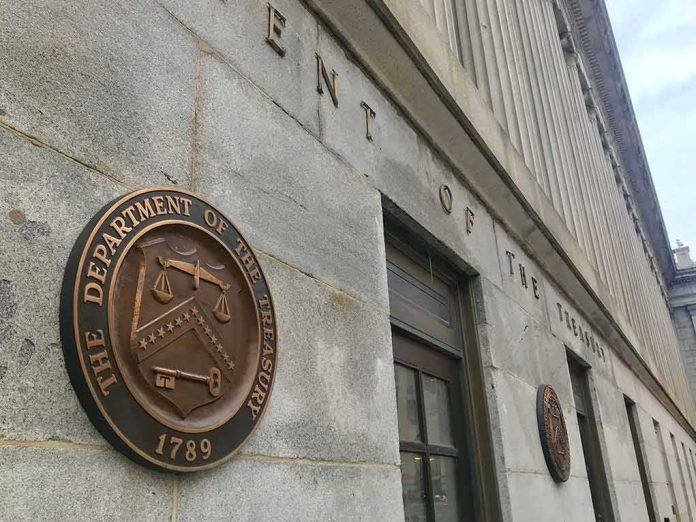
When a bureau built to see the world’s dirty money blinks, the stakes are operational, not cosmetic: FinCEN’s brief move to disconnect a limited set of systems after detecting unauthorized access was a containment play to protect the financial intelligence spine that banks and investigators rely on daily.
At a Glance
- Treasury confirmed unauthorized access to a limited subset of FinCEN systems and isolated affected environments while investigations proceeded.
- Core filing continuity was preserved; online submissions stayed up even as certain automated services were disrupted and specific reporting timelines were extended.
- The sensitivity of FinCEN’s data environment is high: recent Treasury actions spotlight its role in tracking multi‑billion‑dollar illicit flows, including sanctions evasion.
- The response aligns with federal playbooks: disconnect to contain, notify quickly, and disclose selectively while scope and impact are established.
What Treasury reported — and why the response looked the way it did
The Treasury Department’s Financial Crimes Enforcement Network acknowledged a cybersecurity incident involving unauthorized access to a limited subset of its systems and took several systems offline to contain risk and support remediation. FinCEN kept its Bank Secrecy Act (BSA) e‑filing portal available for submissions while certain automated services experienced outages; Treasury also granted targeted reporting relief, including a date extension for specific filers, to bridge operational gaps. That combination — isolate, preserve continuity, provide relief where automation breaks — is a classic containment posture when confidentiality or integrity may be at stake but availability for critical workflows must continue.
The mechanics are straightforward. Disconnecting affected enclaves reduces an attacker’s lateral movement, cuts off command‑and‑control beacons, and limits the chance that adversaries can pivot into higher‑value databases. Meanwhile, sustaining a minimal e‑filing path prevents a back‑log of time‑sensitive anti‑money‑laundering (AML) reports. Under federal incident‑notification rules and CISA’s playbooks, such actions unfold quickly and with sparse public technical detail while responders establish whether the event involved attempted access, persistence, data exfiltration, or alteration of records.
Why FinCEN’s systems matter far beyond “IT uptime”
FinCEN is not a routine administrative shop; it is Treasury’s financial‑intelligence bureau. Banks, brokers, money services businesses, and other covered entities feed it suspicious activity reports (SARs), currency transaction reports (CTRs), and related AML data that power law‑enforcement investigations and sanctions enforcement. The bureau’s recent enforcement moves illustrate the stakes. In November 2026, Treasury announced “Operation Economic Outcast,” cutting off MEXC Global from the U.S. financial system over at least $16 billion in illicit transactions, including sanctions evasion and other predicate crimes — an action that leans heavily on the sort of financial‑intelligence pipelines FinCEN oversees. Days later, Treasury detailed that FinCEN had identified roughly $14.7 billion in potentially Iran‑linked “shadow banking” activity since early 2025, further demonstrating both the sensitivity and analytical value of its data holdings.
This is why the term “limited subset of systems” carries real weight. Not every system in a modern agency hosts crown‑jewel data. Some handle front‑end orchestration or automated ingest; others aggregate, normalize, and enrich filings with third‑party data; still others support investigative collaboration. The containment calculus is to isolate what’s suspect without collapsing the entire reporting ecosystem — exactly what Treasury’s description implies occurred.
How federal playbooks shape public disclosure and operational tempo
Civilian agencies operate under clear incident‑notification standards: report within an hour to CISA once an incident crosses the relevant impact thresholds; provide evolving estimates of affected systems, users, and recoverability; and coordinate communications as facts firm up. That scaffolding explains why early statements often stick to scope (“limited subset”), status (“investigating”), and immediate mitigations (“systems taken offline”) rather than attack vectors or forensics. The objective is twofold: protect the integrity of ongoing response and avoid educating adversaries about defensive architecture.
FinCEN’s operational posture also reflects the bureau’s obligation to keep the private‑sector compliance engine running. Financial institutions depend on predictable rules to meet SAR and CTR obligations; when automation is disrupted, regulators can — and did — extend specific deadlines and instruct institutions to continue monitoring and filing via available channels. The policy signal is consistent: compliance cannot pause, but regulators will cushion process disruptions that arise from the government’s own containment steps.
Separating FinCEN’s incident from unrelated federal cyber events
The FinCEN incident arrived alongside reports of compromises involving unclassified systems at other federal entities. That temporal clustering can blur distinctions, but the record keeps them separate. Treasury characterized FinCEN’s event as unauthorized access limited to specific systems with targeted disconnections; reporting on the other events indicated that no classified capabilities were disrupted. There is no authoritative indication that FinCEN’s containment is technically linked to those other incidents, and the operational facts we do have — limited scope, continuity of filings, targeted deadline relief — stand on their own terms.
It’s useful, however, to recognize the shared anatomy of modern government compromises: attackers probe externally exposed services and identity infrastructure; defenders detect anomalies via authentication logs, endpoint telemetry, and SIEM alerts; and agencies move quickly to minimize blast radius. The vocabulary choices — “cybersecurity incident,” “unauthorized access,” “disconnected systems” — map to that choreography and should be read as signals about process, not euphemisms.
FinCEN, which tracks suspicious banking activity, suffered a cybersecurity breach affecting a 'limited subset' of its systems, per @KobeissiLetter citing a US official. It holds some of the government's most sensitive financial intelligence.
— Sequa – Finance Coach (@getsequa) November 25, 2026
What this means for banks, investigators, and adversaries
For financial institutions, the takeaway is straightforward: keep monitoring programs hot, file through the channels that remain available, and follow any agency notices adjusting timelines or formats. The obligation to detect and report suspicious activity persists, and continuity measures are designed to prevent intelligence blind spots even under degraded government automation. For investigators, short‑term friction — losing an automated feed, rerouting submissions — is a price worth paying to prevent integrity compromise in analytic repositories. Data contaminated by an attacker is worse than a temporary outage; it can misdirect cases for months.
Adversaries will study the public contours of Treasury’s response for clues about visibility and segmentation. That scrutiny is precisely why agencies reveal little while response is active. What matters is the strategic signal: FinCEN can wall off suspect components without collapsing core compliance channels, and Treasury will prioritize data integrity over convenience. Those are deterrent messages in their own right.
How to read the next update
Expect future agency statements, if any, to focus on restored services, any permanent security control changes, and refinements to filing processes. If a technical root cause is disclosed, it will likely reference a class of failure — identity compromise, third‑party software flaw, or configuration exposure — rather than a detailed exploit chain. That pattern comports with CISA’s governmentwide playbooks and the long‑standing balance between transparency and protection of investigative methods.
The essential facts already set the frame: unauthorized access was detected; a limited subset of FinCEN systems was taken offline; e‑filing continued with targeted deadline relief; and the bureau maintained its core mission while hardening the perimeter. In financial intelligence, restraint at the right moment is a form of strength. Treasury used it to protect the value of the data that, week after week, underwrites billion‑dollar enforcement actions and the credibility of the U.S. AML regime.
Sources:
redstate.com, home.treasury.gov, ofac.treasury.gov