

Markets don’t sell off because of gossip; they sell off when investors see governance colliding with national security process. The furor around Jensen Huang’s rapid reinstatement sits precisely at that seam, where security-clearance adjudication, counterintelligence risk management, and export-control enforcement meet corporate oversight and political power.
At a Glance
- U.S. intelligence reporting linked a woman involved with Jensen Huang to China’s Ministry of State Security, elevating counterintelligence and export-control risk concerns.
- Nvidia’s board reversed course and unanimously reinstated Huang after receiving input from senior U.S. officials, stating his return posed no national-security risk.
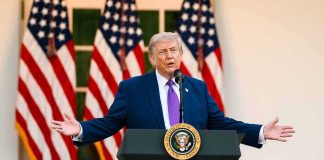
- President Trump publicly backed the reinstatement and said the government had no evidence Huang engaged in unlawful conduct; DOJ officials conveyed similar assurances to the White House.
- Huang reportedly still holds a U.S. security clearance, even as revocation was discussed, underscoring how clearance risk can be managed short of criminal findings.
What Actually Happened: The Facts That Matter
The essential conflict is straightforward. Multiple outlets reported that U.S. intelligence assessed Alice (also reported as Wong/Huang in different accounts) maintained contact with an officer of China’s Ministry of State Security over a period that overlapped with her secret relationship with Nvidia’s Jensen Huang. That allegation—credible enough to trigger corporate and government scrutiny—put the episode squarely in the “foreign influence” category that security adjudicators watch closely.
Yet the company’s board, after initially resisting a return, unanimously reinstated Huang. Their stated rationale: input from senior levels of the U.S. government and a conclusion that Huang’s return posed no national-security risk. President Trump publicly endorsed that judgment, adding that the administration had no evidence Huang engaged in unlawful conduct; NBC further reported that a Justice Department official said Attorney General Todd Blanche conveyed to the President that DOJ had found no wrongdoing by either Huang or Nvidia. Separately, CBS reported that Huang continued to hold a U.S. security clearance, though revocation had been discussed.
How Security Risk, Counterintelligence, and Export Controls Intersect
Three systems govern episodes like this, and they do not use the same yardsticks. Security-clearance adjudication looks at vulnerability and influence, not only crimes. A personal relationship connected to a foreign intelligence service is a textbook foreign-influence flag; adjudicators weigh disclosure, susceptibility to coercion, and patterns of behavior to determine mitigation or revocation. The Defense Counterintelligence and Security Agency (DCSA) administers a high-volume, continuous-vetting regime and can tailor outcomes short of pulling a badge—tightened reporting, access limitations, or enhanced monitoring among them.
Counterintelligence risk management, for its part, focuses on exposure pathways—who had access to what, when, and under what controls—not merely the presence of wrongdoing. And export-control enforcement lives on a third plane: prosecutors and national-security litigators examine transactional evidence of unlawful transfers or evasion schemes; absent that evidentiary spine, the National Security Division may decline to bring a case, even while urging stronger corporate controls and ongoing cooperation. The systems are designed to diverge because risk can be real without being provable beyond a reasonable doubt.
The Evidence, Weighed: What Holds Up and What Doesn’t
On the risk side, the most concrete, specific claim is the reported intelligence linking the woman to China’s MSS and the temporal overlap with her relationship with Huang—a combination any seasoned security professional would treat as a serious vulnerability pending mitigation. No court docket is needed to call that risky; it is the definition of a clearance concern under foreign influence frameworks.
On the exculpatory side, the strongest facts are official posture and process signals: the board’s stated reliance on senior government input, the President’s assertion of no evidence of unlawful conduct, and DOJ’s communication to the White House that it found no wrongdoing by Huang or Nvidia. A further concrete data point is Huang’s reported retention of his clearance—another process signal that, for now, risk is viewed as mitigable rather than disqualifying. None of these contradict the intelligence reporting; they explain the present-tense outcome: risk recognized, no chargeable offense established, access managed.
Why the Board Reinstated Amid Ongoing Scrutiny
Boards do not adjudicate espionage; they steward enterprise risk. Nvidia’s board faced a triad of exposures—leadership continuity, export-control scrutiny, and insider-threat optics. After initial hesitation, directors say they weighed direct government input and rebalanced toward reinstatement while continuing their own probe into whether Huang had been targeted by a foreign intelligence effort. That is consistent with good-faith governance under uncertainty: keep the essential operator in place, strengthen controls, and let investigative processes run.
The administration’s public stance—no identified illegality or national-security risk from Huang’s return—lowered the temperature for directors, even as it did not, and could not, erase counterintelligence concerns. In this model, the board’s job is to harden systems: tighten data-access segmentation, reinforce export-controls compliance, and shrink single-person failure modes in decision rights. Those are mechanics, not slogans.
How Professionals Manage Residual Risk Without Criminal Findings
Clearance and insider-threat programs are built for the grey zone. Continuous vetting flags anomalies; insider-threat teams correlate travel, communications patterns, and data behavior; compliance units map export-controlled flows and counterparties. When a senior executive is involved, companies add compensating controls: dual-control procedures for sensitive briefings, narrower “need-to-know” partitions, mandatory reporting of foreign contacts, and third-party monitoring around high-risk relationships. Government counterparts, meanwhile, calibrate access and require prompt reporting of material personal developments, particularly those that could invite foreign leverage.
Corporate enforcement exposure is separate. NSD’s corporate enforcement policy gives credit for self-disclosure and remediation, even when no charges are brought, and it encourages structural fixes that survive leadership changes. This is why the absence of an indictment does not end the compliance story; it begins the remediation chapter.
🚨BREAKING: Nvidia ($NVDA) CEO Jensen Huang reportedly still holds a security clearance, per CBS News.
Revoking it was discussed, sources said.
Nvidia declined to comment. pic.twitter.com/mP2H4bqUQO
— Disclosed: Politician Stock Tracker (@disclosedhq) November 25, 2026
What It Means for Investors and Policy
For markets, the immediate volatility was never about salacious detail; it was about whether national-security process had been subordinated to personality and politics. The public record supports a more prosaic interpretation: intelligence flagged a genuine vulnerability; investigators to date did not find chargeable conduct; the government signaled mitigable risk; the board reinstated with caveats and continued inquiry. That sequence is messy but not lawless—it is how risk disciplines frequently converge under pressure.
The durable takeaway is operational. Companies sitting at the chokepoints of strategic technology must build governance that assumes senior-leadership targeting attempts will occur. That means codifying disclosure duties for foreign contacts, embedding clearance-style attestation into executive employment terms, and institutionalizing the power to limit even a CEO’s access when risk dictates. It also means investing in export-control analytics that track indirect channels and reseller networks with the same rigor used on direct sales—because adversaries optimize for the seams.
Sources:
nbcnews.com, 41nbc.com, nytimes.com, smh.com.au, cnn.com, ccsglobaltech.com, justice.gov, dcsa.mil, congress.gov