

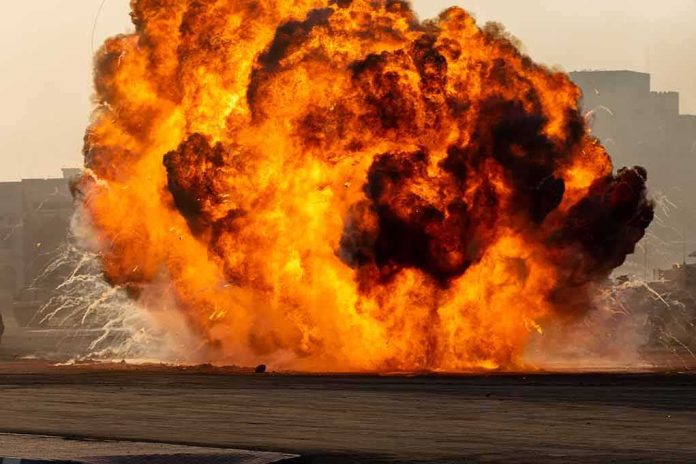
When energetic materials degrade, risk shifts from theoretical to kinetic; the safest option becomes the one that decisively ends uncertainty. The Army’s plan to conduct an in-place, controlled detonation of degraded lead azide at the Iowa Army Ammunition Plant sits precisely at that junction—where acute explosive hazard meets chronic environmental concern—and the governing question is not whether detonation is “safe” in the abstract, but whether any demonstrably safer alternative can be executed in time for this material, in this condition.
At a Glance
- Lead azide is an extremely sensitive primary explosive; when degraded, it can become dangerously unpredictable to move or handle.
- The Army argues an in-place, controlled detonation is the lowest-risk option available before weather and time increase instability, and it has delayed only up to the last safe window.
- Environmental groups counter that chemical neutralization and other contained treatments were not fully pursued and warn of potential lead exposure from fallout.
- Federal hazardous-waste law permits open detonation only when safer alternatives are not viable; the crux is evidencing why alternatives are impracticable for these specific drums, now.
What lead azide is, and why deterioration changes the risk calculus
Lead azide is a primary explosive—an initiator that converts a small stimulus into a detonation wave to set off secondary charges. Its practical virtue in munitions is exactly what makes it treacherous when degraded: high sensitivity. Over time, storage conditions and chemical breakdown can increase unpredictability, elevating the risk of inadvertent initiation from shock, friction, or thermal cycling. That is why movement—normally a benign prerequisite to treatment—can become the most dangerous phase of any remediation plan. The Army states it discovered degrading lead azide at the Iowa Army Ammunition Plant in March 2026 and tied the schedule to the latest feasible moment before a forecast temperature drop that, in their assessment, would further destabilize the material.
For explosives professionals, this timeline logic is recognizable. Temperature swings can induce crystal growth, phase changes, and container stress that change sensitivity in hard-to-model ways. When the material is in multiple drums, each with its own microhistory of storage, the variance compounds. In such cases, risk reduction often favors eliminating the inventory in place with engineered standoff, shielding, and blast-absorption designs calibrated to contain fragments and limit ejecta, rather than risking transport or manipulation.
The Army’s operational case: lowest measured risk under a legal and technical framework
The Army frames the operation as the lowest-risk path to address a deteriorating explosive hazard, supported by emergency permitting, interagency coordination, and specific timing choices keyed to weather windows. That posture is not ad hoc; it maps to the Resource Conservation and Recovery Act (RCRA) framework the Environmental Protection Agency has applied for decades. EPA disfavored open burning/open detonation (OB/OD) of explosive hazardous waste beginning in 1980, but retained an explicit exception when the waste “cannot safely be disposed of through other modes of treatment”. In plain language: detonation is a last resort—allowed only when safer alternatives are either unavailable, infeasible for the specific item, or would introduce greater risk than they remove.
EPA guidance and proposals in recent years have tightened this expectation: facilities must evaluate—and periodically re‑evaluate—whether safe alternatives exist, and must use them where available. The Army’s claim sits squarely within that structure. It is not enough to cite the category of lead azide; the case must address the condition of these drums, the handling risk today, and why movement to an alternative treatment train would, in total, increase rather than reduce risk. The Army says it has done that analysis and planned toward the last safe time horizon; in November, leadership postponed to the edge of a forecast cold snap but not beyond it, citing public safety as the controlling variable.
The countercase: alternatives, exposure pathways, and procedural adequacy
Environmental organizations, local officials, and residents have pushed back on three fronts. First, they argue the Army and EPA did not fully vet chemical neutralization or other contained treatments that avoid a blast entirely, referencing options cataloged in EPA resources and, in public commentary, specific neutralization processes proposed by explosives specialists. Second, they warn that any detonation—even controlled—could disperse lead particulates across homes, farmland, and waterways, with disproportionate risk to children and pregnant women and implications for livestock and wildlife. Third, they contend notice, monitoring, and cleanup plans were insufficiently specified to ensure accountability if fallout occurs.
On alternatives, the legal standard matters. EPA’s own compendia document a maturing ecosystem of replacement technologies—mechanical disassembly, fluid jet cutting, autoclave melt-out, chemical neutralization—that can displace OB/OD for many energetic wastes. EPA’s policy trajectory clearly favors moving away from OB/OD wherever practicable. The decisive question, however, is situational: are those alternatives practicable without moving or manipulating drums whose contents are reportedly degraded and unstable? If even minimal handling elevates the probability of an accidental high-order event, the alternative ceases to be “safer” in the only sense that counts—total risk, start to finish.
Where the evidence is strongest—and what still needs to be documented
The Army has put forward specific, time-bound reasoning tied to a known deterioration mechanism and a weather trigger, and it has asserted operational controls intended to protect the public; those specifics anchor the case for in-place detonation. The countercase contributes legitimate, named concerns but is thinner on technical refutation: it does not demonstrate that a specific neutralization or contained-treatment method could be executed on these drums, in situ or with tolerable handling, within the same time window and with a lower net risk than detonation. EPA documents acknowledge that alternatives exist in general; they do not, on their face, settle their feasibility for this inventory’s present condition.
Two areas would most benefit from transparent, single-point documentation. First, a hazard and operability summary that shows how the Army evaluated candidate alternatives against the specific configuration and condition of the drums—especially handling steps, standoff requirements, and fault trees for accidental initiation. Citing RCRA’s alternative-use mandate and then showing precisely why those alternatives fail here would square the plan with the letter and spirit of the rule. Second, an environmental monitoring and remediation protocol tied to modeled deposition footprints and trigger thresholds for soil, dust, and water testing in potentially affected zones, including who pays, how quickly results are published, and cleanup decision criteria. Even if plume models predict minimal off-site impact, lead’s toxicology and the public’s lived experience argue for post-event verification rather than reassurance alone.
The broader pattern: acute hazard versus chronic exposure
This Iowa dispute reflects a national inflection point. For decades, OB/OD persisted because many energetic wastes were too dangerous to treat otherwise. As alternative technologies mature, the burden rightly shifts: each detonation must be justified not by custom but by a documented absence of safer, practicable options for the specific waste at hand. EPA’s proposed revisions would formalize that shift and strengthen technical standards for any OB/OD that remains necessary. That is good governance. It preserves the safety valve for cases like unstable initiators while building public trust that “last resort” really means last resort.
If the Army’s analysis is as sound as it claims, publishing the alternatives assessment and committing to rigorous, independent post-detonation monitoring will likely quiet much of the skepticism without compromising safety. If not, the push from communities and advocates will accelerate the regulatory pivot away from OB/OD across the board. Either way, the durable lesson is the same: in explosives remediation, the safest plan is the one that reduces total risk—operational and environmental—under real constraints, and then proves it.
Sources:
dvidshub.net, freep.com, edition.cnn.com, apnews.com, iaenvironment.org, us.cnn.com, politifact.com, epa.gov, rcrapublic.epa.gov