

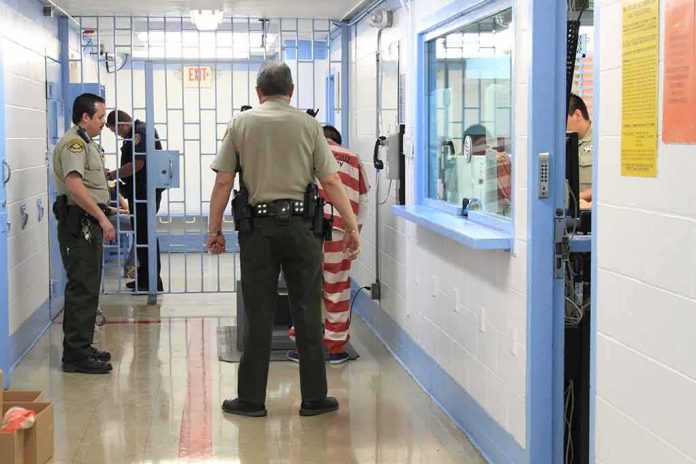
Pretrial detention sits at the fault line between two bedrock commitments in American criminal justice: the duty to protect the public from credible, imminent harm and the constitutional presumption that an accused person is innocent until proven guilty. Alabama’s Aniah’s Law thrusts that tension into sharp relief, and a sitting circuit judge’s critique has made the friction impossible to ignore: when detention turns on a charge and not yet an adjudication, how do courts keep “regulation” from becoming punishment in all but name?
At a Glance
- Alabama’s Aniah’s Law broadened judges’ power to deny bond in serious violent cases, part of a national swing toward preventive detention.
- Judge David Carpenter publicly argued that jailing “on the basis of a charge only” assaults the presumption of innocence; in court, he has still applied the law after individualized hearings.
- Supporters frame the law as targeted judicial discretion to manage danger and flight risk, not automatic incarceration.
- The constitutional line, drawn by federal precedent, tolerates pretrial detention if it is regulatory, evidence-based, and procedurally rigorous—yet the practical risk of prolonged, charge-driven confinement remains real.
What Aniah’s Law Changes, and Why It Matters
Enacted as a constitutional amendment approved by voters in 2022, Aniah’s Law authorizes Alabama judges to deny bond for a wider set of serious violent offenses beyond capital murder. Policymakers have since advanced proposals to expand qualifying offenses further—such as attempted murder, solicitation or conspiracy to commit murder, and discharging a firearm into an occupied structure—explicitly to keep high-risk defendants in custody before trial. This is the preventive-detention model: not punishment for past acts, but interim control to avert danger and ensure appearance. Proponents—legislators and big-city mayors among them—argue that giving courts this discretion is essential to protect families and avoid tragedies linked to accused offenders released on bond.
The law’s namesake, Aniah Blanchard, supplies the narrative force behind these reforms. Her killing—and the allegation that the accused was out on bond—galvanized a coalition that sees judicial power to detain as a public-safety imperative. In their telling, Aniah’s Law arms judges with tools, not mandates: detention follows a hearing, evidence, and a specific finding that no conditions of release will suffice.
The Judge’s Critique: Presumption of Innocence Versus Charge-Driven Jailing
Jefferson County Circuit Judge David Carpenter publicly criticized the legal architecture that enables jail based “on the basis of a charge only,” calling it a direct assault on the presumption of innocence. He contrasted the political attention lavished on surveillance controversies with the comparative quiet surrounding expanded pretrial incarceration authority. Carpenter’s formulation hits a nerve: the presumption of innocence is not merely a trial instruction; it sets the moral frame for pretrial liberty. If a person can be jailed for months awaiting adjudication because the accusation alone triggers no-bond eligibility, the presumption risks becoming an abstraction rather than a constraint.
There is, however, an important counterpoint embedded in Carpenter’s own docket. In a 2025 Aniah’s Law hearing for a homicide defendant, he denied bond after crediting multiple unbiased witnesses, noting incriminating statements, and stressing the event’s violence—an individualized analysis, not a charge-only detention. That record underscores the conceptual divide in this fight: not whether courts may ever detain before trial, but whether the law’s design and day-to-day administration reliably tether detention to evidence of danger and flight risk rather than the label of the offense alone.
The Constitutional Line: What Salerno Permits—and Demands
The Supreme Court has already drawn the outer boundary. In United States v. Salerno, the Court upheld the federal Bail Reform Act’s preventive-detention scheme because it served a “compelling regulatory purpose” and embedded procedural safeguards: prompt hearings, counsel, an evidentiary standard, and findings that no conditions can mitigate danger. The Court emphasized that pretrial detention is constitutional when it regulates risk rather than punishes, and when it does not extinguish the presumption of innocence as to guilt at trial. Related decisions caution that courts must independently test government justifications for depriving presumptively innocent persons of liberty and that procedural deadlines, while important, do not themselves nullify a detention scheme absent prejudice.
The takeaway is precise. The Constitution does not forbid pretrial detention; it demands procedures and discipline that keep detention a narrowly tailored regulatory act. When that discipline weakens—when hearings are perfunctory, timelines sprawl, or offense labels do the heavy lifting—the constitutional risk grows. Alabama’s policy debate is ultimately a design debate: do Aniah’s Law’s eligibility lists, evidentiary thresholds, hearing timelines, and review mechanisms reliably track Salerno’s narrow path?
Supporters’ Case: Discretion, Danger, and Time to Do It Right
Supporters emphasize discretion, not automatism. Lawmakers and city leaders argue that Aniah’s Law empowers judges to make case-specific danger assessments and deny bond where release conditions cannot manage the risk; it is intended to protect victims and communities, not to warehouse all accused persons of serious crimes. They also advance an administrative fairness point: modest extensions in pre-hearing timelines can serve both sides by allowing prosecutors and defense counsel to gather discovery, marshal witnesses, and avoid duplicative proceedings—improving the fidelity of detention decisions rather than reflexively expanding custody. That justification aligns, in principle, with Salerno’s proceduralism if the additional time is used to elevate rigor rather than simply prolong incarceration.
In practice, that equilibrium is fragile. Local reporting shows variation across counties—some securing no-bond orders consistently, others releasing defendants after hearings, still others encountering charge-classification gaps that preclude hearings at all. Variability is expected in a system built on discretion, but it also invites scrutiny: when does healthy judicial independence shade into outcome inconsistency that erodes legitimacy?
Where the Real Disagreement Lies: Procedure, Duration, and Evidence
Strip away the rhetoric and three concrete questions remain. First, are detentions under Aniah’s Law grounded in robust, individualized findings, or do offense labels exert undue gravitational pull? Carpenter’s “charge only” warning resonates because offense-based eligibility lists can quietly shape outcomes if judges treat them as proxies for danger rather than gateways to inquiry. Second, how long do people remain detained pretrial under this regime, and how promptly are hearings held? Prolonged incarceration without adjudication or meaningful periodic review is where regulatory detention starts to feel punitive, a constitutional tripwire illuminated by federal doctrine even if not yet litigated in Alabama’s appellate courts. Third, what evidentiary standard and record quality govern these decisions? Salerno survived because Congress built an architecture of proof and findings; state analogs must show similar rigor in the transcript and the order.
Carpenter’s own mixed posture—public skepticism of preventive detention paired with case-level application after weighing witnesses and statements—captures the system’s duality. The principle is contested; the practice can still be careful. The goal is to close the distance between them by design.
What Sensible Reform Would Target Next
For jurisdictions refining a Salerno-compliant regime, the fixes are concrete, not abstract. Require a prompt adversarial hearing within a short, enforceable window; if continuances are necessary, demand on-the-record reasons and presumptive outer limits, with periodic review. Specify an evidentiary standard calibrated to danger findings and flight risk, and obligate written orders that articulate why no combination of conditions can mitigate those risks. Clarify that offense eligibility triggers a hearing, not a presumption of detention. Create data feedback loops—tracking time-to-hearing, detention length, case outcomes, and reversals—to audit whether the law is functioning as intended, not merely as imagined.
None of this repudiates public safety. It operationalizes it within constitutional guardrails. The presumption of innocence is not a talisman that bars pretrial restraint, and preventive detention is not a blank check to incarcerate on accusation. The distance between those truths is where a legitimate system lives—careful in design, disciplined in application, and candid about the tradeoffs it asks the accused, victims, and communities to bear.
Sources:
foxnews.com, 1819news.com, x.com, newsagentdata.com, al.com, yellowhammernews.com, wbrc.com, rocketcitynow.com, wsfa.com