

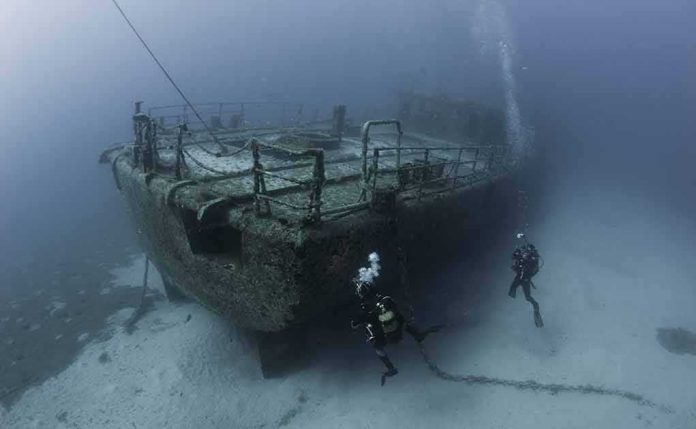
A nuclear reactor has been leaking cesium-137 into the Norwegian Sea for more than three decades, and the scientists who documented it are the same ones telling the public not to worry — a contradiction that says less about dishonesty than about the gap between a confirmed local measurement and a confirmed ecological threat.
Key Points
- A 1989 fire sank the Soviet submarine Komsomolets, which once set a depth record of roughly 3,350 feet before it came to rest nearly 5,500 feet down, carrying a nuclear reactor and two nuclear-armed torpedoes.
- A 2019 Norwegian-Russian expedition sampled water directly from the wreck’s ventilation pipe and measured cesium-137 at up to 857 Bq/L — roughly 800,000 times normal Norwegian Sea background.
- Norway’s Institute of Marine Research and radiation authority both concluded the release poses no risk to people, fish, or seafood, because the contamination dilutes rapidly at 1,700 meters depth.
- No study, Russian or Norwegian, has found weapons-grade plutonium escaping the torpedo warheads, and the submarine’s designer argued decades ago that frigid water would slow corrosion of the weapons compartment.
- Key unknowns remain: there is no published strontium-90 confirmation, no measured release rate, and no independent long-term biomonitoring of the wreck site.
How a Record-Setting Hull Became a Radioactive Time Capsule
Komsomolets was never an ordinary attack submarine. Built around a titanium pressure hull rather than steel, it could dive deeper than any Western boat of its era, reaching roughly 3,350 feet in trials — a depth that let it operate below the reach of most torpedoes and sonar of the period. That same hull put it nearly 5,500 feet down on the Norwegian Sea floor after a fire broke out aboard on April 7, 1989, killing 42 of its crew. It went down with a single nuclear reactor and two torpedoes carrying plutonium warheads still inside, a combination that has made the wreck a standing subject of concern for Arctic and Scandinavian scientists ever since.
What makes Komsomolets different from most sunken military reactors is that it has been checked. Russian researchers first detected releases from its ventilation duct in the 1990s and again in 2007, according to expedition leader Hilde Elise Heldal. That history matters: the 2019 reading was not a one-off anomaly but the latest data point in a pattern stretching back nearly to the sinking itself.
What the 2019 Expedition Actually Measured
In July 2019, a Norwegian-led research cruise aboard the vessel G.O. Sars used a remotely operated vehicle to draw water directly from the same ventilation pipe where earlier releases had been documented. Onboard analysis found cesium-137 activity ranging from below 8.0 Bq/L up to 857 Bq/L — a result the Institute of Marine Research’s own cruise report described plainly: releases from the reactor are still occurring, three decades after the sinking. Compared against an ordinary Norwegian Sea background of roughly 0.001 Bq/L, the peak reading was close to 800,000 times normal.
That ratio is the number that has traveled furthest in headlines, and it is accurate as far as it goes. But it describes a sample drawn from inside or immediately beside a ventilation duct connected to the reactor compartment — not a reading from open water, a fishing ground, or a seafood catch. Other samples taken from the same pipe during the same expedition came back far lower, and researchers attributed that variability to rapid dilution at a depth of 1,700 meters, where strong currents disperse contaminants quickly into an enormous volume of seawater.
Why the Scientists Who Found the Leak Say It Isn’t Dangerous
This is where the story resists a simple villain-or-vindication narrative. The same Institute of Marine Research team that measured the 800,000-times spike also stated, in the same release, that the findings would have no impact on Norwegian fish and seafood, because of how quickly the reactor’s output dilutes at depth. Norway’s Radiation and Nuclear Safety Authority echoed that conclusion: the releases, it said, pose no risk to people or the marine environment. A follow-up Barents Observer review found little evidence of any radionuclide buildup in the surrounding environment despite more than thirty years of intermittent leakage.
The warhead question has an even thinner evidentiary trail — in the direction of reassurance. Igor Spassky, the Rubin Institute designer associated with the submarine’s construction, told interviewers in the early 1990s that the near-freezing water at the wreck site would slow corrosion of the torpedo warheads for years, and that any escaping radioactive particles would have to pass through a maze of internal compartments before reaching the ventilation trunk at all. A CIA historical assessment of the disaster reached a similar judgment: radiation leakage was minimal, plutonium leakage was not immediately evident, and any eventual leak would be unlikely to spread far. More recent studies, Russian and Norwegian alike, have found no weapons-grade plutonium in sediment or seawater near the wreck, and reporting on a 37-years-later assessment credited the torpedoes’ titanium patches with still holding.
What Remains Genuinely Unresolved
Confirmed cesium leakage and confirmed public safety are not the same finding, and conflating them is the recurring error in how this story gets told. The 2019 report itself flagged strontium-90 and plutonium isotopes as subjects for further laboratory analysis — not as settled negatives. No published source in the public record offers a continuous discharge rate, a cumulative release estimate, or a multi-year biomonitoring record of fish and sediment near the site. Nor has there been sustained, repeated, independent sampling since 2019 to establish whether the ventilation-duct readings are stable, declining, or capable of spiking further as the hull continues to corrode on the seafloor.
That gap is precisely where the disagreement, such as it is, actually lives. It is not a dispute between activists and officials over whether a leak exists — both sides agree it does. It is a dispute, mostly unspoken, over how much weight a localized, duct-level measurement should carry in public risk communication, and how long reassurance drawn from 1990s-era engineering judgments and periodic snapshots can substitute for sustained, transparent monitoring of a wreck that still holds a reactor core and two nuclear warheads under 5,500 feet of Arctic sea.
Sources:
19fortyfive.com, dsa.no, themoscowtimes.com, hi.no, bbc.com, usni.org, thebarentsobserver.com, cia.gov, thedailyjagran.com