

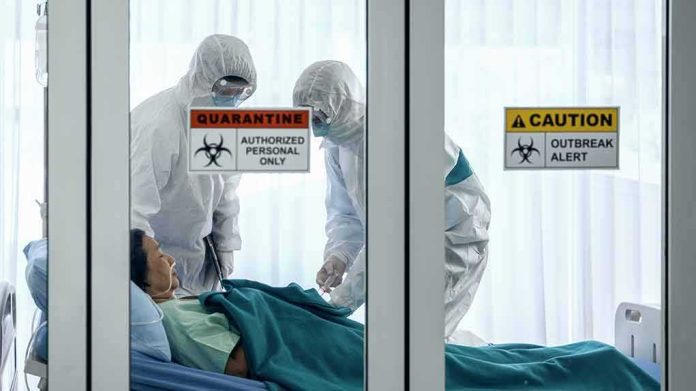
When a fatal pneumonia strikes a worker inside a plague-research institute, the right question is not “Is it plague?” but “How do high-consequence labs, governments, and global health systems behave before the lab reports are in?” The Irkutsk case is a textbook example: decisive containment steps, careful international posture, and contested public messaging while diagnostic certainty lags.
At a Glance
- A laboratory employee at Irkutsk’s anti-plague institute died of severe pneumonia; authorities quarantined facilities and monitored roughly 200 contacts while testing proceeded.
- Russian officials publicly denied detecting plague in the patient or her contacts and reported no recorded plague cases in Irkutsk.
- WHO treated the event as an active investigation with low to moderate local risk and very low regional risk, consistent with no detected onward transmission.
- The evidence supports a serious but contained incident under investigation, not a confirmed plague outbreak.
What happened and why authorities moved fast
A young researcher working at the Irkutsk Anti-Plague Institute developed severe pneumonia and died; the setting alone escalated the response. Facilities were quarantined, and approximately 200 recent contacts were identified and placed under monitoring—standard practice for suspected high-consequence respiratory infections pending a lab diagnosis. The World Health Organization (WHO) said laboratory testing was underway and no official cause of death had been confirmed at the time; it offered support to Russian authorities and followed developments closely. The logic was simple: treat the situation as potentially serious, contain any possible spread early, and let diagnostics catch up.
These measures are consistent with respiratory pathogen containment playbooks. Pneumonic syndromes demand caution because some pathogens—plague among them—can spread via droplets in close contact and worsen rapidly without antibiotics. Moving quickly on quarantine and contact monitoring buys time. That Russia’s health system activated special anti-epidemic measures after the death fits that template, as does WHO’s posture of engagement without alarm.
Competing claims: what is—and isn’t—established
Two claims ran in parallel. First, the precautionary frame: the death occurred in a plague-research environment; a neighboring governor publicly aired plague as a possibility; international agencies tracked the case; quarantine and monitoring were imposed. This set of facts justifies heightened attention and explains why outside governments asked for transparency. Second, the official denial: Russia’s public health agency reported that samples from the deceased showed no microorganisms associated with her professional duties, characterized the fatal illness as pneumonia of unknown etiology, and told WHO no plague cases had been recorded in Irkutsk.
On the evidence available, a confirmed plague diagnosis is not established. There is no public autopsy, PCR panel, culture result, or chain-of-custody record linking the pneumonia to Yersinia pestis; there is also no documented transmission beyond the index patient—contacts reportedly had no symptoms during monitoring windows. WHO’s initial risk read—moderate to low for Irkutsk, low for Russia, and very low for the wider region—tracks with those findings and the absence of secondary cases.
The biosafety lens: why early narratives diverge
Events like this reliably produce an information vacuum into which two narratives rush: outbreak suspicion (to spur vigilance and accountability) and institutional reassurance (to avoid panic and reputational damage). In specialized labs, first signals are often syndromic—fever, pneumonia—paired with immediate containment steps rather than instant pathogen confirmation. That sequencing is why early coverage tilts between alarm and dismissal while diagnostics run their course. The Irkutsk case fits the pattern precisely.
Plague research in Siberia has long-standing public-health rationale; Y. pestis remains enzootic in regional rodents, and anti-plague institutes historically surveil and study it. A death in that context is bound to trigger concern. But biosafety investigations hinge on verifiable artifacts—incident logs, exposure assessments, and lab results. Without them, broken-vial anecdotes remain unproven, and the more disciplined inference is the one supported by surveillance outcomes: a single severe pneumonia case, robust containment, no confirmed pathogen match to plague work, and no detected secondary spread.
Mechanism and medicine: why pneumonic plague is feared—and manageable
Pneumonic plague is the lung form of plague caused by Yersinia pestis; it can be transmitted via respiratory droplets at close range and, untreated, is often fatal. The counterweight to that lethality is modern antibiotics—gentamicin, fluoroquinolones, doxycycline—paired with early recognition and supportive care. In public-health terms, what matters is speed: fast diagnosis and empiric therapy protect the patient and truncate transmission chains. That clinical reality explains both the heavy initial caution in Irkutsk and WHO’s confidence in a low broader risk once contacts remained asymptomatic and no laboratory confirmation emerged.
It is also why the absence of secondary cases carries outsized evidentiary weight. Droplet-spread infections leave footprints in close contacts; when a health system actively surveils nearly 200 people closely tied to the index patient and finds no symptomatic cases in the expected incubation interval, the probability of a sustained, missed outbreak drops sharply.
Transparency, trust, and credible assurance
The public will accept reassurance if it is earned: clear timelines, named officials, and concrete diagnostic outputs. In Irkutsk, Russian authorities’ message—no plague detected, pneumonia of unknown origin, stable epidemiological situation—has been consistent, but thin on shared documentation. That gap invites skepticism, particularly given the institute’s sensitive mission and geopolitical mistrust. Calls from WHO and foreign officials for more information are unsurprising and, in well-run investigations, should be easy to satisfy: publish the diagnostic battery performed, methods, results, and the exposure assessment; describe the contact-tracing denominator and outcomes; and release a de-identified pathology summary.
Until those records surface, the fairest read is the one aligned with observed consequences rather than conjecture: a serious laboratory-adjacent death handled with appropriate containment, no detected onward transmission, and no laboratory confirmation of plague in clinical samples to date. That is not a clean bill of biological safety—only transparent diagnostics and incident documentation can provide it—but it is also not evidence of a spreading outbreak.
The WHO is seeking details after reports that a second laboratory employee developed pneumonia following the death of a worker at a Siberian plague institute. Russian authorities say no plague cases have been detected among the worker’s contacts.https://t.co/LGrBxvJ4OX
— AlertMedia (@alertmedia) October 7, 2026
What to watch next
Three documents would resolve most of the uncertainty. First, the full diagnostic workup: PCR targets used, culture conditions and results, and any metagenomic sequencing from respiratory and blood specimens. Second, the biosafety incident log: whether an exposure event occurred, inventory reconciliations for Y. pestis, and staff exposure assessments. Third, the contact-tracing line list: who was monitored, for how long, with what symptom and testing outcomes. If those align with current public statements—no plague detected, no exposure event, no secondary cases—the case closes as a tragic, isolated pneumonia death in a sensitive setting. If they do not, the record, not rumor, will justify a different conclusion.
Sources:
insiderpaper.com, apnews.com, news.un.org, cnbc.com, euronews.com, nbcnews.com, english.aawsat.com, time.com, thenationalnews.com, gavi.org, aa.com.tr, cbsnews.com, abc.net.au, rte.ie