A roadside horror on Interstate 5 near DuPont, Washington, became a case study in how quickly ordinary bystanders can become the difference between a tragedy and a catastrophe — and how modern crash reporting, built on officer affidavits filed after the fact, means the public often learns the broad shape of an incident well before the paperwork that will ultimately decide its legal fate.
Key Points
- Washington State Patrol says a 35-year-old Steilacoom woman, now identified as Janieka Ellington, crashed her SUV on southbound I-5 near DuPont around 9 a.m. and then attacked two girls with a knife.
- A 9-year-old suffered multiple broken bones and a stab wound; a 15-year-old was hospitalized without serious injuries.
- Two soldiers from Joint Base Lewis-McChord stopped at the scene and got the knife away from the suspect before troopers arrived.
- Investigators initially cited potential DUI, vehicular assault, and first-degree assault; later reporting says Ellington faces attempted murder and vehicular assault charges.
- One account attributes to investigators the belief that the crash itself was deliberate, preceding the knife attack rather than causing it by accident.
What Happened on the Highway
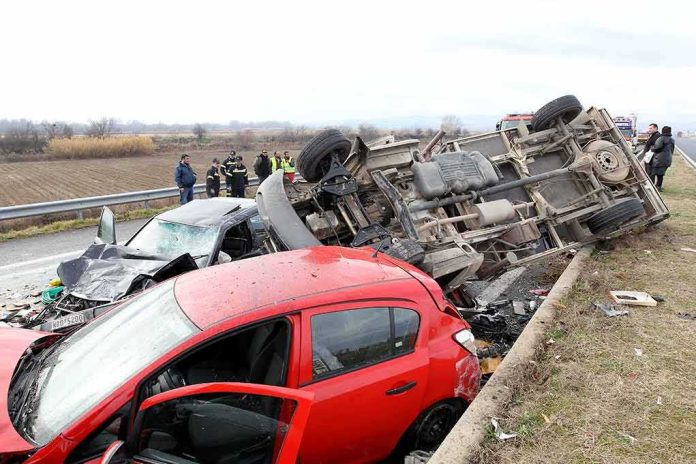
Just after 9 a.m., a Washington State Patrol-linked account places an SUV on southbound I-5 near DuPont, where it left its lane, struck a barrier, and came to rest after what multiple outlets describe as a rollover or collision with a semi-truck. The exact mechanics — whether the vehicle rolled before striking the truck or crossed lanes first — vary slightly across early reports, which is typical of crash coverage built from scanner traffic and trooper briefings rather than a released collision report. What is consistent across every outlet is the sequence that followed: once the vehicle came to a stop, the driver produced a knife and attacked the children riding with her.
The victims were a 9-year-old girl, who suffered multiple broken bones and a stab wound, and a 15-year-old girl who was hospitalized but not seriously injured. Later reporting identified the suspect by name as Janieka Ellington, 35, and described the younger girl and older girl as her daughters, with one account stating investigators believe she tried to stab the older daughter before the crash and stabbed the younger daughter afterward, while the vehicle was still on its side. That detail, if it holds up through the charging process, reframes the incident from a chaotic post-crash outburst into something investigators characterize as a sustained, intentional assault that bracketed the collision itself.
The Intervention: Soldiers at the Scene
What arrested public attention beyond the crash itself was the response of bystanders. Two soldiers assigned to Joint Base Lewis-McChord — JBLM sits a few miles from the DuPont interchange — stopped after witnessing the collision and physically intervened, getting the knife away from the suspect before law enforcement arrived. Descriptions of exactly how that intervention unfolded differ slightly from outlet to outlet: some accounts describe the soldiers disarming her, others describe them holding her down until troopers took over. The variation is the kind of granular detail that eyewitness accounts of a fast-moving, violent scene routinely produce, and it does not undercut the core, repeatedly corroborated fact that armed civilians-turned-first-responders stopped an active knife attack on a highway shoulder before it could escalate further.
From Scene to Charging Sheet
The suspect was taken to a hospital for medical evaluation before being transported to jail, a standard step when a suspect may have been injured in the same crash that precipitated the arrest. Early reporting described Washington State Patrol investigating potential charges of DUI, vehicular assault, and first-degree assault. That initial charge theory later hardened, according to subsequent coverage, into formal charges of attempted murder and vehicular assault against Ellington. The gap between an agency’s initial, provisional description of likely charges and the prosecutor’s final filing is routine in American criminal procedure — troopers describe what they believe happened at the scene; prosecutors decide, often days later and after reviewing toxicology, medical records, and witness statements, what the charging document will actually say. As is true of any pending criminal matter, the charges against Ellington remain allegations that she is entitled to contest in court.
Why the Public Record Arrives in Pieces
Washington’s own collision-reporting framework explains why incidents like this one surface to the public as a sequence of partial updates rather than a single authoritative account. State law requires the investigating officer to file a police traffic collision report for any crash involving injury, and that report is a sworn declaration — the officer must certify its contents under penalty of perjury — but it is not instantaneous. The Washington State Patrol’s own instruction manual for these reports lays out a formal chain of signatures, badge numbers, and approving-authority sign-off before a report is finalized and entered into the state’s collision records system. Meanwhile, journalists covering a fast-breaking violent crime are working from trooper briefings, 911 traffic, and hospital updates — all accurate as far as they go, but necessarily a step removed from the finished investigative packet. That is simply how breaking local crime coverage works in every state with a similar reporting statute, not a flaw unique to this case.
What the Pattern Says About Roadside Violence and Bystander Response
Cases like this one tend to get remembered for their most cinematic element — in this instance, uniformed soldiers disarming a knife-wielding attacker on a freeway shoulder — and that instinct is understandable; it is also, in a narrow sense, the least surprising part of the story. Bystander intervention in roadside emergencies is common precisely because highways are public, heavily trafficked spaces where help often arrives within seconds, long before first responders can. The harder, more consequential thread running through this incident is the question investigators are still working to resolve: whether the crash was an accident that triggered a violent breakdown, or, as one report suggests investigators now believe, a deliberate act that was itself part of the attack. That distinction will shape whatever sentence, if any, a court ultimately hands down, and it is the detail worth watching as the case moves from the roadside to the courtroom.
Sources:
foxnews.com, fox13seattle.com, kiro7.com, komonews.com, app.leg.wa.gov