

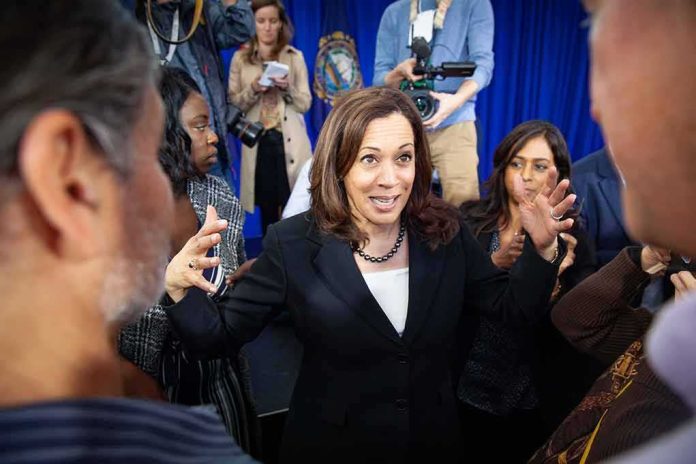
Within durable party coalitions, realignment rarely looks like conversion; it looks like principled dissent contained by shared priorities. Abdul El-Sayed’s handling of the Gaza divide with Kamala Harris is a case study in how a faction can challenge its party on substance and still choose to collaborate.
At a Glance
- El-Sayed publicly argued his party mishandled Gaza and opposed unconditional U.S. military support to Israel, framing the split as substantive, not symbolic.
- He backed Michigan’s 2024 “uncommitted” protest vote, evidencing organized, not merely rhetorical, dissent inside Democratic ranks.
- After Biden exited the 2024 race, he endorsed Harris and later campaigned with her, insisting shared priorities warranted coalition unity despite unresolved disagreements.
- Harris’s articulated stance centered on ending the war via a ceasefire/hostage deal while maintaining Israel’s security and Palestinian self-determination, a posture short of an arms embargo.
- The episode maps a broader Democratic fracture over Gaza policy that polling captured early and that strategists have tried to reframe as manageable.
What El-Sayed actually argued — and why it mattered
Abdul El-Sayed did not soft-pedal his critique: he said he disagreed with his party’s approach to Gaza, including unconditional military aid to Israel, and he labeled the war a genocide in public remarks. The significance lies less in the rhetoric and more in the through-line — a policy argument about U.S. military assistance and the terms of support — that he presented consistently across venues. Reported interviews and appearances depict him stressing that his position was stable over time; he underscored that none of his views on Gaza, foreign military aid, weapons sales, or the characterization of the war had changed, even as he worked alongside Harris on the trail.
The credibility of “substantive, not symbolic” dissent is bolstered by behavior. In 2024 he backed Michigan’s “uncommitted” protest ballot — a move that channeled progressive and Arab American frustration into a quantifiable intra-party signal — and later publicly navigated the political cost of that choice inside a broader Democratic coalition. BridgeMichigan’s fact-check is a guardrail against overstatement: he was not the movement’s leader, which matters for accuracy even as it leaves intact the evidence that his dissent was organized rather than performative.
Harris’s stated Gaza posture: ceasefire diplomacy with guardrails
Candid assessment requires putting Harris’s own words on the table. Across 2024 appearances, she framed an endgame anchored in a ceasefire and hostage deal, coupled with international humanitarian law protections, and an end state that kept Israel secure while safeguarding Palestinian dignity, freedom, and self-determination. She repeatedly rejected an Israeli reoccupation of Gaza as an acceptable outcome and described the civilian toll as devastating — rhetoric that acknowledged suffering without adopting an arms embargo or ending defense cooperation with Israel.
That positioning created a real gap with activists who sought explicit conditionality on U.S. military aid or broader restrictions. But it also provided a bridgeable lane for cooperation with Democrats who prioritize shared domestic objectives and accept that foreign policy alignment will be imperfect. El-Sayed’s subsequent endorsement and joint events made that transaction legible: retain the disagreement on Gaza; advance overlapping goals on health equity, affordability, and governance; ask voters to weigh the totality.
Mechanism of dissent inside a broad-tent party
Intra-party disputes harden or heal based on incentives. The “uncommitted” vote operationalized leverage among progressives and Arab American organizers by demonstrating that a measurable bloc would defect over Gaza policy. Party leadership, facing general-election math, sought to redescribe the fracture as a real but containable disagreement, emphasizing shared aims and future policy effort rather than relitigating 2024. El-Sayed’s pathway — protest, then endorsement and collaboration — is how those incentives meet: dissent to register cost; unity to avoid collective defeat. It is not contradiction; it is sequencing.
Polling snapshots from 2024 help explain why the gap surfaced and why leadership worked to narrow it. A Reuters/Ipsos survey found 44% of Democratic registered voters disapproved of the administration’s Gaza handling that spring — a serious cleavage for a governing party. Pew, the same season, showed strong Democratic support for humanitarian aid to Gaza but far weaker support for military assistance to Israel, an asymmetry that made unconditional support politically brittle.
Where the disagreement is real — and where it is not
The disagreement is real on conditionality and the framing of Israel’s military campaign. El-Sayed’s opposition to unconditional aid and his use of “genocide” mark policy and moral distance from the Harris line, which supported Israel’s right to defend itself while pressing for a ceasefire/hostage package and humanitarian protections — a calibrated but not embargo-anchored stance.
The disagreement is not a wholesale rejection of coalition priorities. El-Sayed repeatedly argued that shared Democratic aims — on health care, affordability, community investment — outweigh a single-issue split, however consequential. His choice to endorse Harris after Biden exited and to campaign jointly, particularly to reach constituencies skeptical of national Democrats, is the operational evidence behind that claim of proportionality.
Michigan as the proving ground
Michigan concentrated every pressure point: a large and politically engaged Arab American population, Black voters central to statewide victory, and a 2024 primary that recorded more than 100,000 “uncommitted” ballots — a visible ledger of estrangement for the national ticket. In that context, El-Sayed’s stance resonates as coalition management as much as ideology. He argued the case for stricter conditions on military aid while making the case for unity to audiences that might give Harris a new hearing — an approach that made strategic sense in a state where cross-community trust was strained and the electoral margins were tight.
That balancing act drew scrutiny. Some Jewish leaders voiced concerns and pressed Harris to engage directly about her ally’s positions; El-Sayed, for his part, emphasized dialogue and safety for Jewish communities alongside Palestinian rights in other public forums — a signal that his critique of U.S. policy did not map onto hostility toward Jewish constituents.
What this model of dissent means going forward
The lesson for parties is not that internal criticism must be suppressed to win. It is that durable coalitions make room for persistent, value-rooted disagreements while insisting on a hierarchy of goals. El-Sayed’s trajectory — protest vote support, firmed-up critique of unconditional aid, subsequent endorsement, and disciplined joint campaigning — illustrates a method to register costs without burning the coalition down. The inverse is also true: leadership must treat those disputes as legitimate policy arguments, not mere disloyalty tests, if it wants critics to rejoin the fold.
Sources:
apnews.com, washingtonexaminer.com, freep.com, yahoo.com, theguardian.com, ms.now, washingtontimes.com, dailymail.com, nymag.com