
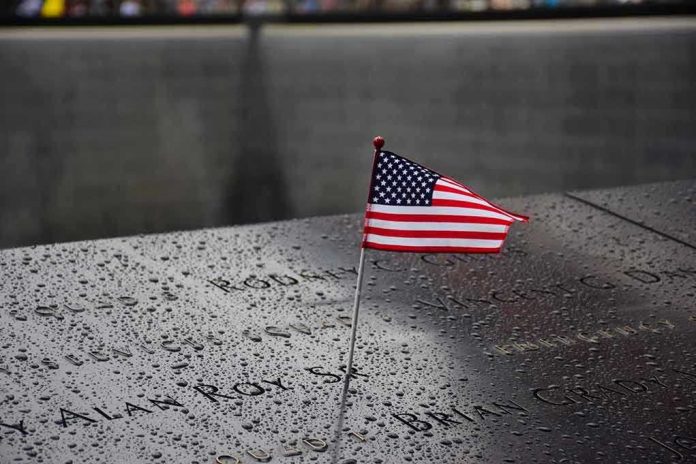
When grief and politics collide at Ground Zero, the flashpoint isn’t etiquette; it’s authority over public memory—who gets to stand in the sacred space, and on what terms. The fight over Mayor Zohran Mamdani’s attendance at the 9/11 commemoration sits squarely in that struggle, where bereaved families, elected officials, and media outlets contest not just behavior in the moment but the legitimacy of a public figure to bear witness at all.
At a Glance
- Families of victims and several public figures urged Mamdani not to attend, calling his presence disrespectful; he attended anyway.
- The core factual dispute centers on demeanor and symbolism, not a documented breach of protocol or disruption.
- Museum organizers and Mamdani framed attendance as apolitical witness, consistent with past mayoral practice.
- The controversy exemplifies how 9/11 remembrance doubles as a political arena where “respect” is argued through identity, associations, and media framing.
What actually happened: attendance contested, not behavior adjudicated
The concrete, uncontested sequence is narrow but consequential. In the run-up to the commemoration, a group of 9/11 victims’ family members publicly petitioned Mamdani to stay away, calling his attendance disrespectful; more than a dozen mourners delivered the petition to City Hall, and prominent figures amplified their objections. Coverage placed him at the ceremony at Ground Zero amid mounting criticism from families and Republicans who viewed his presence as provocative. Mamdani, for his part, confirmed in advance he would attend, saying he would “proudly honor the families, the survivors, [and] the first responders” by standing alongside them—language he and his office repeated across outlets.
What never materialized was a formal incident record. No ejection, censure, or official finding of misconduct was reported. Accounts of demeanor diverged: one report alleged “yukking it up” during the reading of names; another sourced account said he remained somber, respectful, and stayed to the end. The museum’s own posture emphasized that officials of all political stripes attend simply to bear witness and that the commemoration is intentionally kept free of politics. On the day, he and Rudy Giuliani exchanged brief pleasantries and a handshake—symbolically notable given the pre-event rhetoric—but hardly evidence of disruption.
Why “disrespect” became the charge: symbolism, not procedure
In the absence of a procedural breach—no broken rule or interrupted rite—the claim of disrespect rested on symbolism: a contested reading of who Mamdani is, what associations critics attribute to him, and how that identity sits within the 9/11 memory field. Commentary and partisan media connected objections to alleged past rhetoric and perceived associations, effectively arguing that the very fact of his presence signified dishonor to the dead, regardless of comportment that day. That argument is powerful in politics because it shifts the burden from evidence of conduct to an indictment of character.
But symbolic indictment cuts both ways. The counter-framing, advanced by the museum and by Mamdani’s office, made attendance a duty of office and continuity of civic ritual—mayors attend to bear witness, not to perform allegiance tests. If the ceremony’s design is to foreground families and minimize politics, the official line holds, presence itself is not a provocation; it is participation in a civic act that transcends partisanship.
The evidence standard: what the record shows—and doesn’t
An expert reading of the record comes down to what is provable. There is specific, named documentation of family opposition and public urging for Mamdani to skip the event. There is also a clear, on-the-record commitment by Mamdani to attend and honor the victims, and a corroborated handshake with Giuliani on-site. The crux—alleged levity during name readings—rests on dueling media frames rather than primary-source verification; no official clip, transcript, or incident report has been surfaced to settle the matter, and at least one sourced account defends his solemnity and full attendance. In short, the grievance is real; the alleged breach is unproven.
For readers accustomed to forensic clarity, that may feel unsatisfying. But public memory disputes rarely turn on adjudicated facts. They turn on interpretive authority. Who gets to define respect at a memorial—grieving families, institutional stewards, or elected leaders acting in a representative capacity? When these authorities disagree, the evidentiary bar shifts from rule violation to the optics of presence and posture.
How we got here: 9/11 remembrance as a political arena
From the earliest design debates over the memorial to recurring media cycles on anniversaries, Ground Zero has operated as both a site of mourning and a stage for competing narratives about nationhood, security, and belonging. Scholars of memory politics have long shown that official commemorations reflect power struggles over which stories are elevated and which are excluded; “respect” becomes the language through which those boundaries are policed. That is why the same image—a public official standing at attention—can read as solidarity to one audience and as an affront to another, depending on the frame into which it is placed.
Media dynamics intensify the effect. Outrage headlines and selective clips travel farther than institutional statements about apolitical bearing witness. The base-rate pattern in anniversary coverage oscillates between unity and suspicion, often mapping anxieties about Muslim identity or geopolitical conflict onto domestic civic rituals. In such an environment, even a neutral act—attending a memorial—acquires argumentative weight before it acquires facts.
The real disagreement: legitimacy versus comportment
Strip away the noise and two positions remain. One says legitimacy is at issue: that certain public stances or associations are incompatible with the moral gravity of Ground Zero, making attendance itself offensive regardless of behavior. The other says comportment is the standard: if an official attends as a mourner among mourners, observes the protocol, and refrains from politics, the ceremony’s integrity holds. The first standard privileges identity and past rhetoric; the second privileges conduct and institutional continuity. Both claim to protect the sanctity of the space; they differ on which threat—hypocrisy or exclusion—does the most damage.
On the evidence, the second standard is the one the ceremony’s stewards appear to apply. The museum emphasizes apolitical witness; officials across parties have long attended; and absent a documented breach, participation stands as part of the rite. That does not invalidate the pain of families who objected. It does clarify the rule set actually in force.
Longtime Democratic strategist James Carville criticizes Rudy Giuliani for demanding New York City Mayor Zohran Mamdani avoid attending 9/11 memorial events in his city https://t.co/eLxUu394Au
— Wonderwall (@Wonderwall) September 14, 2026
What it means going forward: designing for plural memory
Ground Zero will remain a contested memory site because it does what healthy civic rituals do: gather a plural public around irreducible loss. The price of that pluralism is friction. The safeguard is a clear, consistently applied norm: the ceremony exists for families first and for a broad public to bear witness without political performance. When disputes hinge on identity rather than conduct, institutions should default to conduct—codify expectations, publish protocols, and, where feasible, preserve full archival footage to narrow the interpretive battlefield.
Sources:
cityandstateny.com, theguardian.com, usatoday.com, cnn.com, nypost.com, foxnews.com, jpost.com, studenttheses.uu.nl