

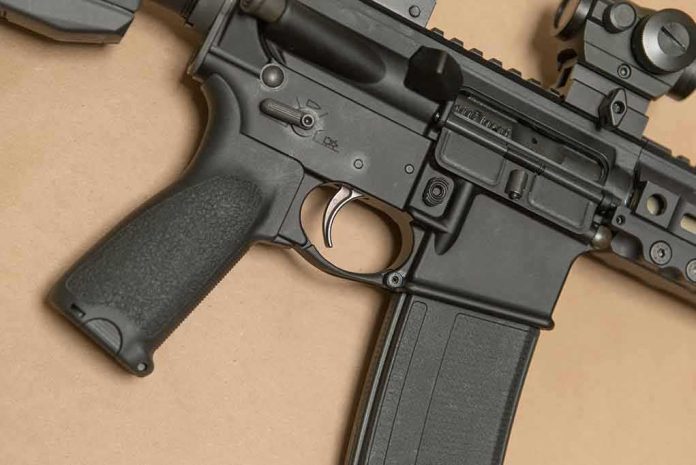
Turning ordinary rifles into viable counter‑drone tools is no longer theoretical; IWI’s ARBEL shows how a small, weapon‑mounted computer can meaningfully raise hit probability on fast, low‑signature quadcopters out to a few hundred meters—without changing the optic, the ammunition, or the shooter’s muscle memory.
The Short Version
- ARBEL is a computerized fire‑control add‑on for rifles and light machine guns that times shots automatically when the sight picture is momentarily correct.
- It is designed to intercept small drones in daylight to roughly 450 meters while using existing optics and standard ammunition.
- The system integrates an electronic trigger, inertial and motion sensors, and a processor; when enabled, it meters short, precise pulses instead of continuous fire.
- Its debut follows a broader shift toward standardized, scenario‑based counter‑UAS testing as governments seek comparable performance data across vendors.
What ARBEL Is: A Computerized Fire-Control Layer for Small Arms
ARBEL is not a new rifle; it is a compact, weapon‑mounted computer and upgraded electronic trigger that sits inside the host platform’s normal ergonomics. Israel Weapon Industries introduced the system as a “computerized small arms” capability for assault rifles and light machine guns, explicitly showing integration on AR‑15–pattern rifles, IWI’s ARAD family, and the Negev LMG. The architecture is straightforward: motion and stability sensors track the muzzle’s micro‑movement, the onboard processor predicts the fleeting instant when the line of sight crosses the target, and the electronic trigger releases at that instant—automating what experienced shooters already try to do under stress, but with machine‑timed consistency.
In counter‑drone use, the goal is not a single golden BB; it is to sustain brief, decisive pulses during the moments when a small, erratically moving target intersects an accurate sight picture. That is what the firing logic is built to do. External demonstrations and trade coverage emphasize daylight engagements against small drones at short to medium ranges, with IWI promoting effectiveness out to roughly 450 meters for these use cases, while retaining the original weapon’s optics, magazines, and ammunition.
How It Works in Practice: Timing, Stability, and Controlled Pulses
The technical leap is timing, not raw accuracy. Traditional marksmanship couples human perception with a mechanical trigger break; even expert shooters induce sight wobble and timing error, which are magnified when tracking small aerial targets. ARBEL’s sensors sample that wobble, model target motion, and let the electronic trigger release only when the computed solution crosses the aimpoint window. In auto or burst settings on compatible platforms, the system meters ultra‑short pulses rather than letting the weapon run continuously, preserving barrel control and extending the window for repeated, sight‑aligned shots. Because the core ballistic path and terminal effects are unchanged—standard 5.56 mm or 7.62 mm ball remains ball—gains show up as improved hit probability per round fired, not as new lethality modes.
Mechanically, ARBEL is designed to be reversible: if the battery depletes or electronics are disabled, the host weapon reverts to conventional trigger operation. This fail‑safe matters for unit adoption because it preserves baseline training and logistics; the shooter keeps the same magazines, optics, and manual of arms. The additive mass is modest for rifles and immaterial for LMGs, which already carry the weight budget for sustained fire.
Why It Matters: The Drone Problem Meets the Infantryman’s Reach
Small quadcopters and FPV drones collapse warning time and compress the engagement envelope. Electro‑optical trackers, RF jammers, and interceptors all have roles, but they are not always with the squad at the instant a drone appears at 100–300 meters, below the tree line, and moving unpredictably. A rifle‑borne solution meets the moment because it is already in the shooter’s hands. ARBEL’s value proposition is precisely there: raise the probability of a stopping hit inside a short engagement window without summoning a dedicated counter‑UAS element or specialized ammunition. Consistent with IWI’s public positioning and demonstrations, the system is aimed at daylight, short‑to‑mid‑range shots on small targets, where timing beats brute fire volume.
This concept aligns with the broader counter‑UAS toolkit: it is a kinetic end‑effector that slots beneath missile‑class interceptors and above unguided, unaided small‑arms fire. It does not replace detection, identification, or RF defeat options; it complements them by giving the rifle squad a credible last‑fifty‑meters shot when other layers are saturated or out of position.
Fit with Emerging Standards: Demonstrations vs. Comparable Data
Public information on ARBEL’s performance comes mostly from manufacturer demonstrations and trade‑press coverage—credible as product introductions but not equivalent to third‑party, scenario‑based testing. That distinction matters because U.S. and European efforts are converging on standardized counter‑UAS evaluation: common scenarios, common data capture, and interoperable reporting so buyers can compare like for like across vendors. Initiatives such as JIATF‑401’s guidelines and CEN workshop agreements push for repeatable trials that record setup time, calibration, environmental conditions, and target classes—turning ad hoc demos into evidence packages that procurement officers and commanders can trust across missions.
ARBEL arrives in that policy climate. Its promise—elevated hit probability against small drones to circa 450 meters with existing rifles—fits neatly into the kind of test matrices allies are building: daylight vs. low‑light runs, static vs. maneuvering targets, varied approach vectors, and measured shooter workload. As those standards mature, systems like ARBEL should see data captured in the same scorecard columns as other kinetic and non‑kinetic options, clarifying where the computerized trigger advantage is decisive and where other layers are a better fit.
Israel Weapon Industries (IWI) has presented ARBEL, an anti-drone system designed to turn standard assault rifles into counter-UAS weapons.
ARBEL integrates with AR-15 family rifles and the IWI ARAD, using motion sensors and a computerized fire-control system. The system… pic.twitter.com/ldzRsYiaI3
— Drone Wars (@Drone_Wars_) August 31, 2026
Where It Likely Excels—and Where It Does Not
ARBEL’s sweet spot is the close fight: small UAS at short ranges, daylight, and within the rifle squad’s organic reach. Engagements benefit when the shooter can track the target through existing day optics, keep the muzzle on a predictable crossing, and exploit the computer’s timing to land multiple hits in one or two pulses. Light machine guns with higher cyclic rates and belt depth amplify the concept by throwing denser, better‑timed shot strings while the fire‑control logic prevents wasteful overshoot.
There are natural boundaries. Weather and light affect the shooter’s ability to maintain a usable sight picture; at night or through obscurants, the limiting factor becomes the optic, not the trigger. Against larger, faster, or higher‑flying fixed‑wing drones beyond a few hundred meters, rifle ballistics and time‑of‑flight work against kinetic interception; missiles or proximity‑fused munitions regain the advantage. And where rules of engagement or collateral‑risk constraints preclude ballistic solutions, RF or cyber‑based defeat modes will still lead. None of these are knocks on ARBEL; they describe the lanes in a layered defense where each tool makes tactical sense.
Adoption Logic: Training, Logistics, and Cost of Capability
Commanders buy probability, not promises. ARBEL’s adoption case is strongest where it avoids new line items: no special ammunition, no proprietary optic, no new manual of arms. Because it augments rather than replaces the host weapon, unit conversion can be phased—start with lead gunners and LMG teams, expand if the measured hit probability and ammunition expenditure ratios pencil out in training and exercises. In an era when counter‑UAS budgets are growing quickly, program offices are under pressure to show value per dollar and to document it with standardized data. A weapon‑mounted system that meaningfully improves last‑ditch interception with minimal logistics is, on paper, a cost‑effective layer; standardized trials will quantify that claim in the same units used to compare jammers, radars, and interceptors.
Bottom Line
Computerized fire control for small arms has matured from a laboratory curiosity into a practical counter‑drone enabler. ARBEL exemplifies the shift: sensor‑timed shots, reversible integration, and a focus on the short‑range, daylight envelope where squads actually encounter small UAS. As allied testing frameworks converge on common scenarios and metrics, expect the real value of this class—improved hit probability per round, inside seconds that matter—to show up in comparable data. Until then, one judgment is safe: giving an infantryman better timing is rarely wasted capability, and against small drones at a few hundred meters, timing is the fight.
Sources:
military.com, israeldefense.co.il, youtube.com, israel.com, ynetnews.com, znews.vn, breakingdefense.com