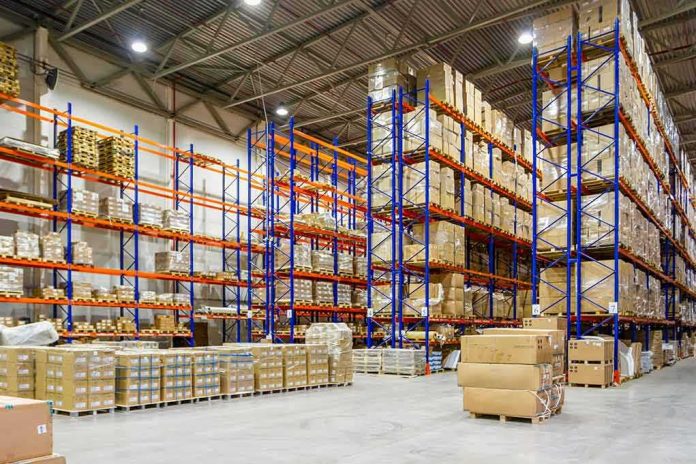
Modern drone warfare blurs the line between civilian commerce and military logistics; the sustained Ukrainian campaign against Wildberries warehouses shows how a retailer’s distribution network can become a battlefield objective when a state argues those hubs are feeding an adversary’s war machine.
At a Glance
- Ukraine has repeatedly struck Wildberries logistics centers across multiple Russian regions, framing them as dual-use nodes supplying sanctioned components for drones and navigation systems.
- Wildberries and Russian officials describe the sites as civilian warehouses for consumer goods, deny military use, and highlight casualties and business disruption.
- This dispute sits squarely in the dual-use dilemma: the same infrastructure that powers e-commerce can, if repurposed, accelerate procurement and distribution for war.
- Evidence in the public domain is largely claims and denials; decisive adjudication would require inventory, shipping, and forensic records that neither side has released.
What Ukraine targeted and why it matters
Ukraine has carried out a sustained series of long-range drone strikes on logistics centers operated by Wildberries, Russia’s largest e-commerce company. Across roughly two weeks, multiple warehouses in regions including Leningrad, Tambov, Krasnodar, Stavropol, Penza, Samara, and the Moscow environs were hit, triggering large fires, evacuations, casualties, and service disruptions reported by regional officials and the company. The scale and repeatability mark this not as a one-off incident but a deliberate logistics campaign aimed at degrading an economic network Kyiv describes as feeding Russia’s war effort.
Kyiv’s public rationale is direct: these were “major logistics facilities” involved in supplying sanctioned components for drone manufacturing and navigation equipment. That framing moves the warehouses from retail infrastructure to dual-use targets—civilian in form, but military-relevant in function—if the claim holds. In an era when quadcopters and FPV kits crowd the gray zone between hobbyist gear and battlefield tools, the allegation is not inherently implausible; the evidentiary question is whether these specific sites held such goods at the time of the strikes.
Mechanics of a dual-use target: how a retailer’s network can become logistics infrastructure
Large e-commerce platforms operate at national scale with high-throughput nodes: inbound docks for bulk vendor shipments, cross-docking lines, mezzanines for sortation, and outbound lanes feeding last-mile carriers. In Russia, Wildberries processes vast order volumes and runs regional hubs that consolidate flows from thousands of sellers to millions of buyers; it reportedly handles tens of millions of orders per day, a throughput that, if redirected or selectively prioritized, could accelerate procurement and distribution of dual-use components—including electronics, optics, small motors, and radio units common to both consumer gadgets and improvised drones.
That is the heart of the dual-use dilemma. A warehouse does not need to be a Ministry of Defense depot to shift the tactical picture; it needs to provide speed, coverage, and deniability in moving items that are legal in isolation but militarily consequential in aggregate. If a bellwether hub stocks or channels sanctioned components—GNSS modules, high-discharge batteries, flight controllers—its military value rises. Conversely, if it is moving shoes and shampoo, its targeting becomes harder to justify under the law of armed conflict. The category is not the question; the contents and operational intent are.
The public record: claims, denials, and the gap that decides the case
On the record, Ukraine says the targeted sites supported Russia’s military logistics by supplying restricted components for drones and navigation systems; this has been reported by major outlets quoting President Volodymyr Zelensky’s framing. Wildberries and Russian officials reject that allegation; the company characterizes itself as a civilian retailer, condemns the strikes as terrorism, and reports evacuations, injuries, and disruption across its network. Both things can be true at once in a dual-use setting; which prevails depends on proof that remains offstage in public coverage.
What would settle the dispute? Three evidentiary classes. First, contemporaneous inventory and shipping documentation—bills of lading, intake logs, WMS extracts—showing that drone components or restricted navigation gear were in storage or cross-dock at the struck hubs. Second, independent post-strike forensic analysis of debris and residue—component fragments, packaging identifiers, and material assays aligning with dual-use electronics rather than general merchandise. Third, sworn testimony or verifiable operational records demonstrating systematic handling of such items as part of a supply chain knowingly serving the armed forces. None of that has been made public to a standard that would neutralize the opposing side’s narrative.
Legal lens: distinction, dual-use, and proportionality
International humanitarian law requires distinction between military objectives and civilian objects; dual-use facilities may be targeted if, by their nature, location, purpose, or use, they effectively contribute to military action and their destruction offers a definite military advantage. The gray area is evidentiary and temporal: the status of a site can hinge on what it contains and does at a given moment. If the Wildberries hubs were used to store or route sanctioned components for Russia’s drone program, they could qualify as military objectives; if they were not, they remain civilian infrastructure, and the harm to workers and small businesses reported across multiple strikes would weigh heavily in any proportionality assessment.
Here the public record emphasizes harm—deaths and injuries among warehouse workers, fires that raged for hours, and what the Kremlin described as business suffering—without providing a definitive accounting of contents. Harm alone does not resolve lawfulness; it informs proportionality. The decisive variables remain the presence and materiality of dual-use items and whether feasible precautions—timing, warnings, choice of aim points to minimize worker exposure—were taken by the attacker in light of expected military gain.
Strategic logic: why these hubs, and why now
Even absent a conclusive public chain of proof, the strategic logic behind Kyiv’s target set is legible. Russia’s battlefield adaptation relies on scale procurement of relatively simple components—electronics, batteries, optics—integrated into drones that strike Ukrainian positions and infrastructure. A broad, resilient civilian logistics lattice gives that procurement a backbone. Disrupt the backbone, and you raise costs, extend lead times, and inject friction into unit-level resupply. Repeat across regions, and you force operational rerouting and defensive hardening around sites never designed as military bases. That is classic logistics interdiction adapted to the age of e-commerce.
For Moscow, the counter-logic is equally clear. Framing these strikes as attacks on civilians shifts the narrative terrain, mobilizes domestic outrage, and justifies countermeasures. Operationally, Wildberries can redistribute flows to surviving hubs, accelerate vendor dropship models, and move time-sensitive items via alternate carriers. But scale cuts both ways: a network built for consumer convenience is efficient but brittle under kinetic pressure—smoke, evacuations, and insurance shocks cascade through seller ecosystems, as independent reporting has shown with small vendors losing inventory and income when hubs burn.
Ukraine hits a Wildberries warehouse after Zelensky accused them of supplying Russian drone parts.
Dual-use companies aren’t civilian anymore.
— Richard Doe™ (@RichardDoe_On_X) August 5, 2026
What would change the assessment
Because public reporting is dominated by claims and denials, the next tranche of credible evidence would carry outsized weight. Three developments would be decisive. One, audited warehouse management system exports and matched bills of lading for the days surrounding each strike, redacted for personal data but preserving SKU-level specificity, to confirm or refute the presence of sanctioned or dual-use components. Two, independent forensic reporting—component residue, serials, vendor codes—linked to known drone builds used by Russian forces. Three, geospatial analysis of truck flows and operational patterns consistent with military procurement cycles rather than retail seasonality. Any one of these, if rigorous and verifiable, would shift the burden of persuasion materially.
Implications for future conflicts
However this specific dispute is ultimately judged, the template is clear. As militaries lean on dispersed procurement of commercially available technologies, high-throughput civilian logistics becomes a strategic enabler—and a potential target. That raises three enduring challenges. First, compliance: retailers operating in belligerent states need robust sanctions screening down to SKU attributes and vendor ownership to avoid accidental entanglement. Second, resilience: network designs optimized for delivery speed must add redundancy and physical hardening against kinetic risk. Third, transparency: when allegations surface, the only durable defense is timely, verifiable data that can withstand hostile scrutiny. None of these are public-relations fixes; they are operations problems with legal stakes.
Bottom line
The Wildberries strikes capture the central tension of contemporary warfare: the same networks that knit a consumer economy together can, if leveraged for dual-use supply, become legitimate targets—and if not, their destruction is unlawful and strategically self-defeating for the attacker. Ukraine has articulated a clear military-use rationale; Russia’s largest retailer and officials reject it and point to civilian harm. The truth, in this case as in many dual-use disputes, likely sits in records and residues still locked away. Until those surface, this episode stands as a warning to every major logistics operator in a world where the boundary between cart and cartridge has never been thinner.
Sources:
facebook.com, reuters.com, youtube.com, bbc.com, aljazeera.com, npr.org, rferl.org, pbs.org