
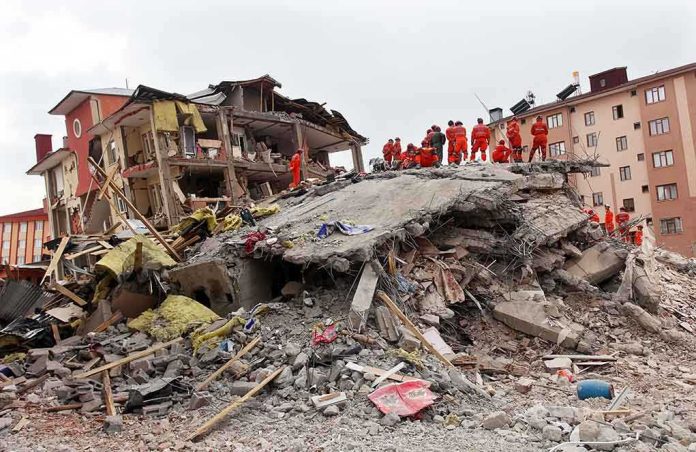
The real story in Venezuela is not merely that foreign rescuers arrived; it is that search-and-rescue became a race against time in a country where collapsed buildings, damaged airports, and political suspicion all narrowed the space in which humanitarian action could actually work.
Intro Header
- The United States did deploy search-and-rescue teams from Fairfax County and Los Angeles, and Rubio said those teams were being sent immediately to support the most urgent phase of the response.[1][3]
- The aid package was substantial: reporting tied the U.S. response to a $150 million commitment, plus medical resources, overhead imagery, and other logistics support.[8][6]
- The claim of “four-legged heroes” is directionally true in the broader rescue effort, but the available evidence does not quantify how many survivors any U.S. K9 team located.[4][9][10]
- The stronger argument is not that U.S. dogs alone changed the outcome, but that U.S. teams joined a large, rapidly internationalized operation during the narrow window when live rescue was still possible.[1][5]
The Operational Logic of Urban Search and Rescue
Earthquake response is brutally time-bound. In the first 48 to 72 hours, rescuers are not doing abstract disaster management; they are trying to find breathing people in voids, voids that can disappear as rubble settles, aftershocks continue, and heavy machinery becomes both a necessity and a danger. Rubio’s description of the mission was consistent across reporting: the United States was sending search-and-rescue personnel from Fairfax County and Los Angeles because collapsed structures made immediate victim location the top priority.[1][3][4] That is also why aerial imagery mattered. When coastal damage and blocked access reduce line-of-sight, overhead assessment becomes an operational tool, not a public-relations flourish.[1]
The reports that mention dogs fit this mechanism. In urban search and rescue, K9 units are not symbolic mascots; they are among the fastest instruments for detecting live victims under debris, especially where sound, cameras, and seismic cues are limited. The social transcript summaries describe specialized teams arriving with trained dogs designed to work in collapsed structures, and one report said the British team included six life-saving dogs.[11] But for the U.S. contingent, the record here confirms deployment, not outcome. That distinction matters. Deployment proves intent and capability; it does not, by itself, prove that the dogs found survivors or changed the mortality curve.[1][2][4]
What the United States Actually Sent
The U.S. response was broader than a handful of rescuers. Rubio said the State Department was “immediately deploying search and rescue teams, medical resources, and humanitarian assistance,” with teams from Fairfax County and Los Angeles already moving.[3] Other coverage tied the response to Virginia Task Force One and California Task Force Two, both heavyweight urban search-and-rescue assets with the training and equipment to operate in unstable disaster zones.[6] Reporting also placed the American response inside a wider international surge: by June 27, Venezuelan officials said more than 1,600 foreign rescuers had arrived, with more on the way.[1]
The aid figure matters because it shows the United States treating this as a full emergency package rather than a symbolic gesture. Coverage summarized a $150 million commitment, including allocations for the World Food Programme, International Medical Corps, and a UN pooled fund.[6][8] That is not a trivial sum in the logic of disaster relief, where cash enables food, medical supply chains, shelter, and local procurement long after television crews leave. The State Department’s emphasis on imagery, medical resources, and rescue teams shows a layered model: immediate lifesaving support at the front end, then logistics and recovery capacity behind it.[1][8]
The Political Problem No Rescue Mission Can Escape
Even the most technically sound relief operation enters a political field. Side B’s strongest objection is not that the U.S. failed to deploy; it is that U.S. deployment can be read through the lens of prior confrontation with Venezuela. Al Jazeera noted concerns that Washington’s military presence and aid posture might be interpreted as a militarized intervention rather than clean humanitarian relief, especially given earlier U.S. actions toward Nicolas Maduro.[10] That skepticism is not airy partisanship; it is a predictable response when warships, transport aircraft, and helicopters are discussed in the same breath as humanitarian assistance.[10] In disaster diplomacy, tools matter as much as intent, because recipients judge both.
There is also the practical friction of sovereignty. Venezuelan authorities later restricted access to La Guaira, the worst-hit area, requiring permits for entry.[5] That kind of restriction is often justified as an attempt to manage traffic and preserve rescue lanes, but it also signals how quickly humanitarian space can narrow when a government is overwhelmed, defensive, or both. Local reporting and aid coverage suggested that the first 48 to 72 hours saw limited visible state response in the hardest-hit zones, which made foreign teams look less like supplements to domestic capacity and more like replacements for it.[5][11] That perception can distort the public reading of any outside mission, however competent the rescuers on the ground may be.
The Historical Pattern Behind the Venezuela Response
Nothing about this episode is historically unusual. The United States has been doing foreign disaster assistance for a long time, and Venezuela itself sits inside that history. The Organization of American Historians notes that after the Caracas earthquake of March 1812, Congress appropriated $50,000 and authorized President James Madison to ship food to survivors.[15] That early precedent is more than trivia; it shows that humanitarian response in the hemisphere has long mixed compassion, state capacity, and strategic signaling. Later U.S. disaster aid across Latin America followed the same logic, with military and civilian assets repeatedly used together to move food, medicine, tents, and personnel.[15][22]
That older pattern helps explain why today’s Venezuela response produces two simultaneous reactions. Supporters see a familiar American reflex: send specialists, fund relief, and help where local systems are overwhelmed. Skeptics see a familiar geopolitical pattern: use humanitarian language in a place already charged by power politics. Both reactions are structurally understandable. What the evidence in this case supports most clearly is that the U.S. did deploy real search-and-rescue capability and real funds into a genuine mass-casualty emergency.[1][3][6] What it does not support is the more dramatic claim that U.S. K9 teams, specifically, have been shown to deliver a measurable rescue effect in the public record available here.
What Readers Should Take From the Record
The sober reading is straightforward. The U.S. response was real, fast, and operationally relevant. It included specialized rescue teams, medical support, aerial imagery, and a large aid commitment, all directed at the narrow period when live rescues were still possible.[1][3][6] The presence of dogs in the broader international response reflects standard urban search-and-rescue doctrine, not a novelty. But the available reporting does not prove a quantified dog-led breakthrough, and the political setting ensured that every aircraft, uniform, and permit request would be interpreted through a second, more skeptical lens.[5][10][11]
That is why the most accurate formulation is also the least flashy: U.S. teams, alongside many others, entered Venezuela during the decisive phase of a catastrophic earthquake response; they brought the right tools for the job; and they did so in a country where access, trust, and timing were all as important as brute rescue capacity.[1][5][8]
Sources:
[1] Web – U.S. deploys four-legged heroes to Venezuela to help find and rescue …
[2] Web – Death Toll in Venezuela Quake Tops 1,400 as Rescue Efforts Intensify
[3] YouTube – US deploying search and rescue teams to Venezuela …
[4] YouTube – Venezuela Earthquake BREAKING: U.S. Leads Global Rescue In …
[5] Web – Elite US rescue teams head to Venezuela after deadly quakes
[6] Web – Venezuelans dig for earthquake survivors as death toll rises to 1430
[8] Web – On 25 June 2026, the Federal Council took note of the devastating …
[9] Web – Rescue efforts turn to recovery as aftershocks shake Venezuela
[10] Web – U.S. pledges generous earthquake relief to Venezuela – NPR
[11] Web – International community pledges aid to Venezuela after earthquakes
[15] YouTube – Mexico joins the effort to Aid Venezuela following the Earthquakes
[22] Web – [PDF] US Disaster Response Aid in US Southern Command Region