
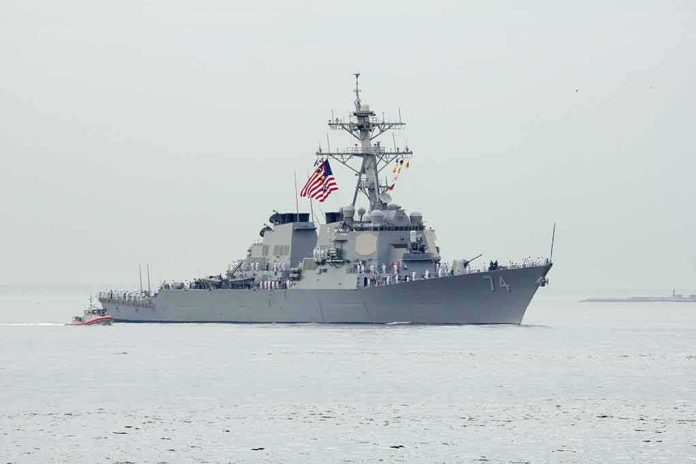
Rubio’s blunt warning that any threat to U.S. destroyers in international waters “will be blown up” puts Tehran on notice and signals the Trump administration will not yield control of the Strait of Hormuz to Iranian overreach.
Story Highlights
- Rubio says Iranian forces fired on U.S. destroyers in international waters; U.S. returned fire defensively [2].
- He warns Iran is trying to “normalize” control of the Strait of Hormuz through an alleged traffic-control scheme [3].
- He states recent U.S. strikes were defensive and separate from Operation Epic Fury [5].
- Iran-linked outlets claim U.S. hit Iranian tankers first, framing Tehran’s response as retaliation [7][9].
Rubio Describes Defensive U.S. Fire After Destroyers Came Under Attack
Secretary of State Marco Rubio said U.S. Navy destroyers transiting international waters near the Strait of Hormuz were fired upon by Iranian forces, prompting immediate American defensive fire to protect the ships and crews [2]. Rubio emphasized that when drones or missiles are launched at U.S. destroyers, the Navy will shoot back to stop the threat [2]. He framed the response as common-sense self-defense under international law, making clear that any vessel approaching aggressively or firing weapons would be neutralized [1].
Rubio’s account, delivered on camera, aligns with administration messaging that the United States did not initiate hostilities in these incidents [2]. He rejected the notion that restraint equals weakness, arguing that deterrence requires decisive action when American lives are targeted [1]. While Rubio’s description is direct, it relies on administration statements rather than publicly released Navy logs, video, or third-party verification, leaving open-source confirmation of “who fired first” limited at this stage [2].
Concerns Over Iranian Attempts To Control An International Waterway
Rubio warned that Iran is trying to “normalize” control of the Strait of Hormuz by advancing an alleged traffic-control authority that would insert Tehran between commercial vessels and free navigation norms [3]. He called any such move illegal and unacceptable because the Strait is a critical international chokepoint serving allies, global commerce, and American energy security [3]. He cautioned that allowing Iran to set de facto rules in these waters risks copycat behavior by other regimes seeking leverage over shared maritime arteries.
The senator said American policy must preserve freedom of navigation and deny Tehran any precedent to tax, delay, or intimidate neutral shipping through bureaucratic fronts or armed harassment [3]. He tied that stance to a broader defense of Western-aligned trade, warning that strategic waterways cannot become bargaining chips for hostile states. Public documentation detailing the structure or legal basis of Iran’s alleged “agency” has not been produced in the cited material, underscoring the need for transparent evidence even as U.S. officials press allies to push back [3].
Separating Defensive Actions From Broader Military Operations
Rubio stated that recent U.S. strikes were defensive and distinct from Operation Epic Fury, which has targeted Iranian military infrastructure in other contexts [5]. He contended the immediate actions near Hormuz focused narrowly on neutralizing threats to U.S. vessels, not on escalating into wider conflict [5]. This distinction matters for coalition diplomacy and markets; defensive framing can sustain allied support and calm energy traders wary of a prolonged war affecting oil flows.
“Only stupid countries don’t shoot back when you’re shot at”
Marco Rubio, US Secretary of State, defends the US retaliation following an attack on a Navy ship, saying Iran started the confrontation and the response was warranted pic.twitter.com/CK0hAVqJKE
— TRT World (@trtworld) May 8, 2026
Iranian and regional outlets circulated a counter-claim that U.S. forces attacked two Iranian-flagged tankers in violation of a ceasefire, and that Iranian strikes were retaliation rather than aggression [7][9]. That narrative attempts to invert the timeline and cast Washington as the provocateur. However, those reports do not present forensic evidence—such as radar tracks, launch telemetry, or verified imagery—directly rebutting Rubio’s assertion that U.S. destroyers were fired upon first in international waters [2]. The gap highlights why timely, declassified Navy reporting could strengthen U.S. credibility.
Why This Standoff Matters For American Families And The Economy
Freedom of navigation through the Strait of Hormuz underpins stable energy prices and the reliability of supply chains that touch every American household. Any Iranian attempt to restrict passage, impose unofficial tolls, or menace ships invites higher insurance costs, tighter supply, and price spikes that hit family budgets. The Trump administration’s message—that U.S. ships will defend themselves and keep the sea lanes open—aligns with core conservative priorities: peace through strength, lawful self-defense, and safeguarding the economy by protecting critical infrastructure at sea [3][5].
Rubio’s warning also carries a constitutional subtext: Congress and the executive share obligations to defend American forces and commerce from foreign aggression without yielding sovereignty to hostile actors. Deterring Iran’s harassment of U.S. vessels protects service members, shields trade, and avoids setting a dangerous precedent other authoritarian regimes could exploit. Clear evidence releases, robust diplomacy with allies, and steady rules of engagement can maintain deterrence while minimizing the risk of a wider conflict in an already volatile region [2][5][7].
Sources:
[1] US will ‘blow up’ threats against Navy ships, Rubio says
[3] Rubio Presses Europe on Iran Action as He Seeks to Mend Ties …
[5] Rubio: Friday’s U.S. Strikes in Iran Were Defensive – IranWire
[7] US fire on Iran tankers sparks reprisals as deal hangs in balance