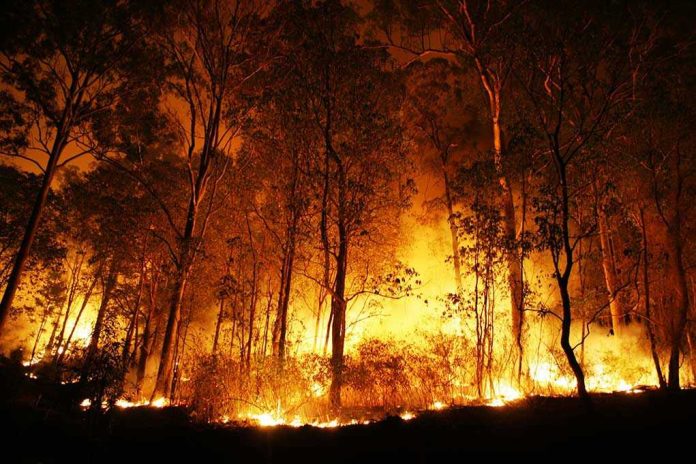
As Nebraska fights multiple fast-moving wildfires, one hard truth is already clear: when disaster hits, rural families pay the price first—and they need clear, accountable leadership, not bureaucratic fog.
At a Glance
- Nebraska officials briefed reporters on March 14, 2026, as major wildfires continued to grow across the state.
- The Cottonwood Fire is burning in Lincoln and Dawson Counties and is one of four large fires named by officials.
- Other major fires cited in the official briefing include the Morrill Fire, Road 203 Fire, and Anderson Bridge Fire.
- Public messaging has emphasized wildfire growth and concerns tied to federal assistance, underscoring how quickly resources can become strained.
What the State Briefing Confirmed About the Cottonwood Fire
Nebraska officials, speaking during a March 14 briefing covered by Nebraska Public Media, identified the Cottonwood Fire as actively burning in Lincoln and Dawson Counties. The same update grouped Cottonwood with three other major incidents—the Morrill Fire, Road 203 Fire, and Anderson Bridge Fire—highlighting that the state was not facing a single contained emergency but multiple large, competing demands at once. The briefing also addressed wildfire growth and concerns related to federal assistance.
Because the available research is limited to a single public-media briefing summary, key operational details are not confirmed in the provided source, including the fire’s acreage, the exact locations of structure threats, containment percentages, the timing and scope of evacuations, and whether specific highways or critical infrastructure were closed. Readers should treat any claims outside the official briefing as unverified unless corroborated by additional official updates from emergency management or local law enforcement.
Multiple Fires at Once: Why “Resource Strain” Becomes the Story
The official update’s mention of several large fires matters for a practical reason: every major incident competes for the same scarce resources—trained crews, aviation support, engines, water tenders, and law enforcement support for evacuations and traffic control. When multiple fires expand in the same time window, even well-prepared states can face painful tradeoffs. The briefing’s focus on growth and federal assistance concerns signals that leaders were already weighing how to sustain a prolonged response.
For communities in and around Lincoln and Dawson Counties, the Cottonwood Fire’s designation as one of the state’s major incidents suggests a situation serious enough to be tracked alongside other headline fires. The public deserves clarity during moments like this—what’s known, what isn’t, and where to find verified instructions—because confusion during wildfire events can put families in danger. Based on the single source provided, officials were communicating broad situational awareness but not a full incident-by-incident breakdown.
Accountability and Communication Standards During Emergencies
Emergency response succeeds when information moves faster than the fire: clear evacuation guidance, clear jurisdictional responsibility, and clear public updates. The March 14 briefing confirms officials were in front of reporters, which is important, but the limited detail available in the provided research also shows a gap for readers trying to understand local impact. When the public is told a fire is growing and federal aid is a concern, the natural next questions are practical—who is in charge, where to go, and how to protect property.
What We Still Don’t Know From the Provided Research
The user’s prompt references evacuations in Dawson County, but the only confirmed facts in the supplied research are that the Cottonwood Fire is burning in Lincoln and Dawson Counties and that it was one of four major fires discussed in the March 14 briefing. The single citation does not confirm where evacuations were ordered, which neighborhoods or rural routes were affected, or whether orders were expanded or lifted. With only one source, a cautious summary is the responsible approach until additional official documents are provided.
For readers tracking this story, the best next step is to seek incident-specific updates directly from county emergency management, sheriff’s offices, and official state channels, then compare those updates against what was said in statewide briefings. The March 14 briefing establishes the high-level reality—multiple large Nebraska fires, including Cottonwood, were growing and testing response capacity. But without additional verified reporting in the research packet, a deeper claim-by-claim reconstruction of evacuations, damage, and response timelines cannot be completed.
Sources:
March 14 special report: Nebraska officials on wildfire growth