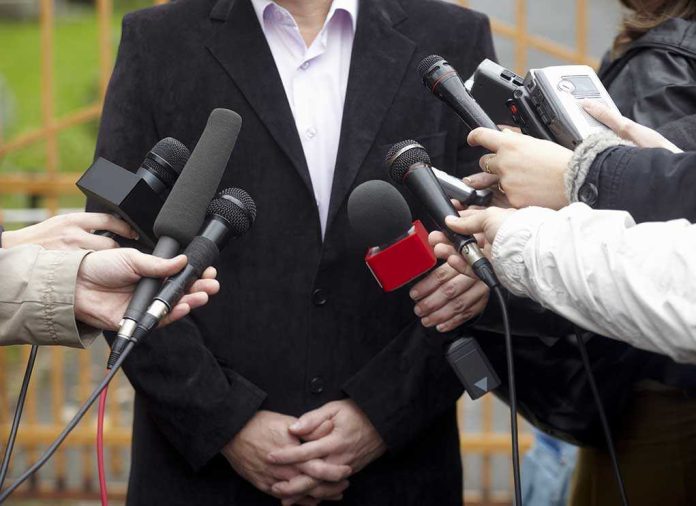
A veteran journalist just asked a potential presidential candidate if being too handsome hurts his political prospects while his state grapples with the nation’s highest poverty rate.
Story Snapshot
- Katie Couric opened her 90-minute interview with Governor Gavin Newsom by asking if his looks create a career problem, referencing a Vogue article calling him “embarrassingly handsome”
- The March 5, 2026 question sparked immediate backlash on social media, with critics calling it “cringeworthy” and evidence of media bias favoring Democrats
- California currently ties Louisiana for the nation’s highest poverty rate at 17.7 percent, while its education system ranks behind Mississippi for low-income students
- Conservative commentators contrasted the softball approach with tougher questioning typically directed at Republican politicians like JD Vance
When Journalism Becomes Fan Service
Katie Couric launched her YouTube interview with California Governor Gavin Newsom on March 5, 2026, by diving deep into the most pressing issue facing voters: whether his chiseled features pose a professional liability. Referencing a Vogue magazine piece describing Newsom as “embarrassingly handsome,” Couric asked if his appearance creates a “Zoolander problem” that might derail a 2028 presidential run. The question landed with the subtlety of a campaign commercial masquerading as journalism. Newsom played along gracefully, acknowledging his “slick” reputation while asserting self-acceptance. Yet within 24 hours, the exchange became viral proof of what many Americans already suspect about media double standards.
The Tale of Two Interview Standards
Conservative commentator Megyn Kelly captured the moment’s absurdity with surgical precision on X, suggesting Couric would never pose such fawning questions to a Republican like JD Vance. The contrast highlights a persistent pattern. Republican politicians routinely face aggressive interrogation about policy failures, personal controversies, and ideological consistency. Democratic politicians, particularly those with national ambitions like Newsom, often receive treatment resembling celebrity profiles rather than accountability journalism. This isn’t about partisan preferences; it’s about professional standards. When serious journalists prioritize aesthetics over governance, they surrender credibility and fuel justified skepticism about media objectivity.
California’s Inconvenient Reality Check
The timing of Couric’s question magnified its inappropriateness. California currently shares the nation’s highest poverty rate with Louisiana at 17.7 percent, significantly exceeding the national average of 12.9 percent. The state’s education system, despite massive spending, produces outcomes that trail Mississippi for disadvantaged children. Housing costs have driven middle-class families to neighboring states. Yet Couric chose to lead with a Vogue article. To her credit, the 90-minute interview eventually addressed these substantive issues, with Couric pressing Newsom on poverty statistics and unemployment. But placing the looks question first signaled priorities that undermine serious political discourse. Voters facing unaffordable housing don’t care whether their governor photographs well.
The backlash transcended typical partisan sniping. RadarOnline published a mocking article within hours. Social media users across the political spectrum ridiculed the exchange as emblematic of declining journalistic standards. Even neutral observers recognized the optics problem: a potential presidential candidate receiving treatment typically reserved for movie stars promoting summer blockbusters. Newsom’s national ambitions, fueled by book tours and appearances at international forums like Davos and the Munich Security Conference, demand scrutiny befitting someone seeking executive power. Asking about bone structure while Californians struggle with basic affordability isn’t journalism; it’s public relations with a microphone.
Media Bias as Campaign Contribution
This interview format represents something more insidious than isolated poor judgment. It demonstrates how sympathetic media treatment functions as an in-kind campaign contribution. Newsom benefits from questions that humanize him and deflect from policy failures. Republicans receive no such courtesy. The pattern reinforces public distrust of mainstream journalism, which increasingly resembles ideological activism rather than neutral fact-finding. Conservative outlets dominated coverage of this story precisely because establishment media ignored it. That silence speaks volumes about whose interests most journalists serve. When the press abandons accountability for flattery, democracy suffers regardless of party affiliation. Americans deserve journalists who challenge power, not cosplay as fan club presidents.
Couric’s career trajectory adds context to this misstep. Once the first solo female network evening news anchor at CBS, she’s now navigating digital media’s fragmented landscape through podcasts and YouTube interviews. Her 2014 talk show failed. Her influence has diminished significantly since her Today show peak. This interview represented an opportunity to demonstrate continued relevance through substantive conversation. Instead, she reinforced perceptions of bias that plague legacy journalists transitioning to new platforms. Newsom, meanwhile, continues positioning himself as the polished Democratic alternative for 2028, banking on charisma to overcome California’s measurable decline under his governance. Whether voters prioritize style over substance remains the actual question worth exploring.
Sources:
Katie Couric Dragged For Asking Gavin Newsom If He’s ‘Too Good Looking’ – RadarOnline
Did You See Gavin Newsom’s Embarrassing Interview With Katie Couric? – Townhall
Katie Couric Asks Gavin Newsom, ‘Are You Just Ridiculously Good Looking?’ – National Review
Katie Couric Mercilessly Mocked For ‘Drooling’ Over Gavin Newsom – AOL