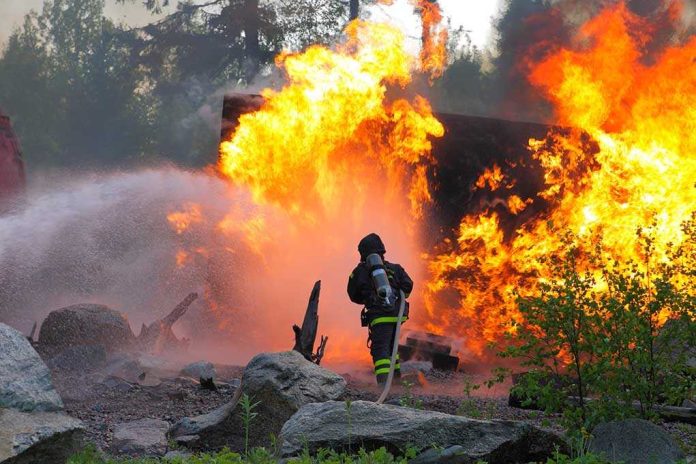
Four Georgians died and dozens fled their homes not in a Hollywood-style inferno, but in a swarm of small fires that turned a cold week into a hidden natural disaster.
Story Snapshot
- Nearly 500 wildfires and structure fires erupted across Georgia in a single dry, windy week.
- At least four people died in cold‑weather house fires linked to everyday activities like cooking and heating.
- Brush fires sparked by a passing train forced evacuations and drew in 36 fire departments.
- Older residents in manufactured homes faced the deadliest risks as resources stretched thin.
How a Cold Week Turned North Georgia Into a Fire Zone
North Georgia did not need triple‑digit heat to burn; it only needed wind, dry air, and human habit colliding at the wrong moment. In late February and early March 2025, foresters tallied nearly 500 wildfires statewide in roughly a week, many clustered in the mountains and foothills. Gusty winds and low humidity whipped leaf litter and pine needles into ready tinder, while residents used stoves, space heaters, and makeshift heat sources to push back the cold.
Crews chased not one iconic megafire but hundreds of brush, woods, and structure fires that lit up the dispatch boards. The Georgia Forestry Commission scrambled bulldozers and rangers while county departments tried to cover overlapping calls. This was the kind of outbreak that does not trend on national news because no single plume dominates the skyline, yet for the people in its path, it felt like the whole region had quietly caught fire.
The Human Toll Behind the Fire Statistics
Statistics sound sterile until you put a name and an age beside them. In Lumpkin County, an 82‑year‑old woman died when her mobile home near Dahlonega burned, investigators citing unattended cooking as the cause. State Insurance and Safety Fire Commissioner John King called it Georgia’s 17th fire death of 2025, and it came during the same window when wildfire danger sat at “very high.” One forgotten pan on a stove became part of a statewide emergency.
Her story matches a painful pattern Georgia officials have seen for years: older adults in manufactured or older homes, relying on stoves and heaters during cold snaps, pay the highest price when something goes wrong. Elsewhere in the state that winter, a Coweta County house fire killed six people and injured five more. Different county, same season, same formula: cold weather, vulnerable housing, and limited time to escape once flames start moving.
Train Sparks, Dry Grass, and a Four‑Mile Gauntlet
Farther northwest in Walker County, the ignition source did not come from a kitchen or a heater but from a train line most people barely notice. Sparks from a passing train reportedly lit combustible material along roughly four miles of track between Rossville and areas near Chickamauga, throwing off multiple brush fires almost like a string of firecrackers. Flames moved toward homes along Chris Lane, and deputies began knocking on doors and calling for evacuations.
Thirty‑six different fire departments from north Georgia and neighboring Hamilton County, Tennessee, rolled apparatus into the fight. Engines and tankers leapfrogged down rural roads while dozer lines and staging areas tried to stay ahead of shifting wind. Officials said there were no deaths there, but the risk was not theoretical; one spark through a vent, one ember under a porch, and Walker County would have been counting fatalities too. Infrastructure that keeps commerce moving also became an ignition fuse laid across dry grass.
Why These Fires Hit Rural, Older Georgians Hardest
The people most exposed to this kind of outbreak are not theory; they are older, often lower‑income North Georgians living in manufactured homes tucked into the woods. Many rely on space heaters, wood stoves, and older wiring, with fewer working smoke alarms and slower emergency access on steep, narrow roads. When officials talk about “wildland‑urban interface,” they mean these houses perched in forested hollows where one brush fire can quickly become a structure fire.
American conservative instincts lean toward personal responsibility, and those values absolutely matter here: turning off burners, maintaining heaters, clearing leaves from around homes. At the same time, common sense says responsibility must be matched with infrastructure that does not shower sparks into dry rights‑of‑way and with state codes that do not treat a single‑wide trailer and a modern brick home as equal in real‑world fire risk. Citizens can do their part only if railroads, regulators, and local officials do theirs.
What This “Hidden Disaster” Reveals About Preparedness
Georgia has seen what drought and wind can do before; the 2016 Rough Ridge fire burned nearly 25,000 acres in the Cohutta Wilderness and forced the state to pour millions into suppression. That history should have inoculated leaders against complacency. Yet 2025’s outbreak shows a different failure mode: not one giant blaze, but a relentless swarm of smaller fires that collectively strain volunteer-heavy departments and consume budgets through overtime and equipment wear.
Policy debates often chase the spectacular—massive Western infernos, federal climate fights—while the truly fixable problems smolder closer to home. Controlled burning to take fuel off the ground, tightening standards for rail‑line vegetation and spark control, targeted grants to upgrade smoke alarms and wiring in older homes, and mutual‑aid compacts that recognize how many departments rely on volunteers are all boring until they are the only things standing between a routine cold front and another four obituaries.
Sources:
Atlanta Journal-Constitution – North Georgia wildfires grow
Atlanta Journal-Constitution – Killed, injured in north Georgia wildfires
FetchYourNews – Wildfires in North Georgia
Patch – 1 Dead In Nearly 500 Wildfires During Dry Week In GA
WLHR – Lumpkin County fire death is 17th this year
WHIO – 6 dead, 5 hurt in Georgia house fire
Wildfire Today – Georgia wildfires coverage