
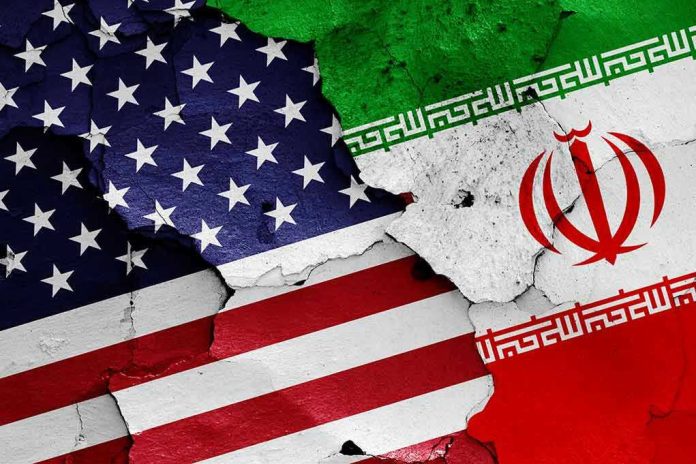
The United States and Iran are closer to a deal than they have been in years — and further away than the headlines suggest, both at the same time.
Story Snapshot
- Trump describes Iran negotiations as “proceeding nicely,” but also says the U.S. is “not satisfied yet” with the state of talks.
- A draft memorandum of understanding reportedly outlines a 60-day ceasefire framework, but no agreement has been signed.
- Iran’s Foreign Ministry stated there are “no plans for the next round of negotiations,” directly contradicting signals of momentum.
- The U.S. launched strikes inside Iran that Tehran called a ceasefire violation, even as diplomatic talks continued in parallel.
Trump’s Iran Diplomacy Is Running Two Tracks Simultaneously
President Trump told reporters and Cabinet members that negotiations with Iran are “proceeding nicely” and framed the outcome as either “a great deal for all or no deal at all.” [5] That kind of binary framing is classic Trump leverage — it signals maximum pressure while keeping the door open. What makes this moment different from prior Iran diplomacy is that military action and diplomatic outreach are happening at the same time, not in sequence. The U.S. launched what it called self-defense strikes inside Iran even as negotiators were reportedly still exchanging drafts. [5]
Iran called those strikes a ceasefire violation. The Trump administration pushed forward anyway. That tells you something important about the negotiating posture Washington is running: military pressure is not paused to create diplomatic goodwill — it is being used as a concurrent lever. Whether Tehran responds to that kind of pressure by conceding or by hardening is the central question that remains unanswered.
What the Draft Framework Actually Contains — and What It Leaves Out
Reporting from CBS News described a draft memorandum of understanding that would establish a 60-day ceasefire and create a framework for negotiating the harder issues afterward. [7] That structure should sound familiar to anyone who followed the 2015 Joint Comprehensive Plan of Action, commonly known as the Iran nuclear deal. Negotiators reached early frameworks on architecture and principles while deferring the most politically explosive items — sanctions sequencing, enrichment limits, inspection access, and proxy forces — to later phases. [3] Coverage then routinely overstated “breakthrough” because a draft framework looked like a final deal to outside observers.
The issues reportedly on the table this time include reopening the Strait of Hormuz, addressing frozen Iranian assets, and constraining Iran’s nuclear program. [6] Those three items alone represent years of entrenched disagreement. A 60-day ceasefire framework does not resolve any of them. It creates a window. Whether both sides use that window productively or use it to reposition militarily is an entirely different question.
Iran’s Public Posture Is Not Matching the Optimistic Signals
Iran’s Foreign Ministry spokesman stated plainly that there are “no plans for the next round of negotiations.” [1] That is not a minor footnote. When one party to a negotiation publicly denies that talks are even scheduled, the gap between what Washington is describing and what Tehran is acknowledging becomes a credibility problem for the optimistic narrative. Trump himself acknowledged the disconnect, saying the U.S. is “not satisfied yet” with where things stand, which directly contradicts the “proceeding nicely” framing offered just days earlier. [4]
The Iran deal is reportedly 90 percent complete according to sources close to the negotiations. The last 10 percent is wordsmithing. Iran needs language it can sell domestically as a victory.
Trump needs something he can declare as historic. Both sides are close enough to touch… pic.twitter.com/EOFwzkgpo9
— Narrative Decoded (@narrative_dc) May 28, 2026
Reports also surfaced describing Iran claiming the negotiations had reached a “strategic deadlock” over U.S. demands on nuclear enrichment. That framing from Tehran, combined with the Foreign Ministry’s denial of scheduled talks, suggests Iran may be running its own dual-track strategy — keeping the diplomatic channel technically open while signaling domestically that it has not capitulated. That is a recognizable Iranian negotiating pattern, and it has frustrated American administrations across both parties for decades. [3]
Trump’s Leverage Is Real, but the Clock Is Working Against Everyone
Trump set a 60-day deadline for Iran to reach an agreement. That deadline passed without a signed deal, and Israel subsequently launched strikes against Iran. [3] The escalation ladder is not theoretical — it has already been climbed several rungs. Trump has also reportedly warned that rejecting his deal would result in U.S. strikes on Iranian power plants. [1] That threat, combined with active military operations already underway, means the cost of diplomatic failure is not abstract. Both sides understand what a breakdown looks like in practice because they are already partially living it.
The honest read here is that real progress exists — a draft framework, active back-channel communication, and mutual acknowledgment that some movement has occurred. [4] But progress on architecture is not a deal. Iran has not confirmed the next meeting. The hardest issues are explicitly deferred. And military operations are running alongside diplomacy rather than standing down to support it. Trump’s approach is unconventional by every historical measure, and unconventional sometimes works. But “proceeding nicely” and “not satisfied yet” in the same week is not a deal — it is a negotiation in progress, with an outcome that remains genuinely uncertain.
Sources:
[1] Web – Trump’s Iran Peace Deal Gains Momentum — Here Are the Latest Updates …
[3] YouTube – Trump paints murky picture of Iran peace talks in …
[4] Web – 2025–2026 Iran–United States negotiations – Wikipedia
[5] YouTube – U.S. and Iran suggest progress on peace talks, but deal ‘not imminent’
[6] YouTube – Where do peace negotiations with Iran stand?
[7] YouTube – Where the U.S.-Iran peace deal stands as Trump says …