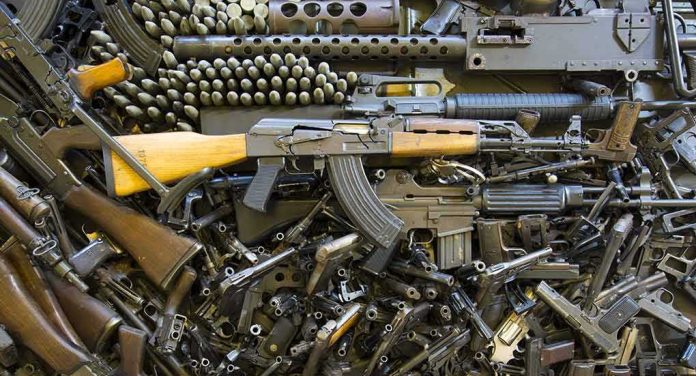
The significance of Trump’s Gaza announcement is not the slogan of “peace” itself; it is that the conflict’s hardest problem has been pushed into an explicit disarmament sequence, with weapons surrender tied to governance transfer, Israeli withdrawal, and outside verification. That is the central bargain of every serious Gaza endgame: not whether a plan can be proclaimed, but whether armed power can actually be converted into a monitored political order.
Key Points
- Trump said the Board of Peace had reached an agreement for the complete disarmament of Hamas and other armed groups in Gaza.
- The plan’s logic is phased: weapons surrender, verification by independent monitors, and only then broader withdrawal and governance transfer.
- Reporting from July described the deal as a breakthrough, but the implementation details remain contingent on sequencing and compliance.
- The underlying challenge is familiar in Gaza diplomacy: announcing demilitarization is easier than enforcing it on the ground.
What Trump Announced
Trump publicly framed the moment as a “major milestone” in his 20-point Gaza plan, saying the Board of Peace had reached an agreement for the “complete disarmament of Hamas and all other armed groups in Gaza.” ABC News reported that the Board of Peace said Hamas had “agreed to a detailed Roadmap for implementing the next phases of the Gaza ceasefire,” and that the group had committed to relinquishing its weapons. Bloomberg and Axios similarly described the announcement as a breakthrough in the administration’s effort to move Gaza from ceasefire to demilitarization and new governance.
The basic structure is important. This was not presented as a single-day handover of arms, but as a staged political-security arrangement. Under the terms described in coverage, disarmament would proceed alongside Israeli withdrawal, the installation of a new Palestinian governing structure, and the deployment of an international security presence. In other words, the agreement was framed less as an isolated military concession than as the hinge on which the next phase of the Gaza plan turns.
The Architecture of the Plan
The clearest textual description of the plan comes from the published 20-point framework itself. The BBC’s rendering of the plan says Hamas and other factions would have no governing role in Gaza, that military and offensive infrastructure would be dismantled and not rebuilt, and that demilitarization would be overseen by independent monitors through an agreed decommissioning process. That language matters because it shows the proposal is built around institutional verification, not mere political declaration.
Reuters’ earlier reporting filled in the operational design. Its March account described an eight-month staged process in which Hamas would gradually surrender arms, tunnels would be dismantled, Palestinian technocrats would assume security oversight, and Israeli troops would withdraw only after Gaza was confirmed to be free of weaponry. Axios later described a similar six-to-eight-month decommissioning period, with heavy and light weapons placed under supervision and authority transferred section by section only after demilitarization was verified. The pattern is consistent: the plan is recursive and conditional, not instantaneous.
Why Sequencing Is the Entire Story
Disarmament in Gaza is not simply a question of whether weapons exist; it is a question of who collects them, who counts them, who verifies destruction, and what happens if one side stalls. That is why the plan’s phased logic is not a footnote but the central mechanism. If Israeli withdrawal comes too early, the security vacuum can undercut enforcement. If Hamas is asked to disarm before any reciprocal political or territorial concessions materialize, the agreement becomes unsellable inside Gaza. Every serious version of the plan therefore depends on reciprocal timing and external monitoring.
This is also why the language in the reporting matters. Reuters described a proposal that would compel Hamas to disarm over time; Axios said Hamas could sign in the coming days; the BBC’s plan text describes future phases and supervised decommissioning. Those formulations point to a diplomacy of conditionality. The headline version sounds final. The underlying machinery is provisional by design.
What Gives the Announcement Weight
The announcement was not made in a vacuum. Trump has been pushing a Gaza endgame built around demilitarization and a new governing arrangement since the broader 20-point framework emerged. The BBC reported that the plan had already contemplated a technocratic committee, an international transitional body chaired by Trump, and a security architecture involving an international stabilization force. NPR’s March reporting similarly described U.S. mediators formally presenting Hamas with a disarmament proposal, showing that the July statement was the culmination of a longer negotiation track, not a sudden invention.
That longer arc is the reason the July announcement carried real diplomatic weight. It signaled that the disarmament concept had moved from abstract principle to negotiated roadmap, with Egypt, Qatar, and Turkey all described as involved in the process. In peace-process terms, that is the difference between rhetoric and architecture. Even if the road ahead remains difficult, the existence of a structured sequence, named mediators, and an explicit governance transition gives the plan more substance than a generic ceasefire statement.
🇺🇸 🇵🇸 #US President Donald #Trump announced the complete #disarmament of all armed groups in the #Gaza Strip, while Hamas confirmed Friday it had agreed to a deal. pic.twitter.com/4n8T3gAaYv
— Moses (@moses_kendi) July 31, 2026
The Open Question Is Implementation, Not Direction
The broad direction of the plan is clear: Hamas is supposed to disarm, Gaza is supposed to be demilitarized, and local governance is supposed to shift to a non-Hamas administration under outside supervision. The unresolved question is how durable that arrangement can be once it leaves the realm of announcements and enters the world of tunnels, stockpiles, rival armed groups, and broken trust. That is why the plan’s credibility will be judged less by the declaration itself than by the first verifiable acts of decommissioning, the first monitoring reports, and the first territorial handoffs.
For now, the most accurate reading is straightforward: Trump announced that Hamas would disarm as part of a larger Gaza peace framework, and the available reporting shows a detailed, phased mechanism designed to make that happen. The claim is strongest where it describes the structure of the deal; it is weakest where it implies that full compliance has already been demonstrated. In Gaza diplomacy, those are not the same thing.
Sources:
cbsnews.com, abcnews.com, bbc.com, reuters.com, theguardian.com, npr.org, cbc.ca, nypost.com