

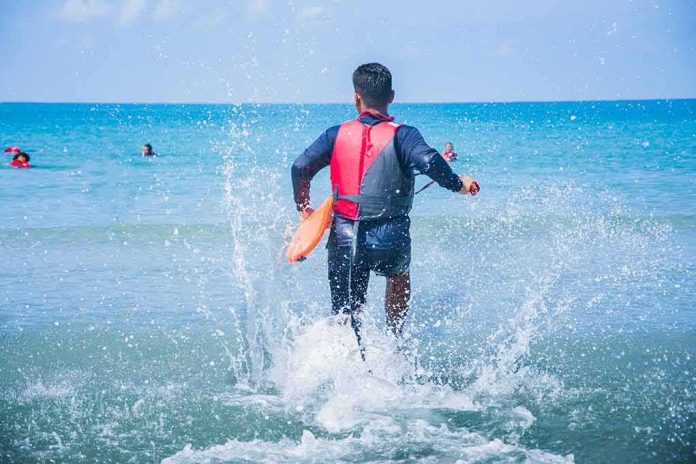
The essential fact here is not that a beach rescue went viral; it is that a 16-year-old lifeguard pulled a 10-year-old boy out of dangerous surf, and that act quickly became the kind of public heroism the White House likes to convert into ceremony. The visit is still being planned, not fully formalized, but the rescue itself is already established across multiple reports and videos.
Key Points
- A teenage California lifeguard, Ryder Williams, rescued a 10-year-old boy from heavy surf at Seabright State Beach in Santa Cruz.
- President Trump publicly said he would bring Williams and his family to the White House and give the teen a “High Civilian Honor.”
- The boy’s father and other witnesses described the rescue in emphatic terms, including as “miraculous.”
- The family says White House outreach has begun, but no visit date has been confirmed.
The Rescue That Made the Story
The center of the story is a simple but high-stakes lifeguard action: Williams saw a child in trouble, entered rough water, and helped bring him safely to shore. Contemporaneous coverage places the rescue on July 25 at Seabright State Beach and describes the boy as 10 years old and being swept by hazardous surf conditions. In interview accounts, Williams said he saw a child stumble, went in, and refused to let the boy drown; that detail matters because it captures the split-second judgment that defines rescue work rather than spectacle.
The rescue gained traction because it was visible. A bystander video circulated widely, and that visual record turned a local emergency into a national story almost immediately. That sequence is typical now: the camera comes first, the institutional record often comes later, and the public forms its judgment long before agencies finish their paperwork. In this case, the footage and the first-person accounts reinforced one another rather than competing, which is why the heroic framing held so quickly across major outlets.
Why the Family’s Response Matters
The father’s response is part of the evidentiary backbone, not a decorative flourish. Reporting quotes him expressing intense gratitude and characterizing the rescue as miraculous, which supports the conclusion that the family itself viewed Williams’s actions as life-saving and extraordinary. That matters because rescue stories are often flattened into social-media praise; a direct family account anchors the event in human consequence. This was not abstract courage. It was a child’s near-drowning interrupted in real time.
There is also an important practical detail: Williams’s family appears to be handling the aftermath conservatively, keeping the teen focused on school, water polo, and normal routines while White House outreach is sorted out. That is exactly what one would expect when a sudden wave of national attention lands on a minor. The public story becomes much larger than the family’s own agenda, and in this case the family has signaled that the visit is still provisional, not a done deal.
How Trump Turned a Rescue Into a White House Story
Trump’s role is straightforward and heavily documented. Multiple reports say he publicly praised Williams, said he would bring the teen and his family to the White House, and described the planned recognition as a “High Civilian Honor”. That language elevated the rescue from a feel-good local success into a presidential recognition event. It also introduced a familiar ambiguity: the honor was announced in broad terms, but no source in the available record names the actual award mechanism or specifies the legal or administrative path for presenting it.
That ambiguity is not trivial. The United States has formal civilian honors, each with its own procedures, yet the coverage here shows only a rhetorical commitment to recognition, not a finalized award process. In other words, the White House invitation appears real, but the ceremonial scaffolding is still unfinished. The distinction matters because political praise can be immediate and theatrical; administrative action is slower, more precise, and often much less grand than the headline suggests.
What Is Firm, and What Is Still Provisional
The firm ground is substantial. Williams rescued a boy in rough surf; the video went viral; the boy’s father and other reporters described the act as heroic; and Trump publicly said he wanted to honor the teen at the White House. The provisional part is the visit itself. The family has said the White House has reached out, but there is still no confirmed date or time. That means readers should treat the invitation as announced outreach rather than a completed event.
There are also minor reporting inconsistencies that do not change the core story but do matter to careful readers. Some outlets spell the teen’s surname differently, and the phrase “High Civilian Honor” is used without a named award attached to it. Those are evidence-quality issues, not reasons to doubt the rescue. They do, however, show how quickly a vivid story can outrun the bureaucratic details that would ordinarily make it fully documentary. Here, the narrative is clear before the paperwork is.
Why This Story Resonates Beyond One California Beach
Stories like this travel because they satisfy two public instincts at once: admiration for immediate courage and fascination with presidential validation. A lifeguard’s work is usually preventative, repetitive, and invisible until the moment it fails or succeeds dramatically. When it succeeds in public view, especially against dangerous surf, the act becomes legible to people far outside the beach community. Trump’s intervention then adds a second layer of meaning, turning local professionalism into national symbolism.
That is also why the story will likely endure even after the White House logistics settle down. The rescue itself is the durable part; the invitation is the amplifier. If the visit happens, it will formalize a narrative already written by the water, the camera, and the father’s gratitude. If it does not, the underlying fact remains unchanged: a teenage lifeguard acted fast enough, and well enough, to save a child from a dangerous ocean in front of witnesses.
Sources:
nypost.com, marca.com, theinertia.com, me.mashable.com, instagram.com, timesofindia.indiatimes.com, yahoo.com, facebook.com, abcnews.com, theguardian.com
After rescuing Nathaniel Rai from dangerous surf at Seabright State Beach in Santa Cruz, teen lifeguard Ryder Williams received praise from Governor Gavin Newsom and a planned White House invitation from President Trump. pic.twitter.com/3GWhlRmF1z
— MEAWW News (@meawwcom) August 2, 2026