

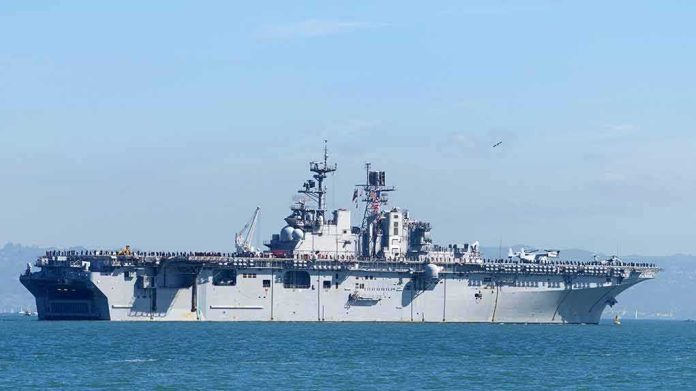
Japan’s new F-35B carriers can now launch stealth jets at sea, but the deck gets so hot from vertical landings that crews must pause operations while the steel cools down.
Story Snapshot
- Japan has turned its Izumo-class “helicopter destroyers” into true F-35B-capable aircraft carriers.
- Vertical landings from the F-35B’s powerful engine blast extreme heat onto the flight deck.
- Engineers added special heat-resistant coatings and now carefully time landings so the deck can cool.
- These limits show how hard it is to turn flashy demonstrations into tough, everyday combat readiness.
Japan’s F-35B Carriers Return Fixed-Wing Air Power
Japanese ships JS Izumo and JS Kaga mark Japan’s real return to carrier aviation for the first time since World War II. Both began life as “helicopter destroyers” but were redesigned to operate the F-35B, a short takeoff and vertical landing stealth fighter. The Japan Maritime Self-Defense Force added new deck structures, lighting systems, and flight procedures so these warships could host fixed‑wing jets at sea once again. This shift is meant to counter growing threats from China and North Korea while reducing dependence on land bases.
JS Izumo took the lead in this effort. In 2021, United States Marine Corps F-35Bs landed and took off from Izumo, the first fighters to fly from a Japanese carrier in about 75 years. That test showed the ship could physically support short takeoff and vertical landing operations. Later, the deck received additional upgrades, including new heat-resistant coatings across key landing zones. By 2024, a United States F-35B also landed on JS Kaga, confirming that Japan now has two carriers able to host the same fifth‑generation jets used by American forces.
The Heat Problem: Why Vertical Landings Threaten the Deck
Vertical landings are where the F-35B’s promise meets physics. To hover, the jet points its engine exhaust straight down onto the deck. Engineers note that normal concrete cannot survive this, and even standard ship steel can crack or warp when exposed to such intense heat over time. Earlier trials on American ships showed that exhaust from the F-35B and the tilt‑rotor Osprey could deform deck plates and damage structures below them. Without special protection, repeated landings can literally cook the ship’s surface.
Experts explain that the F-35B’s exhaust is far hotter and more powerful than older jump jets like the Harrier. When the aircraft hovers over the same spot, the deck takes a continuous blast of super‑heated gas. That heat does not just scorch paint. It can weaken steel, melt coatings, and create structural problems that are expensive to repair. Even big‑deck amphibious ships in the United States fleet had to be modified after discovering that existing materials could not safely handle regular F-35B operations. In short, the jet’s vertical landing ability comes with a hidden cost in deck stress and maintenance.
How Japan Is Reinforcing Decks and Slowing the Tempo
To handle this heat, Japan added specialized thermal coatings to Izumo’s flight deck. Reports describe heat‑resistant paint and sprayed‑on metal layers designed to survive temperatures far above what helicopters or older jets produce. These coatings often use aluminum and titanium powders applied with plasma jets, creating a hardened surface over areas where vertical landings occur. The treated zones can look different from the rest of the deck, marking where F-35Bs are allowed to hover and land. Similar upgrades have been used on British carriers like Queen Elizabeth.
Even with coatings, engineers must manage how often and how long the F-35B hovers. A United States Navy team supporting trials on JS Kaga focused on hover timing and spacing between landings so the deck could cool down enough to protect the ship’s structure. One engineer explained that if landings happen too close together, heat builds up and threatens the deck’s integrity. During testing, crews carefully scheduled vertical landings and limited hover duration to keep the steel within safe temperature limits. This means the ship cannot simply run nonstop high‑tempo vertical operations without planning.
From Showpiece Landings to Real Combat Readiness
These trials highlight a larger defense trend: proving a jet can land on a ship one time is easier than showing it can operate there every day in war. A successful demonstration makes headlines and video clips. But the true test is whether the deck, crew, and gear can handle dozens of landings, heavy weapons loads, hot summer air, and rough seas without failure. United States assessments years ago warned that F-35B thermal issues could force operating limits or costly facility upgrades if not solved. Japan’s need for special coatings and landing intervals shows those warnings were serious, not hype.
JS Kaga (DDH-184 / CVM-184) is an Izumo-class multi-role cruiser operated by the Japan Maritime Self-Defense Force. Originally commissioned in 2017 as a "helicopter destroyer," the vessel has undergone historic structural modifications to operate fixed-wing F-35B stealth fighters pic.twitter.com/I7GywkQWCx
— Boneyard Safari (@Boneyardsafari) July 24, 2026
For Americans watching from home, this story ties into a familiar worry: cutting‑edge programs look great in speeches and defense contracts, yet basic engineering problems drag on for years. Taxpayers on the right and left see huge sums spent on stealth jets, carriers, and foreign support while many feel ignored at home. In Japan’s case, engineers are working the problem and making the ships safer. But the need to pause between landings is a small reminder that even the most advanced weapons still answer to physics, budgets, and human limits, not to political talking points.
Sources:
19fortyfive.com, youtube.com, navy.mil, reddit.com, aerotime.aero, mod.go.jp, en.wikipedia.org, stripes.com, news.usni.org, cpf.navy.mil