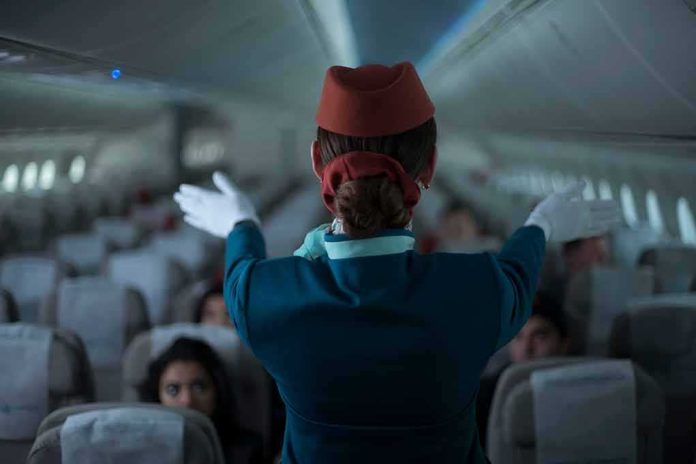
The real story here is not a sensational clash of religion and aviation; it is how a routine seating dispute on a commercial flight can escalate into a criminal assault, and how quickly that kind of incident gets turned into a culture-war headline. The evidence supports the core allegation that a passenger refused to sit next to a woman, invoked Sharia as justification, and then assaulted a flight attendant after intervention by crew and police.
Key Points
- The strongest reported facts are the arrest, the confession, and the assault charge.
- Police reporting also says the passenger cited Sharia law to resist sitting beside a woman.
- Turkish Airlines publicly denied the incident occurred on one of its flights, which complicates the flight-identification trail.
- The case sits inside a broader pattern of unruly-passenger incidents that often begin as compliance disputes and end as workplace violence.
What is firmly established, and what is still missing
On the available record, German police appear to have the essential criminal facts: the passenger was detained after landing, reportedly confessed to the assault, and was charged with assault and insulting officers. That is the backbone of the case. The more contested layer is the narrative wrapping around it. Several outlets, drawing on police statements, say the man refused to sit beside a woman and invoked Sharia law as his reason. That detail is not trivial, because it explains why the seating dispute became a statement of religious exemption rather than a simple comfort complaint.
Still, the public record is incomplete in the ways that matter most to a serious reader. No flight number, passenger manifest, witness transcript, cabin video, or medical report for the flight attendant has been published in the material provided. Turkish Airlines also denied that the incident occurred on one of its flights, which creates an unresolved discrepancy between airline messaging and police reporting. In other words, the assault allegation itself is strongly supported; the documentary chain around the exact flight identity is not yet publicly airtight.
Why the Sharia detail drives the story
The phrase “invoked Sharia law” is doing enormous narrative work. In plain legal terms, German police were saying that a passenger tried to justify a seating refusal by appealing to a religious norm that has no legal force in Germany. That distinction matters. A passenger may dislike a seat assignment for any number of personal reasons; once the reason is framed as religious exemption from an ordinary cabin rule, the dispute acquires a public meaning far beyond one aircraft aisle. It becomes a test of whether private religious claims can override the uniform rules that govern a civil aviation environment.
That is also why the case travels so easily through the media. The combination of religion, gender, and violence makes for an instantly legible headline, but headlines are not the same thing as proof. The evidence here supports the assault report and the police account of the man’s alleged justification. It does not support the larger habit of turning every such case into a referendum on an entire population, an entire religion, or an entire immigration policy. The incident is serious precisely because it is mundane: one passenger, one seat, one refusal, one confrontation, one assault.
The legal significance is narrower than the commentary around it
The criminal law questions are much narrower than the cultural arguments surrounding them. German authorities reportedly treated the matter as bodily harm and insult to officers, which is exactly how aviation disturbances tend to be processed when a passenger becomes physical. The religious language is relevant to motive and context, not to legal justification. In a secular legal system, saying “my faith forbids this seating arrangement” does not create a privilege to disrupt the flight or strike a crew member. That is the central principle police were underscoring when they said the invoked code had no standing in Germany.
The suspect’s confession, if it holds in court and is not successfully challenged on procedural grounds, gives prosecutors a straightforward evidentiary route. The unresolved issue is not whether a passenger quarrel happened; it is how precisely it unfolded, who saw what, and whether later court records preserve the same account now being repeated in the press. That is why the absence of primary documents matters. In a case built largely on police statements and secondary reporting, the difference between a settled fact and a reported fact remains important.
Why Turkish Airlines’ denial matters
Turkish Airlines’ denial does not erase the police account, but it does expose a fault line in the public narrative. If the incident occurred on a Turkish Airlines aircraft, the airline has an obvious interest in minimizing reputational damage; if it did not, then the police-linked reporting has to be reconciled with a conflicting corporate statement. Right now, the available material does not resolve that tension with the kind of primary documentation that would end the argument: a flight number, a manifest, or an official incident report. Until then, the airline’s denial remains a serious complication, but not a refutation of the assault allegation itself.
That distinction is crucial because public debate often collapses two different questions into one. Question one: did a passenger assault a flight attendant after a seating dispute? The evidence says yes, that is the operative allegation and the suspect reportedly confessed. Question two: does every detail in the surrounding media narrative line up cleanly, especially the airline identity? The answer is not yet fully established in the public materials provided. Serious analysis requires holding those questions apart.
BS BRIEF: German authorities are investigating a June 1 incident aboard a Turkish Airlines flight after a passenger allegedly refused to sit next to a woman, claiming religious grounds, before allegedly striking a female flight attendant who challenged him. According to German…
— Common Sense with Chad Law (@chadparkerlaw) July 17, 2026
What this case says about unruly-passenger behavior
This incident also belongs to a broader operational reality: airlines deal with a steady stream of passenger misconduct, and cabin crew are frontline workers expected to absorb frustration, refusal, and aggression in a confined space. The U.S. Government Accountability Office has reported that 10% of airline customer service agents experienced physical assaults in the past year, with about half reporting verbal threats. That is U.S.-specific data, but it helps explain why airlines and regulators treat onboard aggression as a serious labor and safety problem rather than a theatrical one-off. A seat dispute can become a workplace assault in seconds, and in the air there is nowhere for the crew to escape.
The deeper lesson is that the aviation environment magnifies whatever was already present on the ground: rigidity, resentment, intoxication, grievance, or ideological self-justification. Whether the passenger’s invocation of Sharia was sincere, opportunistic, or misunderstood by witnesses is a matter for evidence and court records. What is already clear is that the claim served as a trigger for a confrontation that crossed the line from refusal to violence. That makes the case less a debate about theology than a study in how authority breaks down in the cabin and how quickly a social boundary becomes a criminal one.
Sources:
humanevents.com, nypost.com, gazeta.ru, slobodna-bosna.ba, thesun.co.uk, facebook.com, ojp.gov