
Arguments over the 2020 protest wave keep missing the simplest empirical point: at the movement scale, demonstrations tied to Black Lives Matter were overwhelmingly nonviolent — and that statistical reality can coexist with real, painful episodes of unrest that dominated nightly news.
At a Glance
- Independent event data show roughly 93–94% of BLM-linked protests in 2020 were peaceful, even as a minority included violence or property damage.
- Politicians still litigate the narrative through frames — “peaceful dissent” versus “riots” — because public judgment tracks framing more than totals.
- Labeling a public official “racist” is a political charge, not an empirically testable claim; what is testable are their words, policies, and outcomes.
- Florida’s debate mirrors the national split: critics emphasize discrete nights of disorder; supporters point to the data and the constitutional legitimacy of protest.
What the data actually say about the 2020 protests
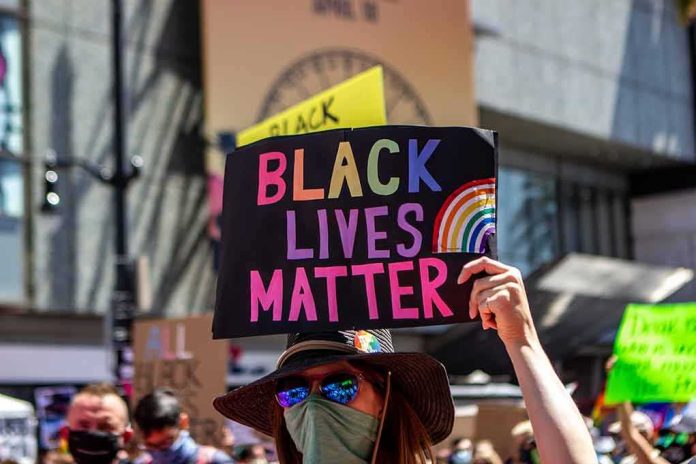
Two large, independent research streams anchor this discussion. First, the Armed Conflict Location & Event Data Project (ACLED) built the U.S. Crisis Monitor to catalog demonstration and political violence events across the country. Its analysis of the 2020 protest wave found that more than 93% of demonstrations connected to Black Lives Matter did not involve violence or destructive activity; a year-later review put that share near 94% as the dataset expanded across time and locations. Second, journalists and academics synthesized similar patterns for general audiences, underscoring that the modal event was a lawful march or vigil with no injuries, arrests, or property damage. These are not advocacy numbers; they are event-level tallies that treat each demonstration as a unit and code it by observed outcomes.
Why the disconnect, then, between data and memory? Salience. A handful of nights in Minneapolis, Kenosha, Portland, or elsewhere produced vivid images — burning precincts, smashed storefronts — that then stood in for “the protests” writ large. But scale matters. ACLED’s methodology draws from a wide source base, logs each event, and classifies tactics using a consistent coding manual, so a peaceful daytime march in a small city counts alongside a chaotic confrontation in a metro core; the national picture is the sum, not the most telegenic slice. Neither fact pattern cancels the other. A movement can be overwhelmingly peaceful and still contain serious episodes of violence.
How narratives are constructed — and why they stick
Public opinion rarely moves on spreadsheets alone. Communication research shows that newsrooms and political actors default to a limited set of “protest frames” — riot, confrontation, peaceful demonstration, debate — and those frames powerfully shape whether audiences extend legitimacy to protesters or to law enforcement responses. When coverage emphasizes the riot/confrontation frame, support for protesters drops; when it highlights the debate/peaceful frame, legitimacy and identification rise. This is not conspiracy; it is media effect. In 2020, different outlets and partisans chose different frames, often for the same cities on the same nights, and audiences absorbed the moral of whichever story they were told.
This framing contest also explains why a statistical claim like “overwhelmingly peaceful” remains controversial among people who lived near a damaged corridor. A resident’s experience of one destructive evening is real and wrenching; the researcher’s claim describes the full distribution of events across thousands of locales. Precision in language reduces pointless fights: movement-level peacefulness does not deny localized harm, and citing event shares is not an attempt to minimize victims’ losses.
Accusations of racism versus assessable evidence
Calling a specific public official “racist” is a charge with high rhetorical voltage and low empirical tractability. What we can evaluate are on-record statements, policy choices, and their foreseeable consequences. In Florida’s case, Governor Ron DeSantis has repeatedly rejected frameworks that describe the United States as systemically racist, labeling such approaches “horse manure,” and has positioned himself against critical race theory in schools and in some corporate trainings. Supporters cast this as a defense of civic cohesion and individual equality; opponents argue that dismissing systemic accounts of racism forecloses honest engagement with disparities. The judgment readers form will turn less on the epithet and more on whether they see those policies as race-neutral governance or as minimizing structural inequities. The label itself settles nothing; the record is what matters.
The same lens helps with protest governance. DeSantis touts a posture of deterrence — calling the National Guard, fortifying penalties, and insisting Florida would not replay the worst urban unrest of 2020 — while critics argue such measures chill legitimate assembly and conflate overwhelmingly peaceful protest with sporadic disorder. Reasonable citizens can disagree on the prudential balance between order maintenance and First Amendment breadth; what they cannot reasonably do is deny the movement-scale tally in favor of anecdote.
Methodology and the limits of the headline number
Any statistic that becomes a talking point deserves scrutiny. ACLED’s coding decisions are public, including what counts as a protest event, how “violence” and “destructive activity” are defined, and how multiple same-day actions are recorded. Some critics recut the same data or adjacent datasets and arrive at slightly different peacefulness shares — for example, by broadening which incidents count as violent or by emphasizing a narrower time window when unrest peaked. But the result is a shift of a few percentage points, not a reversal of the core finding: the BLM-linked protest wave was dominated by nonviolent events across thousands of jurisdictions.
Importantly, “overwhelmingly peaceful” does not mean “costless.” Insurance claims, emergency response overtime, shuttered small businesses, and the psychic toll on neighborhoods that endured the worst nights are real burdens. Democratic societies must hold two truths: mass protest is a legitimate political instrument protected by the Constitution, and the small share of events that turn destructive impose concentrated harms that deserve redress without converting the whole movement into a caricature.
Angie Nixon: “I cannot stand Ron DeSantis with a passion. I don’t like him at all and he knows it. I am so happy that his political career is done. If he tries to run for another thing, Angie Nixon is gonna be on that ass” pic.twitter.com/45r1SOeloS
— Marco Foster (@MarcoFoster_) August 23, 2026
How to think forward: evidence, prudence, and proportion
When slogans harden into talking points — “mostly peaceful” on one side, “riots” on the other — public debate collapses into mutual incomprehension. A better approach is proportion. Start with the full distribution of events: thousands of protests, the vast majority peaceful; a minority violent. Then argue policy on the merits: how to police large crowds with minimal escalation, how to protect bystanders and property without suppressing lawful dissent, how to isolate and prosecute those who do commit crimes swiftly and fairly, and how to ensure that public officials speak about race and justice in ways that neither inflame nor deny. Data won’t end disagreement, but it can bound it. And in a democracy, boundaries grounded in fact are the precondition for any argument worth having.
Sources:
twitchy.com, thegatewaypundit.com, acleddata.com, theguardian.com, npr.org, en.wikipedia.org