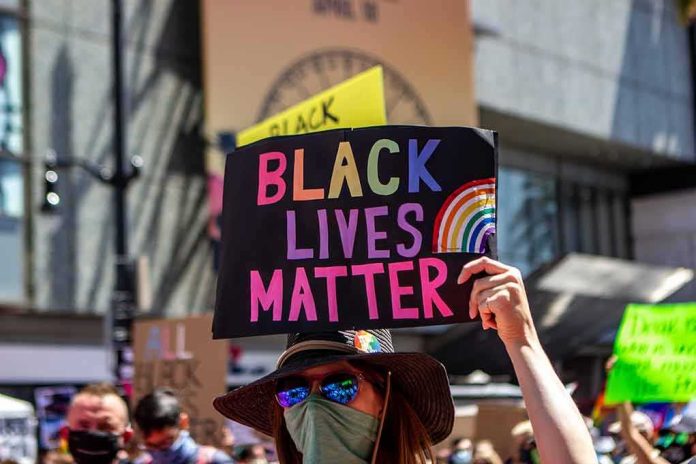
When a decentralized movement meets a virally symbolic image, platform context engines like Community Notes can end up deciding public meaning; with Black Lives Matter, a single Chicago post featuring a paraglider became a proxy fight over what the movement supposedly “stands for,” and that is the wrong level of analysis if you want truth rather than heat.
At a Glance
- BLM Chicago posted, then deleted, an October 10, 2023 image of a paraglider with “I Stand With Palestine,” widely read as echoing Hamas’s October 7 tactic; the chapter apologized afterward.
- X’s Community Notes framed the image in the October 7 context, a linkage critics amplified into a claim about BLM’s broader posture.
- BLM is structurally decentralized; chapter speech does not equal movement-wide doctrine, yet platform virality erases that distinction.
- Community Notes is designed to surface cross-partisan consensus, but research shows it struggles most on polarized content—exactly the terrain of Israel–Palestine and race.
The real question: what one chapter’s post can—and cannot—prove
The Chicago chapter’s post is not in dispute. On October 10, 2023, BLM Chicago shared a graphic of a paraglider with a Palestinian flag and the slogan “I Stand With Palestine,” then deleted it and apologized, acknowledging it had sent messages it was not proud of. The timing and iconography made the interpretive move straightforward for many readers: motorized paragliders had been used in the Hamas assault three days earlier; supportive imagery therefore looked like endorsement of the attack method. X’s Community Notes leaned into that linkage by explaining the October 7 paraglider killings, and critics turned the note into a headline-grade conclusion about “BLM” writ large. Those are concrete facts; they deserve to be stated plainly.
What those facts cannot do is carry more argumentative weight than they can realistically bear. Black Lives Matter is not a single command-and-control entity; it is a banner used by formal organizations and informal networks with varying governance and rhetoric. Even the movement’s own public-facing materials describe it as decentralized—a feature that complicates accountability but also blocks facile generalization from a chapter-level post to the movement’s total “public posture”. A single chapter’s misjudgment, later walked back, does not automatically convert into a platform for the entire movement, no matter how many times the same screenshot is embedded in commentary.
How platform “consensus” shapes what the crowd thinks it knows
Social platforms do not just transmit arguments; they manufacture context. X’s Community Notes aims to attach cross-partisan clarifications to disputed content. The system requires that notes win endorsement from contributors judged to sit on different points of an inferred ideological spectrum—a clever design for depolarizing claims where common ground exists. But the same research literature shows its Achilles’ heel: the more polarizing the topic, the poorer the system performs at timely, balanced context-setting. Publication rates are low, time-to-publication is often slow, and the algorithm tends to defer to notes that can marshal cross-faction agreement on a narrow explanatory frame, which may still fail to capture the intent or nuance of the original post.
That matters in cases like BLM Chicago’s paraglider image. A “helpful” note that ties the icon directly to Hamas’s tactic can be descriptively accurate and still function as a meaning-lock, foreclosing other readings or subsequent clarifications. The crowd’s consensus then hardens into the internet’s memory. In practice, the note’s existence becomes a rhetorical truncheon: not just “this was ill-judged,” but “here is proof of what BLM stands for.” If you want accuracy rather than catharsis, you have to separate those steps.
Decentralization, symbolism, and the durability of misreadings
Movements organized as federations or loose coalitions pay a reputational tax for local errors. BLM’s structure is a textbook example. The arrangement invites entrepreneurial speech at the edges—posts, chants, local manifestos—that can diverge markedly from the values or discipline of other chapters. The trade-off is not unique to BLM; it is common to contemporary social movements precisely because distributed energy is how they scale. But when a conflict as emotionally and historically fraught as Israel–Palestine intersects with American race politics, symbolic shortcuts—paragliders, flags, slogans—become irresistible substitutes for careful reading.
Commentary critical of BLM’s posture on Israel routinely anthologizes such artifacts. The Manhattan Institute, among others, compiled examples of BLM-linked rhetoric that it argues normalize violence by casting it as resistance or self-defense. The evidentiary value of these compilations depends on the provenance of each item (which account said what, under what charter, with what authority) and on acknowledging retractions or apologies when they happen. The Chicago post belongs in any fair record; so does its deletion and contrition. The insistence that one image tells you what a whole movement “is,” however, is a misapplication of evidence.
What Community Notes gets right—and where readers should add their own guardrails
In the aggregate, Community Notes can improve the informational diet. By design, a note that survives cross-faction voting is more likely to correct an omission than to impose a sectarian spin. Studies find that cross-ideological agreement helps, but also that only a small share of submitted notes ever make it to publication and that the system’s utility degrades on precisely the topics that dominate political attention—war, identity, partisan conflict. Readers should therefore treat a “helpful” note as a prompt to examine the claim, not as the last word on intent, scope, or representativeness. On decentralized movements, add two questions before drawing conclusions: who is the speaker, and what authority do they hold within the movement’s governance?
Applied here, those questions push us toward a narrower, truer statement. What is established: a BLM Chicago post used paraglider imagery shortly after October 7; it drew widespread condemnation; X attached a contextualizing note; the chapter deleted and apologized. What is not established: that the image, the note, or even a pattern of chapter-level rhetoric resolves the question of what “BLM’s public posture” is across the network. In a brand as sprawling and contested as BLM, posture is plural and often in conflict with itself—a fact many critics and defenders both elide because it makes for worse cable segments and slower virality.
Standards for judging intent, endorsement, and organizational responsibility
Reasonable people can disagree about whether using that image, at that moment, crossed a red line from solidarity with Palestinians into the celebration—or at least the trivialization—of terror tactics. My judgment: the post was reckless; symbolism at that proximity to atrocity invites—and practically guarantees—an interpretation the poster cannot control. The subsequent apology is not exculpation, but it does undercut the claim of proud endorsement. Organizationally, if a movement wants to avoid reputational cascade effects from local nodes, it needs and enforces guardrails: content standards, rapid correction procedures, transparent accountability. Movements that eschew central discipline pay the predictable price of being defined by their least careful communicators.
Critics, too, owe the public precision. If the charge is that “BLM” as a movement endorses terror, the burden is to demonstrate consistent, formal, organization-level advocacy—not isolated chapter posts later withdrawn. If the charge is narrower—that some chapters or affiliated voices have used rhetoric that collapses moral distinctions or romanticizes violence—there is documentary support for that claim, and it can be argued without inflation. Precision is not a courtesy; it is how we keep hard conversations tethered to evidence rather than outrage cycles.
Rashida Tlaib Gets Nailed for BLM Whopper by Reality and Community Notes https://t.co/nfGg7iH5YF
— peterverbeeck (@pverbeeck2) August 17, 2026
How to read the next viral fragment
This will not be the last time a single post is used to stand in for a movement’s soul. The repertoire is familiar: a charged symbol, a polarized issue, a context note with a veneer of neutrality, and a cottage industry of screenshots. The antidote is posture-aware reading. Ask whether the speech is central or peripheral to the movement’s governance; check whether it was later deleted or clarified; treat platform notes as scaffolding, not scripture. Above all, beware arguments that lean on a fragment to tell you everything about a phenomenon whose nature is multiplicity. Decentralization is messy. That messiness is not a bug in 21st-century movements; it is the cost of scale—and of truth.
Sources:
redstate.com, pjmedia.com, legalinsurrection.com, manhattan.institute, apnews.com, factcheck.org, metrotimes.com