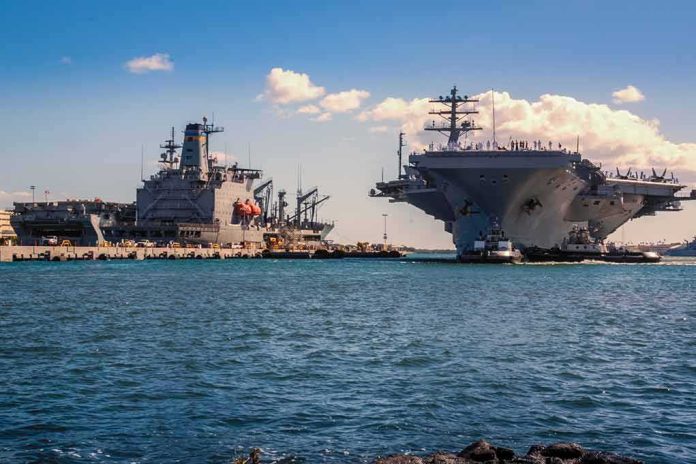
The most important fact here is not a rhetorical question about whether the United States can still “protect Israel”; it is that a senior U.S. commander has reportedly told the Pentagon that the Navy’s current destroyer inventory is too thin to sustain that mission at the present tempo while also preserving other commitments, including homeland defense.
Key Points
- A senior commander in Europe privately warned that available naval forces are not sufficient for the current mission load.
- The bottleneck is not a vague shortage of “power,” but a shortage of destroyers and the missile-defense capacity they carry.
- This warning fits a pattern that has repeated through recent Middle East crises: the same ships are asked to defend Israel, protect U.S. forces, and cover other theaters at once.
- The Pentagon’s public posture has remained that U.S. forces are ready to defend Israel and U.S. assets, even as reporting points to operational strain.
Why the Warning Matters
In practical military terms, this is a force-management problem, not a slogan problem. Ballistic-missile defense at sea depends on a limited set of Aegis destroyers, their radars, and their interceptors; when those ships are tied up in one region, they are unavailable elsewhere, and when their magazines are drawn down, coverage becomes a matter of triage rather than reassurance. That is why the reported warning is consequential: it suggests the United States may be reaching the point where every added defensive commitment in the Eastern Mediterranean or Red Sea carries an offsetting risk somewhere else.
The Washington Post reported that Gen. Alexus Grynkewich, head of U.S. European Command, privately warned Pentagon leadership that he lacked sufficient naval forces to keep defending Israel from incoming Iranian ballistic missiles. Follow-on coverage said the warning would force a choice between continuing to shield Israel and prioritizing defense of the U.S. homeland unless another destroyer was assigned. The core issue is not whether U.S. ships can intercept missiles; they demonstrably can, and have. The issue is whether the Navy can keep doing that indefinitely across multiple missions without degrading readiness elsewhere.
The Operational Constraint Is the Ship, Not the Sound Bite
Destroyers matter because they are the workhorses of layered missile defense. In the Mediterranean, they can be positioned to shoot down incoming ballistic or cruise missiles with Standard Missile interceptors, extending protection beyond what land-based systems alone can cover. That is why the reports consistently frame the shortage around destroyers rather than around abstract “forces.” Once those hulls are committed, they are tied to maintenance schedules, transit times, ammunition inventories, and competing tasking from the Red Sea, the Eastern Mediterranean, and homeland defense missions.
That constraint is not new. During earlier phases of the regional fighting, the Pentagon repeatedly moved ships and aircraft closer to Israel to deter Iran and reinforce air and missile defense, including the deployment of destroyers and carrier strike groups. The record shows a familiar pattern: an acute crisis erupts, the Navy surges assets forward, and then the theater remains on a heightened posture long after the first emergency has passed. Over time, that posture becomes expensive in readiness and munitions, especially when the same interceptors are also being burned defending shipping lanes and U.S. forces elsewhere.
Why the Shortage Has Become So Visible
The deeper story is stockpiles and endurance. Defense reporting has already shown U.S. Navy ships firing large numbers of interceptors in support of Israel, while outside analyses have argued that the pace of expenditure is unsustainable if repeated for long stretches. That matters because interceptors are not generic ammunition; they are specialized, expensive, and slow to replace. Once inventories tighten, commanders stop thinking only about what the enemy can launch and start thinking about what they can afford to fire.
That is the logic behind Grynkewich’s reported warning. It is not a claim that the United States has abandoned Israel, nor that the Pentagon is helpless. It is a statement about opportunity cost: if enough destroyers are already committed, and if other missions continue to compete for the same ships, then protecting one partner more aggressively can weaken protection for another U.S. priority. That is precisely the sort of judgment military planners are paid to surface early, before a crisis turns into a forced failure.
The Pentagon’s Public Line and the Real Meaning of “Postured”
The Pentagon’s public stance has been steady: U.S. forces are “postured” to support Israel’s defense while protecting U.S. troops and assets in the region. That language is technically accurate, but it is deliberately broad. To be postured is to be positioned, not to be limitless. It does not guarantee that every request can be met simultaneously, and it does not resolve the central tension of modern U.S. force posture in the Middle East: one set of ships is being used to cover several overlapping missions at once.
That tension has only sharpened as Washington’s broader strategy has evolved. The 2026 National Defense Strategy emphasizes defending the U.S. homeland, deterring China in the Indo-Pacific, and increasing burden-sharing with allies and partners. Read against that backdrop, the reported warning from Europe is revealing. It suggests that the Navy is already running into the arithmetic problem that planners dread: the fleet is being asked to do too much in too many places, and missile-defense ships cannot be conjured out of thin air.
Gen. Alexus Grynkewich, head of U.S. European Command, privately warned senior Pentagon officials this week that he lacks enough naval forces—specifically Navy destroyers used for ballistic missile defense—to continue protecting Israel from Iranian attacks.
— Michael 🇺🇸 Hoss (@Michael0Hoss) August 2, 2026
What This Means for Israel, the U.S. Navy, and Regional Deterrence
For Israel, the implication is not that U.S. support disappears; it is that support becomes more contingent on fleet availability, maintenance cycles, and the pace of Iranian missile salvos. Israel’s own layered air-defense architecture remains central, but the American role has become a critical supplement, especially against massed ballistic threats. For the Navy, the warning is another reminder that persistent regional defense consumes readiness even when no single battle is lost. For the wider region, it signals that deterrence now rests as much on industrial and inventory depth as on deployed combat power.
The most sober reading is also the least dramatic: this is what military strain looks like before it becomes a crisis. Senior commanders do not normally warn that they are out of options unless the margin is narrowing. Here, the margin appears to be destroyers, interceptors, and the ability to keep one defensive umbrella over several overlapping wars. That is not a collapse. It is a warning that the current posture is finite, and that every extra mission in the Middle East now carries a visible cost.
Sources:
feedpress.me, washingtonpost.com, facebook.com, war.gov, youtube.com, iranintl.com, nytimes.com, livemint.com, politico.com, x.com, yahoo.com, defensenews.com, responsiblestatecraft.org, aipac.org