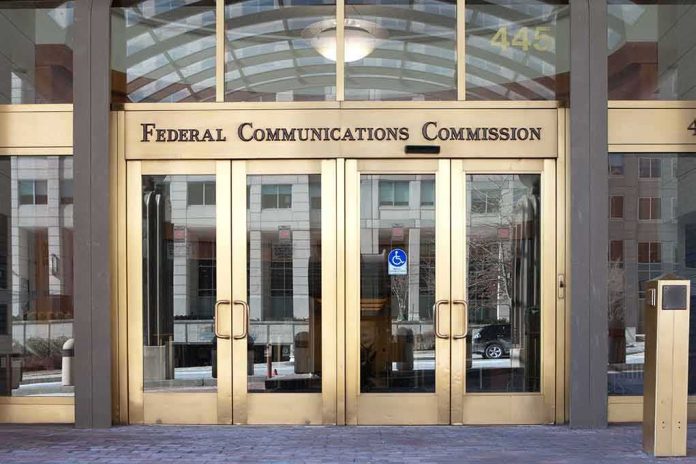
The United States is moving to re-anchor the integrity of its device-approval pipeline at the point of testing, not only by excluding labs linked to foreign adversaries but by conditioning foreign participation on reciprocity—if a country won’t recognize U.S. labs, its labs won’t test for the U.S. market.
The Short Version
- The FCC already barred labs and certification bodies owned, controlled, or directed by national-security threats from the U.S. equipment-authorization process.
- A follow-on proposal ties recognition to market reciprocity, which would exclude Chinese labs because China does not grant equivalent standing to U.S. labs.
- China-based facilities have handled the bulk of FCC certification applications in recent years, creating material transition risk if work shifts elsewhere.
- The legal mechanism sits inside the FCC’s existing accreditation and recognition framework for test labs and certification bodies.
What the FCC is changing—and why it matters
Two policy moves define the FCC’s current posture on test labs. First, the Commission adopted rules excluding “bad labs”—testing laboratories, telecommunications certification bodies (TCBs), and accreditation bodies owned, controlled, or directed by prohibited national-security threats—from the equipment-authorization system. That is an entity-level filter aimed at ownership, direction, and control risk. Second, the Commission advanced a complementary proposal to stop recognizing labs and related bodies in countries that do not accord U.S. labs reciprocal standing—an explicit market-access condition that, as reported, would exclude Chinese labs because China does not grant U.S. labs equivalent recognition.
The rationale is straightforward: when laboratories that produce compliance evidence for U.S.-bound products sit inside jurisdictions or corporate structures susceptible to foreign-adversary leverage, the integrity of the certification pipeline becomes a national-security vector. The FCC says that adversary-controlled infrastructure can “do the bidding of a foreign adversary,” undermining trust in test results that regulators and the marketplace depend on. While the adopted ban targets prohibited-entity control directly, the reciprocity proposal adds a structural lever: countries that wall off their own testing market should not enjoy privileged access to testing for the U.S. market.
How the equipment-authorization system works
Every radiofrequency device that requires certification—phones, Wi‑Fi routers, IoT sensors, vehicle telematics—enters the FCC’s equipment-authorization workflow. Manufacturers submit products to testing laboratories accredited to ISO/IEC 17025 and recognized through the FCC’s process; recognized TCBs can then issue certifications based on those accredited test reports. The Commission has long used mutual recognition agreements (MRAs) with partner economies to accept test results and approvals from foreign conformity-assessment bodies without lowering technical standards, cutting time to market while preserving regulatory control.
That architecture gives the FCC levers at multiple layers: recognition of accrediting bodies, recognition of testing laboratories, and recognition/oversight of TCBs. The 2025 “bad labs” order uses those levers to excise entities tied to national-security threats from any of the layers; the later proposal uses them to restrict recognition in countries that deny reciprocal access to U.S. labs. The point is not to rewrite radio rules, but to tighten who is entrusted to generate the data and approvals under those rules.
Testing concentration in China—and the operational stakes
The scale of work currently performed in China makes the proposal consequential for global electronics. According to reporting on internal FCC Office of Engineering and Technology tallies, China-based laboratories handled 38,491 of 46,402 FCC equipment-certification applications in 2025—roughly 83 percent. Separate coverage has framed the share at “about 75 percent” of U.S. electronics tested in China; either way, the center of gravity is unmistakable.
Moving that volume is not a switch-flip. The transition requires capacity in recognized labs elsewhere—U.S. facilities and labs in economies with MRAs or equivalent arrangements (Japan, EFTA members, and others)—plus trained engineers, calibrated chambers, and queue management to absorb surges without elongating product launch timelines. The Commission itself, in Federal Register notices accompanying its rulemaking sequence, acknowledges that earlier de-recognition actions reduced available supply and highlighted the systemic risk of relying on foreign labs. Those realities do not undercut the security rationale; they define the execution challenge.
Security logic: entity-level bans and the reciprocity lever
The adopted “bad labs” rule rests on a clear principle: the trust model fails when adversary-controlled entities sit inside the compliance stack. The order makes plain that ownership, direction, or control by identified national-security threats is disqualifying for test labs, TCBs, and accrediting bodies. That is the fine-grained safeguard—case-by-case, vettable through ownership and control analysis, and enforceable across the recognition chain.
The reciprocity proposal addresses a different, structural problem: asymmetric access that leaves U.S. firms shut out abroad while foreign labs compete for U.S.-bound testing. By conditioning recognition on reciprocal treatment, the FCC converts market access into leverage, a tool familiar from trade policy but now applied to conformity assessment. Reporting indicates China does not give U.S. labs equivalent recognition, which would, under the proposal, disqualify Chinese labs from testing for U.S. certifications. The mechanism is simple to administer because it rides on public agreements, not opaque ownership webs; it also aligns incentives for partner economies to formalize MRAs or equivalent paths.
What shifts for manufacturers and labs
For manufacturers, planning moves from optional to mandatory. Engineering teams will need to assign projects to U.S. or reciprocal-jurisdiction labs earlier, book chamber time further in advance, and budget for possible price deltas as demand rebalances. Firms that built cost models around China-centric testing will need to update assumptions on throughput, retest rates, and certification calendars. The companies least disrupted will be those already diversified across multiple recognized labs and TCBs.
For laboratories, the proposal redistributes opportunity. U.S. labs gain volume and urgency to expand staff and capacity; labs in MRA economies are poised to take overflow if they can demonstrate speed and quality at scale. Accrediting bodies and TCBs will play an outsized role verifying that growth does not erode rigor. The FCC’s existing recognition rules under 47 CFR Part 2 and program guidance remain the gatekeepers for competence and scope alignment.
How to read the numbers—and what not to expect
Different denominators can yield different share figures—applications, devices, dollar value—but all credible accounts converge on the same strategic fact: U.S.-market device testing has been heavily concentrated in China. The operational implication is clear enough without resolving every statistical wrinkle: migration at this scale will require lead time, capital, and coordination across labs and TCBs to avoid certification bottlenecks.
Do not mistake that transition cost for mission drift. The Commission has articulated a security rationale grounded in control risk and a market-access rule grounded in reciprocity, each squarely within its programmatic authority over recognition and accreditation. The aim is not technical decoupling for its own sake but restoring trust in the gate through which every certified device must pass.
The Epoch Times reports the FCC will vote Oct. 29 on restrictions that limit U.S. device testing to U.S. or reciprocal-country labs.
Chinese labs handled 83% of the FCC’s 2025 certification applications; if adopted, the rule starts Dec. 1, 2028
— StockStorm (@StockStormX) October 10, 2026
What to watch next
Implementation will hinge on three timelines. First, the internal cadence of FCC recognition updates—when accreditation bodies, labs, and TCBs are re-listed or de-listed under the adopted and proposed criteria. Second, capacity expansion milestones at U.S. and reciprocal-jurisdiction labs, visible through hiring, facility additions, and published lead times. Third, the maturation of additional MRAs or equivalent arrangements; every new agreement broadens the map of eligible labs and reduces systemic concentration risk. Each of these is measurable, and together they will determine whether the policy delivers its security objective without unnecessary friction for manufacturers.
Sources:
zerohedge.com, reuters.com, theepochtimes.com, globaltimes.cn, docs.fcc.gov, ground.news, fcc.gov