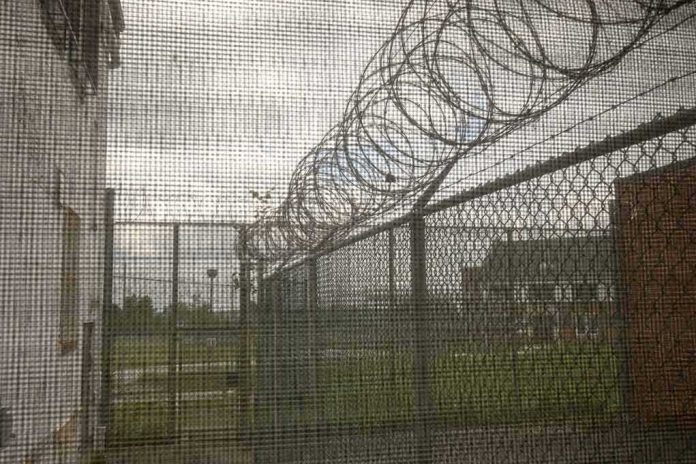
When a modern state seriously explores surrounding Palestinian prisons with crocodile-filled moats, it is not just flirting with the grotesque; it is exposing, in stark relief, how far punitive security thinking can drift from evidence, ethics, and basic institutional restraint.
Key Points
- Israel’s national security establishment has advanced, not merely joked about, a plan to use crocodile-filled moats as a deterrent around prisons holding Palestinian detainees.
- A key legal barrier was removed when Environmental Protection Minister Idit Silman reclassified Nile crocodiles as “managed” or “tended” wild animals, enabling their use outside zoos.
- The Israel Prison Service has conducted feasibility visits to a crocodile farm at Hamat Gader and is studying costs and logistics, even as it withholds clear implementation details.
- Israel’s Nature and Parks Authority, ministry legal advisers, environmental groups, and human rights advocates have issued unusually blunt objections, calling the plan unjustified, risky, and a form of psychological intimidation.
- The proposal sits within a larger, rare but troubling pattern: using predatory animals and animal attack threats as instruments of custody and control, a practice human rights bodies have repeatedly condemned.
From Provocative Idea to Live Policy Option
Itamar Ben-Gvir’s crocodile-moat concept did not emerge as an offhand remark at a press conference; it entered Israel’s security bureaucracy through formal channels and has been methodically advanced. Israel’s far-right National Security Minister first laid out the idea in a meeting with Israel Prison Service (IPS) chief Kobi Yaakobi, proposing a high-security facility for Palestinian security prisoners surrounded by crocodile-filled waterways as a means to prevent escape attempts and reduce staffing costs. Hebrew media describe this as part of a broader push to harden prisons holding roughly 10,000 Palestinians, including detainees from the war in Gaza, by leaning into dramatic deterrence rather than incremental reform.
What might once have sounded like dark satire was quickly treated as a policy project. Reports from Channel 13 and Channel 7, echoed by the Jerusalem Post and regional outlets, indicate that the IPS began examining feasibility shortly after the proposal surfaced. Senior prison officers visited the Hamat Gader crocodile farm in northern Israel, which houses around 250 crocodiles, to receive briefings on crocodile behavior, handling protocols, and associated risks, and to explore the practicalities of acquiring approximately sixty animals for a single high-security site. The initiative is being prepared “in advance of any formal decision,” which is bureaucratic shorthand for building a turnkey option that can be activated once the political and legal pieces line up.
The plan has been linked to two potential locations. One is a new facility near Hamat Gader itself, close to the Jordanian border and adjacent to the existing crocodile park, which would simplify transport and care arrangements. Another, reported by several outlets, is Ketziot Prison in the Negev—a large, maximum-security facility that already holds significant numbers of Palestinian security inmates and has long been a focal point of abuse allegations. The IPS, notably, has declined to confirm either site or any timetable, a silence that functions less as reassurance than as evidence of how far the concept has entered serious planning while avoiding public accountability.
Reclassifying Crocodiles: Law Bent to Fit the Scheme
For many months, the main obstacle to Ben-Gvir’s project was not human rights law or prison regulations but wildlife protection statutes. Under existing Israeli law, Nile crocodiles were classified as protected wild animals that could be held only in licensed zoos or wildlife sanctuaries, and then primarily for educational or research purposes. The Israel Nature and Parks Authority (INPA), which oversees wildlife, used that framework to argue that deploying crocodiles as living prison barriers was illegal and professionally unjustified.
In mid-July, Environmental Protection Minister Idit Silman moved that obstacle aside. She signed an order reclassifying crocodiles as “managed” or “tended” wild animals, a bespoke category that allows state bodies, including the IPS, to keep crocodiles in their facilities under specified conditions. Silman’s decision was made despite explicit opposition from her ministry’s own legal adviser and INPA’s attorneys, who had warned that there was “no sufficient professional basis” for the change and that it risked violating wildlife protection legislation. In practical terms, the decree gives her office the power to authorize crocodiles at detention sites, subject to conditions set by the INPA director—conditions that critics fear will be more theoretical than enforced.
This maneuver is more than a technicality. It is an example of regulatory tailoring: reshaping wildlife categories to accommodate a single controversial security initiative. The legal reclassification does not rest on new ecological data or conservation imperatives; it is driven almost entirely by security politics. That is why seasoned observers, including mainstream Israeli media, have described the move as legally questionable and politically motivated.
Security Claims: Deterrence and Cost Savings, Without Evidence
The case for crocodile moats has been framed around two core claims: enhanced deterrence and reduced costs. According to Channel 7 reporting echoed by regional outlets, officials close to Ben-Gvir argue that crocodile-filled moats will strengthen prison security by creating an instinctive, visceral barrier that makes escape attempts unthinkable. Those same sources suggest that such moats could save “millions of shekels annually” by reducing the need for human guards on external perimeters, noting that a small crocodile costs around $8,000 and a large one up to $20,000.
These numbers are presented as though they constitute a form of cost-benefit analysis, but they are, at best, partial. They do not include the capital costs of constructing secure aquatic enclosures around prisons; the ongoing expense of specialized veterinary care, feeding, and environmental control; or the liability exposure if crocodiles escape or cause harm beyond the intended deterrent effect. Nor is there any empirical evidence offered to support the assertion that predators in a moat meaningfully reduce successful escape attempts compared with modern perimeter technologies—fencing, sensors, cameras, and trained staff.
This evidentiary gap matters. Israel’s own environmental ministry legal adviser, Neta Drori, has stated there is “inadequate professional and factual evidence to support the plans,” underscoring that no modern precedent exists for using crocodiles in the way Ben-Gvir proposes. INPA legal advisers echo that language, arguing that the project “lacks professional justification” and rests on speculative assumptions about deterrence rather than studied security design. In other words, the crocodile moat functions more as a theatrical expression of punitive intent than as a policy grounded in comparative data.
Institutional and Ethical Pushback: Wildlife and Human Rights
If the proposal’s security case is thin, the ethical and legal opposition is unusually dense. INPA has taken the rare step of publicly and formally opposing a ministerial initiative, warning that introducing crocodiles into carceral settings would create “significant risks” to both the animals and public safety. Their concern extends beyond escape scenarios; it encompasses the stress and welfare implications of keeping large predators in artificially constrained, hyper-surveilled environments designed around human punishment rather than animal care.
Environmental organizations have issued joint statements “strongly objecting to the use of animals as a means of guarding and deterrence,” arguing that conscripting wildlife into human coercive systems violates basic conservation ethics and risks normalizing animal cruelty as an instrument of state power. Their argument dovetails with a growing international critique of using attack-trained dogs in prisons—practices that Human Rights Watch and the Equal Justice Initiative have documented as cruel, degrading, and incompatible with modern standards of humane custody. In this broader frame, crocodiles are simply a more visible, more shocking variant of a familiar pattern: weaponizing animals to enhance fear.
Human rights advocates have been equally blunt. Outlets like The New Arab report rights groups describing the crocodile moat concept as a form of “psychological intimidation” aimed specifically at Palestinian detainees. The symbolism is impossible to ignore: surrounding a population already subject to prolonged detention, limited due process, and documented abuse with literal man-eating predators transforms the prison from a site of lawful containment into a spectacle of domination. That symbolism resonates with international audiences, particularly in light of parallel controversies around Florida’s “Alligator Alcatraz” immigration facility, where detainees have been effectively disappeared within opaque state-run systems.[Democracy Now video summary]
Why Predatory-Animal Deterrence Is So Rare
One way to understand the crocodile-moat proposal is to ask why such ideas are almost absent from mainstream prison practice. States routinely invest in high fences, razor wire, electronic surveillance, and armed guards. They almost never institutionalize predatory animals as perimeter tools. The reasons are straightforward. First, containment: predators are unpredictable, and ensuring they never harm unintended targets is far more complex than constraining human staff operating under clear rules of engagement. Second, liability and optics: any incident involving an animal mauling a detainee—or a member of the public—would trigger legal and political backlash far beyond what accompanies more conventional force.
Third, and most important, is the evolving normative framework around detention. Since the mid-20th century, democratic systems have formally committed—if often imperfectly—to standards that distinguish punishment from torture and recognize the inherent dignity of incarcerated people. Human rights law, as interpreted by bodies from the European Court of Human Rights to UN treaty organs, treats deliberate infliction of terror, especially via animals, as degrading treatment. That is why investigations into U.S. use of attack dogs in prisons have condemned the practice as incompatible with basic human rights norms. Crocodile moats, in this light, are not innovative security devices; they are anachronistic throwbacks to medieval imagination.
Politics, Symbolism, and the Palestinian Carceral Landscape
None of this can be separated from the political identity of the proposal’s chief sponsor. Ben-Gvir, leader of the Jewish Power party, is widely described as a far-right extremist whose career has centered on maximalist punitive measures against Palestinians. In that context, the crocodile moat is not just a technical scheme; it is a political message, signaling to his base that he is willing to push the boundaries of cruelty in the name of security. That message lands in a prison system already under scrutiny for deaths in custody, overcrowding, and alleged torture of Palestinian detainees, particularly since the war in Gaza.
The environmental ministry’s reclassification of crocodiles, over expert objection, is part of the same symbolic terrain. It illustrates how regulatory instruments can be bent to accommodate highly ideological agendas, subordinating professional standards to the imperatives of a particular minister’s political theater. The unusual coalition of opposition—from wildlife authorities to human rights groups—suggests that this bending has not gone unnoticed within Israel’s own institutional ecosystem.
What This Signals About the Future of Detention Policy
Whether crocodile moats ever physically surround Ketziot or a new Hamat Gader prison, the fact that such a plan has advanced through serious legal and bureaucratic stages is itself a data point about the direction of detention policy. It shows how easily the language of “deterrence” and “cost savings” can be mobilized to rationalize measures that would have been unthinkable a generation ago, especially when targeted at politically marginalized populations.
It also underscores the importance of institutional counterweights. INPA’s resistance, the ministry legal adviser’s explicit warning about inadequate evidence, and the public stance of environmental and rights groups have, at least for now, prevented the plan from sliding quietly into implementation. Their opposition has reframed the proposal not as creative security design but as a convergence of animal cruelty, psychological warfare, and regulatory overreach.
For observers of prison policy, the crocodile moat episode is a case study in how extreme ideas surface, gain bureaucratic traction, and are either normalized or checked. In Israel’s case, the machinery of advancement—ministerial decrees, feasibility visits, budgetary estimates—is already in motion. Whether institutional and public resistance can arrest that motion will help determine not only the fate of one grotesque project, but the broader boundary between security policy and state-sanctioned intimidation in the years ahead.
Israel reclassifies crocodiles as "domestic" to allow Ben‑Gvir's prison moat plan
"Crocodile Prison" or "Alligator Alcatraz" plan would place moats full of predators around Palestinian prisons, starting with Ketziot in southern Israel.
This is just outright barbaric and insane. pic.twitter.com/Kj1V8WV6Lr
— Chay Bowes (@BowesChay) July 17, 2026
Where the Real Debate Should Focus
The most consequential questions raised by the crocodile-moat plan are not zoological or even strictly legal; they are moral and structural. Should a democracy allow its security ministers to experiment with psychologically terrorizing detainees so long as the mechanisms can be dressed up as “deterrence”? What evidence should be required before such measures are seriously considered, and which institutions are empowered to say no?
In the Israeli case, the available evidence tilts decisively toward the critics. There is no empirical support for crocodile moats as effective or efficient security tools; there is clear, named, institutional opposition on professional, ethical, and legal grounds from the very bodies tasked with wildlife protection and legal oversight. The plan’s momentum rests less on data than on the political appetite of a particular minister and the broader climate of securitized governance over Palestinians.
That is why this story matters beyond its shocking headline. It forces a reckoning with the underlying logic that makes such a proposal thinkable. Crocodile moats are, in the end, a vivid symptom of a deeper pathology: the normalization of fear, spectacle, and dehumanization as instruments of prison policy. Confronting that pathology requires more than ridiculing the idea; it demands a sustained insistence on evidence-based security, robust institutional checks, and a refusal to treat incarcerated people—whomever they are—as props in anyone’s punitive theater.
Sources:
zerohedge.com, wset.com, turkiyetoday.com, youtube.com, echr-cpt.com, en.yenisafak.com, iol.co.za, aa.com.tr