

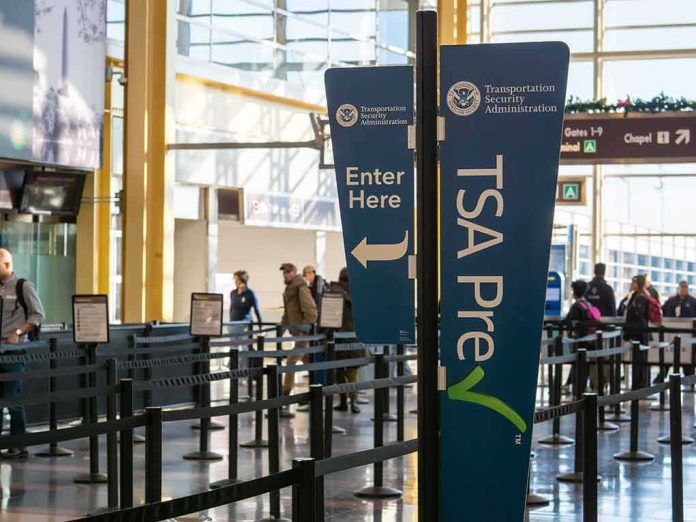
Federal airport security is now helping immigration agents track and arrest travelers inside terminals, turning ordinary domestic flights into a new front line in America’s deportation fight.
Story Snapshot
- TSA and ICE signed a data-sharing deal that lets immigration agents use airport screening information to find and arrest visa violators.
- ICE and DHS say the arrests target people with expired visas or deportation orders, but some detainees had pending cases and work permits.
- Reports show hundreds of arrests tied to TSA tips, raising fears of mission creep and government overreach from both left and right.
- Critics warn that using travel data for routine immigration enforcement erodes privacy and trust in basic security systems.
What Changed Inside America’s Airports
In May 2025, the Transportation Security Administration and Immigration and Customs Enforcement signed a formal agreement to boost information sharing on noncitizen travelers. The agreement, released by watchdog group American Oversight, says TSA can pass “agreed-upon data” to ICE to support national security, law enforcement, and immigration and border management. That dry language has real impact. It means information collected to keep flights safe is now also used to help immigration agents find and arrest people.
Federal documents and news reports show that TSA now sends passenger lists, including names and sometimes photos, to ICE several times a week. ICE cross-checks those lists against its databases to spot people with deportation orders, expired visas, or other immigration violations. When a match appears, agents can be waiting at the airport gate, jetway, or baggage claim. The result is visible arrests of travelers who often thought domestic travel inside the United States was low risk.
How TSA Tips Turn Into ICE Arrests
The New York Times reported that Homeland Security officials describe a simple process: ICE first sends TSA a list of people with deportation orders or other targets. TSA then checks those names against passenger records to see if any are flying that day. When there is a match, TSA alerts ICE officers, who can move into position at that airport to make an arrest before boarding or at the gate. Because both agencies sit inside the Department of Homeland Security, officials say this information sharing is easy and fast.
New reporting shows this collaboration has grown beyond people with final deportation orders. TSA sources told CBS News that agents are now tipping ICE about travelers suspected of civil immigration violations, like overstaying visas, even when they have no criminal record. Immigration lawyers and local news outlets have documented arrests of tech workers, spouses of American citizens, and asylum seekers whose visas expired while their cases were still pending. In one Denver case, ICE said a woman was “in the country on an expired visa,” while her attorneys argued her immigration paperwork was still in process. Those details fuel concern that people following legal steps can still be grabbed mid-journey.
How Big This Airport Enforcement Push Has Become
Internal data reviewed by Reuters showed that TSA flagged information on about 31,000 travelers for ICE from early 2025 through early 2026. Those tips led to more than 800 arrests in and around airports nationwide in that period. That number is small compared with the hundreds of thousands of overall ICE arrests under President Trump, but it is far higher than previously known. A former official said that in one region, about three out of four people flagged through this program were ultimately arrested.
Homeland Security sources have tried to calm fears, saying TSA has “always” shared leads with ICE and that this is not entirely new. The Secure Flight program, started in 2007, was built to screen passengers against terrorism watchlists. Officials now point to that program as the legal basis for sharing data with ICE. But those same documents admit Secure Flight was not originally designed to track immigration violators. That shift in use — from chasing terrorists to catching overstays — is exactly what critics mean when they warn about mission creep.
Why These Arrests Worry People Across the Political Spectrum
Attorneys and advocacy groups say the collaboration between TSA and ICE at airports is “unprecedented” and deeply worrying for people in the immigration system. They argue that when pending applications and work permits do not protect travelers from arrest, it creates a “significant change” in how safe routine travel really is. Viral videos of passengers pulled off jetways or questioned on the floor of terminals make the arrests look harsh and public, not like quiet paperwork enforcement.
ICE is reportedly expanding airport enforcement against visa overstays, according to @nytimes
Those detained reportedly include spouses of U.S. citizens, tech workers, and others with expired visas including some with pending applications to remain in the U.S.…
— M9 USA🇺🇸 (@M9USA_) July 29, 2026
For many conservatives, these airport arrests look like the government finally enforcing laws against illegal immigration and visa overstays, something they have long demanded. For many liberals, the same images show a system that targets families, students, and workers while protecting elites and big corporations. Both sides share a deeper worry: once the government repurposes basic security tools to hunt people for civil violations, there may be few clear limits. Travel screening, once sold as a safety step, starts to feel like another way the federal bureaucracy can reach into everyday life without honest debate or transparency.
Sources:
cbsnews.com, nytimes.com, cnn.com, youtube.com, x.com, facebook.com, instagram.com, abcnews.com