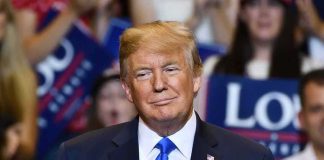


When a bank that touches half a nation’s households seizes up, accountability moves from the balance sheet to the presidency; Paraguay’s Ueno collapse did exactly that, triggering President Santiago Peña’s resignation, a unanimous impeachment in the lower house, and a constitutional reckoning over conflicts of interest and regulatory independence.
At a Glance
- Regulators intervened in Ueno, freezing access to millions of accounts and igniting mass protests and a political crisis.
- Impeachment charges against President Peña center on conflicts of interest, alleged manipulation of oversight, pension-fund exposure, and a cover-up tied to the central bank.
- Peña had ties to Ueno’s holding company and appointed a former Ueno executive to run the central bank that oversaw the lender.
- The lower house voted 78–0 to impeach; Peña resigned after losing party support and said he would present a defense in the Senate.
What happened: a bank failure that became a constitutional crisis
Paraguay’s central bank took control of Ueno, one of the country’s most consequential digital lenders, after it fell below minimum solvency standards. The intervention immediately rippled through daily life: customers found debit cards declined, savings inaccessible, and salary and pension payments stranded. The human scale of the disruption was unusual even by crisis standards; reporting described frozen access for millions of accounts in a nation of a little over six million people, prompting street demonstrations and clashes with police. As the liquidity and solvency shock metastasized into politics, President Santiago Peña announced his resignation and, minutes later, the Chamber of Deputies voted 78–0 to impeach him, sending articles of impeachment to the Senate for trial.
The impeachment charges alleged a pattern of official misconduct intertwined with Ueno’s failure: conflicts of interest, manipulation of regulatory oversight, diversion of pension funds, and participation in an institutional cover-up involving the central bank. Reuters and the Associated Press both reported that Peña had prior business links to Ueno’s holding company, which he had divested the previous year under pressure, and that he had appointed Carlos Carvallo—a former Ueno executive—to lead the central bank tasked with regulating the bank. As resolution proceedings gathered speed, the central bank chief resigned at the president’s request, highlighting the intensity of the institutional crisis.
Mechanism: how banking supervision, solvency, and political liability intersect
Ueno’s downfall, as described in contemporaneous coverage, followed a familiar technical arc: rapid growth in deposits, red flags around related-party lending, and a capital ratio falling below the regulatory floor. When a bank’s own reported capital position diverges sharply from the supervisor’s finding, the regulator’s obligation is clear—intervene to protect the system and small depositors, even at the cost of freezing access to funds while the books are stabilized or wound down. That freeze is politically radioactive because it converts abstract prudential metrics into immediate, visible harm: declined cards, interrupted payroll cycles, and delayed pensions. In Paraguay, that harm landed on an extraordinary share of households at once, shrinking the time window for careful parliamentary or judicial deliberation.
Political responsibility is not the same as proximate causation of insolvency. A president can be held to account for allowing structural vulnerabilities to persist, for installing conflicted overseers, or for tolerating regulatory capture, even if bank managers’ lending and risk decisions triggered the capital breach. In this case, the impeachment filings fused those strands: Peña’s past stake in Ueno’s holding company, his appointment of a former Ueno executive to run the central bank, and allegations of oversight manipulation and pension-fund exposure. The legislative case framed these as failures incompatible with the neutrality demanded of supervisors when a large lender wobbles.
How Paraguay got here: the revolving door and Latin America’s crisis playbook
Latin America’s banking history is punctuated by crises amplified by weak supervision, connected lending, and political interference. The International Monetary Fund and other institutions have long argued that independence and insulation from political pressure are prerequisites for credible bank oversight; when those guardrails fail, resolution decisions arrive late, losses deepen, and the fiscal and social costs multiply. Paraguay’s drama fits the pattern cleanly. The appearance of regulatory capture—embodied in the elevation of a former Ueno executive to the top of the central bank—was combustible even before Ueno’s solvency gap came into view. Once it did, every supervisory action and inaction was read through that lens, and party support for the presidency unraveled.
Impeachment, too, has an established regional lineage as a tool for policing executive responsibility in financial scandals. From Brazil’s Collor to Paraguay’s own Lugo, legislatures have repeatedly asserted their role when financial or corruption crises cut across branches of government. What distinguishes the Paraguayan case is the simultaneity of market resolution mechanics and constitutional sanction: the lower house vote came minutes after the president’s resignation announcement, and the Senate trial machinery engaged while agencies worked to sort insured from uninsured deposits and to triage public funds at risk.
Where the institutional stakes truly lie
Strip away the headlines and the core institutional question is straightforward: can a country credibly supervise a systemically important lender when the executive’s own past financial ties and personnel appointments raise doubts about impartiality? The impeachment articles answered no, asserting conflicts and interference strong enough to justify removal. The unanimity of the lower house vote underscored the political conviction behind that answer, even as formal adjudication shifted to the Senate. The central bank chief’s resignation at the president’s request as resolution began added weight to the perception that supervisory independence had been compromised—or at minimum, that confidence in it had collapsed beyond repair.
The citizen’s stake is equally concrete. Deposit guarantee schemes protect most small savers in principle, but the process is not instantaneous, and large, uninsured balances—often belonging to businesses that make payroll—can be frozen for weeks or longer during resolution. When nearly half a nation’s adults are touched, the collective patience needed for careful, technocratic cleanup evaporates. That compression of time is when constitutions are stress-tested: legislators do not wait for forensic audits; they act on conflict, chain of command, and the appearance of capture. Paraguay’s sequence—intervention, mass access freeze, resignation, impeachment—reflects that logic.
JUST IN: Paraguay prosecutors put former President Santiago Peña under house arrest after his Senate removal tied to the Ueno Bank collapse that locked nearly 3 million people out of their accounts, AP says.https://t.co/Px2vAZLYcV
— NewsDesk Universe (@jasonchango214) November 6, 2026
What it means going forward
Three imperatives emerge. First, rebuild supervisory autonomy with bright-line recusal and appointment rules that preempt even the appearance of capture. The IMF’s comparative work is blunt: financial crises turn systemic when politics warps enforcement; independence is not ornamental, it is the spine of stability. Second, ring-fence public funds within the banking system with concentration limits and transparent mandates that resist political placement; when a pension system’s liquidity depends on a single lender’s solvency, the public-interest test has already failed. Third, force early, credible disclosure on related-party exposures and capital adequacy, so the market and deposit insurers are not the last to know. These are not novel prescriptions, but Paraguay’s experience is a vivid reminder that the cost of ignoring them is paid in constitutional as well as financial currency.
Sources:
zerohedge.com, reuters.com, internazionale.it, apnews.com, npr.org, bbc.com, efe.com