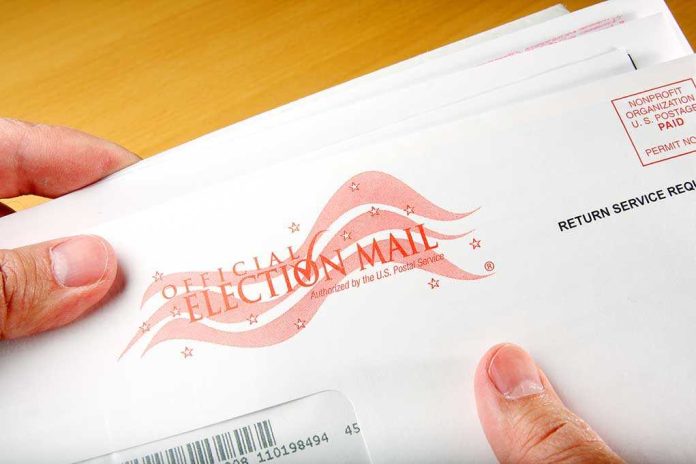
When suspicious letters carrying unknown powders arrive at election and congressional offices across multiple states, the issue is not only what the substance is; it is how a national mail-security and law-enforcement system moves to protect institutions essential to democratic continuity without inflating panic or missing a real threat.
At a Glance
- Federal authorities—the FBI and U.S. Postal Inspection Service—are jointly investigating a series of suspicious mailings to election and congressional offices nationwide.
- Postal inspectors have intercepted at least some letters, and several offices enacted hazardous-mail protocols, including evacuations and screenings.
- The scope spans multiple states and categories of targets, indicating a bona fide federal case rather than an isolated incident.
- Public disclosures so far do not identify a sender or confirm a single coordinated campaign; laboratory identifications of the substances have not been released.
What Happened: A Federal Case with Real Mail in Custody
Federal law enforcement confirmed an active investigation into suspicious letters sent to addresses nationwide, including state election offices and offices of U.S. senators. The FBI described a series of mailings that included unknown substances and said it was working with partners to identify the source and scope. The U.S. Postal Inspection Service—USPIS, the federal agency with criminal jurisdiction over the mail—separately affirmed it was leading on the postal front. This is not rumor or inference; both agencies publicly acknowledged the probe and the cross-jurisdictional nature of the response.
Crucially, inspectors report that some suspect letters were physically intercepted, placing evidence in law-enforcement custody for forensic analysis. USPIS Deputy Chief Inspector Brendan Donahue’s statement—“we have intercepted some of these letters”—underscores that this is a live evidentiary investigation, not a retrospective round-up of anecdotes.
Scope and Response: Multiple States, Standard Hazard Protocols
The targets spanned multiple jurisdictions—state election offices and congressional offices—across states such as Delaware, Oklahoma, Louisiana, Ohio, and Maryland, as well as at least five Democratic Senate offices, according to reporting drawn from agency and local-office statements. Several incidents triggered the safety playbook familiar to anyone who has worked in mailroom security since the early 2000s: isolate the item, evacuate immediate areas if warranted, call in hazmat assessment, and preserve the chain of custody for lab testing.
The Oklahoma State Election Board and Louisiana’s Secretary of State office reported white-powder letters and enacted evacuations; Ohio officials said a letter intended for the Secretary of State’s office was intercepted before delivery. These are canonical responses to potentially hazardous mail—measured, procedure-driven, and primarily designed to protect personnel while preserving evidence for a federal case.
Why Federal Jurisdiction and How the Investigation Proceeds
Two elements make this a federal matter. First, the mail system itself is federal infrastructure; crimes that misuse the U.S. Mail fall under USPIS investigative authority. Second, threatening communications to public officials implicate federal statutes and, when interwoven with interstate mailings, naturally draw FBI participation. In such cases, USPIS leads the postal forensics—envelope, stamp, indicia, and handling data—while the FBI integrates forensic chemistry, fingerprints, DNA, printer and paper analysis, and any threat-assessment or motive indicators. The collaboration is routine and codified by joint operating procedures developed over two decades of biohazard and hoax-mail cases.
From an evidentiary standpoint, investigators will work the postmark and mailstream data first—processing scans, distribution-center logs, and machine-read codes—because those can quickly narrow the origin center or even a specific time window. In parallel, laboratories will characterize the powders: field tests for immediate hazard, followed by confirmatory analysis (e.g., GC-MS for organics, FTIR or XRD for inorganics, targeted assays for biologicals). Forensic comparison across letters—envelope stock, printer artifacts known as banding or microdot patterns, adhesive composition, and trace contaminants—helps decide whether cases cluster under a single sender or represent opportunistic copycats.
What We Know and Don’t: Attribution Lags Substance Control
The confirmed facts support a serious, appropriately scaled response: multiple offices, federal leadership, and physical letters in custody. What remains undisclosed to the public is who sent the mail, whether the incidents consolidate into a single campaign, and the laboratory identities of all powders. Those gaps are unsurprising at this stage. Large multi-state mail cases typically hold attribution details until comparative forensics are complete; premature disclosure risks contaminating witness statements, inviting false confessions, or cueing a sender to change materials and methods. In one Wisconsin-linked episode reported in the broader sweep of incidents, a powder was deemed not hazardous, which illustrates a recurrent pattern in such cases: the operational risk is non-zero even when many individual items ultimately test benign.
The responsible stance is clear: treat each item as hazardous until proven otherwise; escalate only the subset of facts that warrant public action. Federal agencies have communicated precisely that balance—confirming the investigation and the presence of unknown substances without speculating on motive or coordination.
Historical Pattern: Election Work Has Become a Target Environment
These mailings fit a wider pattern in which election administrators and legislators face threats and harassment that surge around high-salience political periods. In 2023 and 2024, clusters of white-powder letters struck election offices in multiple states, sometimes disrupting office operations, occasionally testing positive for controlled substances, and frequently resolving to nonhazardous materials after lab work. That base rate teaches two things at once: operational vigilance is justified, and attribution often takes time and does not always converge on a single architect. The net effect is a recurring strain on election-administration capacity that compounds normal-cycle workloads.
For practitioners, the lesson is institutional resilience. Offices that had preplanned mail-screening protocols, PPE stockpiles, and liaison lines to local hazmat teams tended to contain disruptions to hours rather than days. The best practice set—off-site screening, positive-pressure mailrooms, documented chain-of-custody, and staff drills—turns a frightening incident into an orderly process built to fail safely.
Practical Implications: Security Without Chill
For election systems, the priority is continuity. That means layered defenses that do not depend on heroics: upstream USPS detection, downstream agency screening, and rapid forensic triage. For congressional offices, where constituent mail is a lifeline, the task is calibrating screening so that openness is preserved without making staff vulnerable. These letters test that calibration. They also underscore the value of centralized communication: a single federal point of contact for state and local offices reduces rumor and aligns responses.
One operational bright spot is interception. Ohio officials reported a suspect letter never reached the Secretary of State’s office; USPIS confirmed multiple interceptions overall. Interdiction upstream reduces exposure and accelerates the forensic work that can stitch together dispersed incidents into a prosecutable case.
What to Watch Next: The Forensics Will Decide the Story
Three outputs will define the endpoint. First, laboratory identifications—if multiple samples match or show a signature mixture, linkage strengthens. Second, mailstream forensics—postmark clusters, processing-center convergence, or surveillance near public mail drops. Third, text or physical tells in enclosures—printer artifacts, phrasing patterns, or idiosyncratic stationery that recur. If those converge, expect a clear attribution and, often, a straightforward charging document. If they do not, the incidents may resolve into a mosaic of unrelated threats and hoaxes—still criminal, still costly, but not centrally directed.
For now, the federal posture is appropriately firm: investigate, communicate sparingly but clearly, and keep election and legislative operations moving. That is what a mature security apparatus looks like—one that treats every suspicious envelope as a problem to be solved without turning the mailroom into a theater of fear.
🚨 FBI INVESTIGATES SUSPICIOUS LETTERS SENT TO ELECTION OFFICES NATIONWIDE — WHITE POWDER FOUND WEEKS BEFORE MIDTERMS
Federal investigators are examining suspicious mailings targeting election offices across multiple states, including envelopes containing unidentified…
— MDBayNews (@MDBayNews) October 15, 2026
Bottom Line
A nationwide series of suspicious letters reached—or attempted to reach—election and congressional offices. The FBI and the U.S. Postal Inspection Service are jointly on the case, with some mail intercepted and multiple offices executing standard hazardous-mail protocols. The public may not see attribution or substance IDs until the forensics are complete, but the system in place is doing exactly what it is designed to do: protect people, preserve evidence, and keep civic work on schedule.
Sources:
cbsnews.com, bbc.com, usnews.com, wusf.org, npr.org