A sitting American president standing before a cheering crowd and calling, without qualification, for leakers to be shot is not a policy proposal — it is a rhetorical event that reveals how thin the line has become between national-security seriousness and campaign-trail theater, and understanding which side of that line the country is actually on requires separating the applause from the law.
Key Points
- At an October 14, 2026 rally in Bullhead City, Arizona, President Trump said leakers “should be shot” and invoked historical precedent for executing them, drawing audience cheers.
- He tied the remark to a specific claim: that a disclosure of U.S. troop movement from Missouri delayed a strike, apparently referencing Operation Midnight Hammer against Iranian nuclear sites.
- No named suspect, charging document, or Defense Department account has surfaced to confirm the alleged leak caused any operational delay.
- The statement extended to journalists, with Trump calling reporters “almost as bad as a leaker” — a framing press-freedom advocates say risks chilling legitimate accountability reporting.
- U.S. legal history shows execution for leaking classified information to the press has essentially no precedent; only the Rosenbergs were ever put to death under the Espionage Act, for atomic espionage, not media disclosure.
What Trump Actually Said, and Where
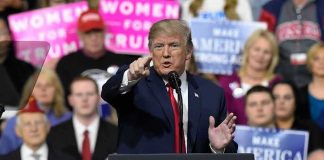
The remark came during a midterm campaign rally ostensibly built around economic messaging, in a swing-adjacent corner of Arizona. Trump departed from that script to declare, “In my opinion, leakers should be shot. They should be shot. In the old days, we used to shoot leakers,” according to multiple outlets present at the event. He went further, calling the source “sleazebag” and “scum of the earth,” and the crowd responded with visible, sustained approval. This was not a single offhand line; it was a sustained riff, delivered with the cadence of a man testing how far an audience will follow him — and in Bullhead City, they followed.
Trump grounded the outburst in a specific scenario: someone, he said, had disclosed that U.S. forces would depart Missouri at a particular time, and that leak delayed an operation by two days. Reporting identified the likely referent as Operation Midnight Hammer, the strike campaign against Iranian nuclear facilities. He framed the strike itself as defensive — aimed at denying a hostile state a weapon “that can blow up millions of people in one shot”. That framing matters, because it recasts a punitive threat against a domestic source as a matter of preventing mass-casualty risk abroad, which is precisely the kind of high-stakes justification that tends to move an audience already primed to see leaks as betrayal rather than accountability journalism.
The Gap Between the Claim and the Record
Here is where the account runs thin. No reporting identifies the alleged leaker by name, employer, security clearance, or method of disclosure. There is no indictment, no FBI affidavit, no inspector-general finding, and no Pentagon after-action report establishing that any leak caused a two-day delay in the Iran operation. Trump’s account may be entirely accurate — presidents do receive classified briefings civilians don’t — but the public record currently rests on his word alone. That is not a minor gap. A claim that a specific disclosure endangered a specific military operation is the kind of assertion that, if true, is normally substantiated through declassified summaries, congressional intelligence briefings, or court filings once a suspect is charged. None of that has materialized.
The ambiguity extends to the punishment itself. Trump alternated between saying leakers “ought to go to jail and be shot” and simply “should be shot,” without clarifying whether he meant execution after conviction, summary punishment, or pure rhetorical flourish. No administration official — not the Defense Secretary, not the Attorney General, not the White House Counsel — has since translated the rally line into a proposed statute, executive order, or military regulation. That absence is itself informative: it suggests the remark functions as mobilization rhetoric for a restive midterm base rather than the opening move of an actual policy initiative.
How This Fits American Legal History
The idea of executing people for leaking information to the press has almost no footing in American law or practice. The Espionage Act of 1917 is the statute under which leak prosecutions typically proceed, but for most of its history it was aimed at spies passing secrets to foreign governments, not sources talking to journalists. Before the Obama administration, only three people had ever been prosecuted under the Act specifically for leaking national-security information to the press; legal scholarship counts just four media-leak prosecutions total between 1958 and 2008. That number jumped sharply after 2009, reaching roughly eighteen cases directly implicating the news media — a real escalation, but one carried out through prosecution and imprisonment, not firing squads.
Execution under the Act has been used exactly once: Julius and Ethel Rosenberg, convicted of passing atomic-weapons secrets to the Soviet Union, were executed in 1953 for espionage, not for talking to reporters. A federal appeals ruling later suggested capital punishment in espionage cases faces serious constitutional obstacles. Retired Air Force sergeant Ronald Pelton and others who sold military secrets to hostile states faced the death penalty as a legal possibility decades ago, but no American has been executed for a press leak, full stop. Treating a disclosure to a journalist the same as treason against a foreign adversary is, historically, a line the American legal system has never crossed.
Press Freedom and the Whistleblower Question
Trump did not confine the remark to hostile foreign agents. He told the Arizona crowd that reporters covering him were “almost as bad as a leaker” and accused journalists of being leakers themselves. Press-freedom advocates have separately criticized the administration’s use of subpoenas against outlets like the New York Times as an escalation that risks colliding with First Amendment protections, cautioning that such tools should be reserved for cases where life-saving information is otherwise unobtainable. Whistleblower advocates make a parallel argument: attorney Stephen Kohn has described military and government leak prosecutions as frequently selective, turning disclosures of wrongdoing into capital offenses in rhetoric even when the underlying conduct was accountability journalism rather than espionage. Former Army counterintelligence agent David Debatto has noted that whistleblowers inside the military already risk career-ending retaliation without any threat of execution attached. Critics have warned more broadly that even rhetorical calls for executing leakers can chill legitimate oversight — the kind of disclosure that exposed troop-welfare failures, procurement fraud, or battlefield misconduct in past decades.
What the Evidence Actually Supports
Weighed plainly: the operational-security concern Trump described — a leak that tips off an adversary to troop movements before a strike — is a legitimate category of harm that every military and intelligence service treats seriously, and nothing here argues otherwise. But the leap from “this disclosure was dangerous” to “the remedy is execution” is unsupported by any historical precedent, any current Defense Department policy, or any named case connecting a specific leaker to a specific harm. The rally line carries real political signal — it tells a frustrated base that the president sees leakers and skeptical reporters as part of the same threat — but as policy it remains exactly what the record shows: an applause line without a statute, a grievance without a defendant, and a threat with no institutional machinery behind it yet.
Sources:
azcentral.com, thehill.com, washingtonexaminer.com, yahoo.com, straitstimes.com, irishstar.com, galvnews.com, politicalwire.com, article.wn.com, freedomforum.org, scoop.co.nz, truthout.org, scholarship.law.missouri.edu, currentaffairs.org, academic.oup.com