Presidential midterm rallies are not policy seminars; they are turnout engines that nationalize local races, sharpen partisan contrast, and attempt to convert a leader’s personal brand into down-ballot votes. President Trump’s Bullhead City, Arizona event—held at the Laughlin/Bullhead International Airport in the final stretch before the 2026 midterms—was a textbook execution of that strategy.
At a Glance
- Trump used an Arizona rally to press voters to back Republicans “top to bottom,” casting the midterms as a binary choice with high stakes.
- He warned Democrats would “destroy our country,” a line consistent with the rally’s mobilization-first rhetoric.
- The event featured Rep. Andy Biggs onstage, tying the message to identifiable candidates and ballot outcomes in the state.
- The rally took place during active early voting, aligning timing with the core goal of accelerating turnout among supporters.
What happened in Bullhead City and why it matters
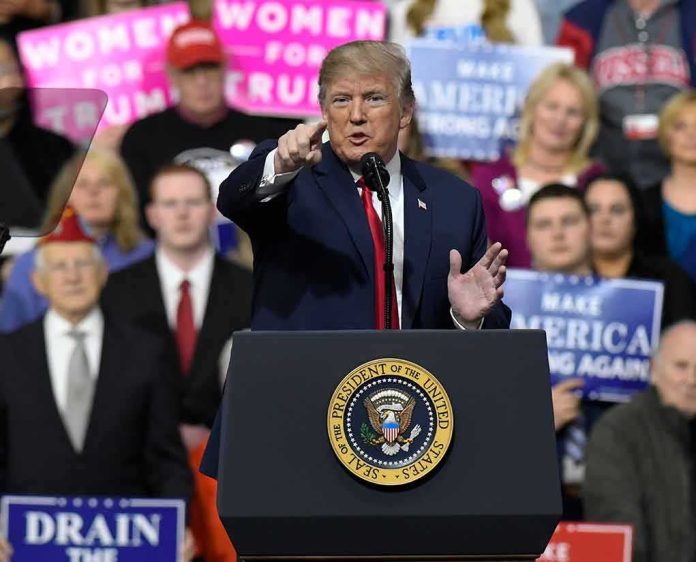
On October 14, 2026, President Trump headlined a Republican rally at the Laughlin/Bullhead International Airport in Bullhead City, Arizona, part of a late-stage campaign blitz aimed at energizing GOP voters ahead of the November midterms. Public event listings placed Trump at the airport venue and framed the stop as a midterm rally; regional and national outlets reported the visit the same day, situating it within a multi-state push to lift Republican fortunes down the ballot. Onstage, Trump’s message was direct: treat the election as a stark choice, and vote Republican up and down the ticket. Fox News quoted him urging Arizonans to “turn the state red from top to bottom,” and carried his line that Democrats would “destroy our country,” a rhetorical crescendo emblematic of the rally’s stakes-forward framing.
The appearance was not an isolated branding exercise. Trump brought Arizona Republican Rep. Andy Biggs on stage, tying presidential star power to state-level contests and giving the mobilization drive a tangible candidate focus. AP-based reporting noted Trump explicitly asked supporters to act as though he himself were on the ballot, a recognition that presidential races draw higher turnout and that borrowing that intensity can matter when early voting is already underway. In short: the campaign constructed a classic base-activation event—clear location, compelling visuals, a featured local figure, and a message optimized for enthusiasm rather than persuasion.
Mechanism: how rallies translate attention into turnout
Midterm rallies like Bullhead City work through three channels. First, message discipline: compressing a sprawling election into a single, affect-rich choice—“us” versus “them,” catastrophe versus restoration—simplifies decision-making for aligned voters and imbues otherwise obscure races with urgency. Second, social reinforcement: a rally produces cues that attendance is normal for people “like me,” a powerful nudge in low-salience contests. Third, timing: scheduling during early voting captures intent while ballots are readily cast, cutting the drop-off between enthusiasm and action. In Arizona, these mechanics converged—a stage with the sitting President, an on-message local ally, and a calendar positioned to convert emotion into votes before momentum dissipates.
Rally rhetoric often favors sweeping warnings over granular policy contrasts; the “destroy our country” line is prototypical. It is designed to prioritize mobilization—a function political scientists and campaign veterans recognize as the dominant objective for late-cycle presidential appearances on behalf of the party slate. Analyses of prior cycles have found such rallies are better at energizing the faithful than flipping the conflicted, which is why the message architecture emphasizes identity and stakes over white papers.
Context: the role—and limits—of presidential coattails in midterms
Historically, presidents who barnstorm during midterms do so to offset structural headwinds and to stiffen turnout among their coalition. The record is mixed: some candidates in rally markets beat expectations, others underperform. But the strategic logic is consistent—elevate attention, nationalize local choices, and push partisan alignment as the dominant heuristic for down-ballot voting. Contemporary commentary around Trump’s 2026 itinerary cast it as a base-turnout strategy—an effort to maximize participation by people already inclined to support Republicans, not to persuade the median undecided voter drifting in a fragmented media environment.
Arizona magnifies those dynamics. Close statewide races, a maturing early-vote infrastructure, and intense partisan organization on both sides make marginal mobilization gains meaningful. The Bullhead City stop knitted national narrative to local consequence: a presidential brand rallying activists; a recognizable in-state figure anchoring the ticket; and an appeal that made straight-ticket voting feel like a civic imperative. Wire services and regional outlets documented the sequence, making the event’s existence and design choices part of the public record rather than a campaign mythologizing.
What was said—and what that signals about campaign priorities
Trump’s through-line in Bullhead City was binary choice and total slate support. Reports captured him urging voters to “turn the state red from top to bottom” and warning that Democrats would “destroy our country”—phrasing that functions as a motivational amplifier in partisan environments. He also told supporters to behave as though he were on the ballot, a tacit acknowledgment of the turnout gap between presidential and midterm cycles and a direct attempt to collapse that behavioral distinction. Featuring Rep. Andy Biggs onstage signaled that the rally’s aim was not only atmospheric but also candidate-directed, yoking the national message to immediate contests.
The speech reportedly ranged across familiar Republican critiques, including border security and Arizona election administration, but the core news value of the event lies in its mobilization architecture rather than in any single policy claim. The presence, the stagecraft, the timing, and the straight-ticket exhortation are the pieces that campaigns can replicate and that observers can evaluate against turnout and fundraising data after the fact.
Please pretend I'm on the ballot."
President Trump gets laughs and applause at a midterm rally in Arizona as he urges Republicans to turn out for the upcoming elections, even though his name won't appear on the ballot.
pic.twitter.com/A0S8u3IXtj— ALEX WEST —BIG DADDY (@ALEXWESTekb1) October 15, 2026
How to measure impact
Rally success is not the crowd size; it is the conversion. The relevant metrics are precinct-level turnout shifts relative to matched areas without such events, the velocity of early ballot returns before and after the stop, small-dollar fundraising spikes traceable to the rally window, and volunteer sign-ups that expand GOTV capacity. Analysts comparing Arizona’s returns to prior midterm baselines can test whether the Bullhead City event delivered a measurable lift. In 2018 and other cycles, such effects have been uneven—confirmation that rally politics is a high-variance instrument, potent in some contexts and inert in others.
Bottom line
The Bullhead City rally executed the midterm playbook with discipline: pick a contested state with robust early voting, nationalize the stakes, place a prominent local Republican onstage, and press for straight-ticket action while votes are being cast. The strongest facts here are simple and well-documented: where and when it happened; who stood on stage; and the central message urging Arizona voters to turn the state red and to treat the midterms as existentially high-stakes. Whether that formula shifts outcomes is an empirical question answered by turnout files and finance reports—not by the decibel level of the applause. For campaigns, though, the logic endures: mobilize first, everywhere you can, exactly when it counts.
Sources:
foxnews.com, azfamily.com, us.headtopics.com, boston25news.com, events.gop.com