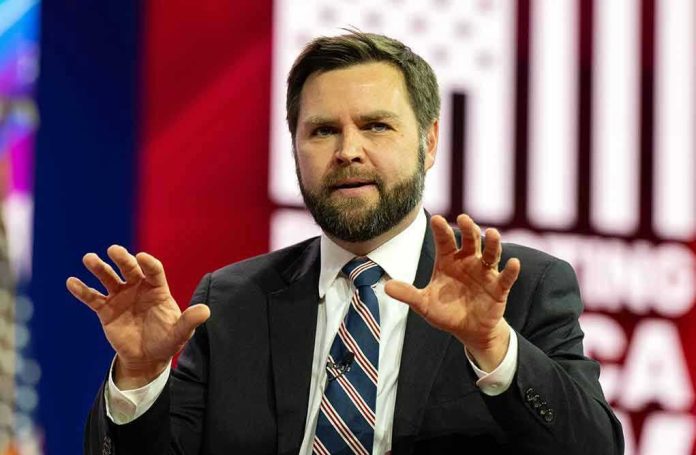
In modern U.S. campaigns, a one-liner can do more work than a policy white paper: it signals tribe, frames an opponent, and ricochets through media systems primed to reward outrage. Vice President JD Vance’s crack about James Talarico is a textbook case—brief, barbed, and perfectly engineered for amplification.
At a Glance
- Vance delivered a crowd-pleasing punchline in Texas that contrasted himself with Democratic Senate candidate James Talarico.
- The exchange was captured on video and widely republished, with consistent wording across outlets.
- Coverage diverged on meaning: description versus insinuation, humor versus slur—illustrating how political jokes travel.
- The episode sits at the intersection of campaign insult comedy, identity politics, and First Amendment protection for sharp-edged speech.
What Happened: The Line, The Room, The Target
The core facts are straightforward and well documented. At a Republican campaign event in Tyler, Texas—held to boost Attorney General Ken Paxton’s Senate bid—an audience member told Vice President JD Vance he loved him. Vance volleyed back: “I love you too, sir, in a totally platonic way to be clear. I’m the vice president, not James Talarico.” The exchange, including setup and punchline, was recorded on video and distributed by C‑SPAN, giving the moment an authoritative contemporaneous record rather than a paraphrase or after-the-fact recollection. News reports placed the remark squarely within the Paxton–Talarico contest and identified Talarico as the intended butt of the joke.
Significantly for reconstructing what happened, the wording did not drift as it moved through coverage. Outlets as ideologically diverse as Newsweek, Townhall, and Raw Story reproduced the same essential phrasing—“I love you too, sir,” “totally platonic,” and “I’m the vice president, not James Talarico”—which reduces the usual uncertainty about what was said in a noisy room. The campaign setting matters: this was not a sit-down interview or policy rollout; it was a rally built for call-and-response, where humor operates as both icebreaker and weapon.
How The Joke Works: Structure, Implication, and Applause Lines
The line lands for three reasons. First, it brazens into an audience member’s affection with performative boundaries—“totally platonic”—which primes listeners for a release. Second, the contrast “I’m the vice president, not James Talarico” provides the snap, converting a personal quip into a partisan punch. Third, the name-check targets a live opponent, which rallies a partisan crowd and guarantees press pick-up. The video preserves this cadence: setup, boundary, contrast—laughter.
Humor in political speech often trades on implication rather than proposition; the speaker invites an inference but does not spell it out. Here, sexuality becomes part of the interpretive puzzle handed to the audience. Some outlets treated the joke as an insinuation about Talarico’s sexuality; others simply described the exchange as a caustic jab at a rival. Both readings circulate because the wording leaves space for inference while achieving the strategic effect of diminishing the opponent in a single beat.
Why It Traveled: Outrage Incentives and Media Amplification
Sharp-edged jokes are ideal content for an attention economy that prizes moralized emotion. Research in political communication and social psychology shows that expressions of moral outrage are reinforced by social media feedback mechanics—likes, shares, outraged quote-tweets—training users and outlets alike to promote material that provokes strong reactions over material that merely informs. Related scholarship has mapped how media market dynamics reward identity-affirming, anger-stoking narratives, creating what some analysts call an “outrage industry” that converts provocation into engagement and engagement into profit.
In this environment, a punchline that can be framed as either a clever ribbing or a homophobic dig becomes liquid fuel. A descriptive clip gets re-captioned with charged language; partisan and lifestyle outlets carry it to their audiences with interpretive overlays; and each pass through the system increases salience while hardening perceptions. Coverage of polarization itself can intensify the sense of division, regardless of outlet ideology—a meta-amplification effect that helps explain why brief rally moments can dominate discourse beyond their intrinsic policy significance.
Where Reasonable People Disagree: Joke Versus Insult
On the facts of the utterance and setting, there is little dispute: the clip shows what Vance said, in sequence, at a Paxton rally in Tyler, and reports align on the wording. The disagreement lies in characterization. Advocates and several outlets called it a gay insinuation or homophobic taunt; others cast it as standard-issue campaign mockery at an opponent’s expense. Because the line relies on innuendo, both interpretations are structurally available to listeners; they hinge not on what was explicitly stated but on what the audience is led to infer. That is the persuasive power of implication—and its political utility.
Notably, the surrounding stump rhetoric at the event, as reported elsewhere, was already adversarial, with Vance portraying Talarico as a threat and deploying harsher epithets. When a joke drops into that atmosphere, many hear it not as a standalone wisecrack but as a component of a broader negative narrative. That context shapes reception as much as the words themselves.
Speech, Law, and Norms: Why Lines Like This Persist
In American law and practice, the boundary between offensive political speech and actionable factual claims is bright. Satire, hyperbole, and rhetorical flourish—especially in the hurly-burly of a campaign—are given wide berth. Defamation requires false statements of fact about a person, not barbed implication embedded in a joke; the First Amendment tolerates a great deal of caustic speech about public figures that may be distasteful but is not legally sanctionable. That is why lines like Vance’s recur across election cycles: they are efficient, legally safe, and often effective in rally settings.
Normatively, the audience bears a share of agency. Political crowds and digital spectators reward different registers—some cheer the jab, others share it with condemnation, both inflate its reach. As platform incentives and partisan media ecosystems continue to privilege content that triggers strong affect, candidates have little reason to abandon humor-as-weapon. The cost-benefit math favors the quip.
JD Vance made a "totally platonic" James Talarico joke in public — while Vance's own old comments about men are still very much searchable. pic.twitter.com/OT53rpg423
— United For Equity (@UnitedForEquity) October 13, 2026
How To Read Moments Like This Going Forward
Three habits help. First, separate the record from the spin: watch the primary clip and register the literal words, cadence, and room reaction before importing captions and commentary. Second, situate the joke in its campaign arc: is it a lone wisecrack, or a recurring motif that defines an opponent? Third, recognize the incentive structure: if a line detonates online, ask who benefits from its spread—cheerleaders and critics alike may be feeding the same engagement loop.
Sources:
youtube.com, newsweek.com, dailymail.com, advocate.com, c-span.org, townhall.com, yahoo.com, lacba.org, bostonreview.net, academic.oup.com