
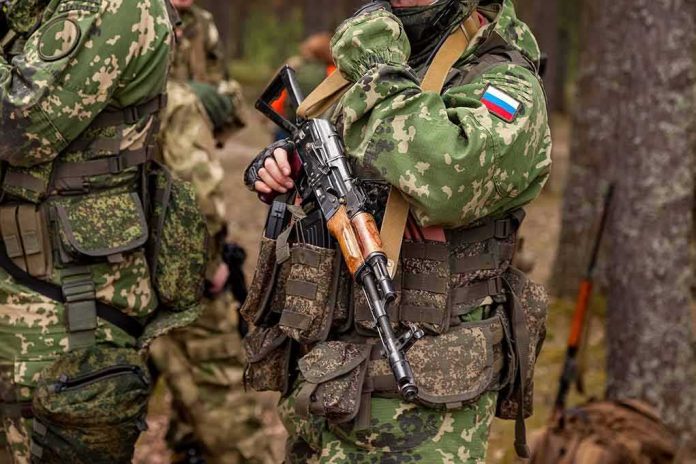
Russia’s use of Chechen “Akhmat” forces in Mariupol shows how Moscow outsources both coercion and commerce in occupied territory—folding loyalist militias into a layered control system that secures political obedience, extracts value, and advertises victory without the paperwork of formal annexed governance.
The Short Version
- Chechen units under Ramzan Kadyrov participated in the siege and subsequent occupation environment in Mariupol; Adam Delimkhanov was identified as a commander.
- Post-siege, Kadyrov and allied channels framed Mariupol’s “restoration” using Chechnya’s template, with Chechen-linked networks reportedly entering the local economy.
- Open-source and outlet reporting tie Akhmat-linked actors to securing and monetizing strategic industrial assets, including scrap from Mariupol’s steel plants.
- The most expansive “handover” language comes from partisan sources, yet the pattern—fragmented sovereignty with militia influence over resources—fits established occupation practice.
What Chechen involvement in Mariupol actually looked like
From the first months of the full-scale invasion, Kadyrov signaled Chechen participation as both battlefield spectacle and political theater. He publicly asserted that Chechen fighters entered Mariupol during the siege and named State Duma member Adam Delimkhanov as their commander—a claim mirrored in independent analytical notes on the “kadyrovtsy,” which placed Delimkhanov atop the Mariupol command structure early in the war. Kadyrov’s Telegram-forward posture—posting operational boasts, celebrating building seizures, and amplifying short, stylized combat vignettes—served two audiences at once: Moscow, which values demonstration of loyalty and “results,” and Chechnya, where regime legitimacy is tied to martial prowess and patronage flowing from the federal center.
After the city’s fall, the Chechen leader shifted rhetoric from assault to stewardship. He lauded the “restoration” of peaceful life and pledged to rebuild Mariupol along Chechen lines. This is not a construction plan so much as a political grammar: “restoration according to the experience of Chechnya” is shorthand for Kadyrov-branded security, contracts, and symbolism underwritten by federal subsidies and enforced by loyal units. The point is ideological and logistical—Mariupol as a stage on which Grozny performs competence, loyalty, and usefulness to the Kremlin.
From presence to patronage: how resources become levers
Occupation economies are seldom tidy. Formal administration may sit with an entity like the so-called Donetsk “republic,” while security functions and key extractive nodes—ports, fuel depots, steel yards—are parceled among regular military, Rosgvardiya, and elite-aligned auxiliaries. In Mariupol, multiple outlets relayed claims that Akhmat-group deployments were reinforced to “monopolize local resources” and secure leverage over industrial assets, echoing a loyalty-for-control logic that has long characterized Moscow’s management of Kadyrov’s fief. While the most sweeping phrasing—“the Kremlin will hand over Mariupol”—comes from partisan resistance channels and their media relays, the underlying mechanics are familiar: give a loyalist militia a meaningful slice of the spoils and a visible arena to police, and you bind its fortunes to the center.
Concrete, if partial, indicators point in the same direction. Investigative reporting has described Akhmat fighters and affiliated structures cutting up the Azovstal and Illich works for scrap, with separatist figure Pavel Gubarev explicitly stating Chechen-linked control over both plants. A research paper on occupied-economy practices notes that Mariupol was twinned with Grozny and that Chechen networks later became active in the local economy, situating those anecdotes within a broader pattern of looting, illicit seizures, and networked profiteering across occupied areas. The combination—a militia’s visible presence at strategic sites, local testimonies of asset stripping, and a policy analysis documenting the template elsewhere—is consistent with de facto control over revenue streams even when formal paperwork routes through occupation administrations.
Why “handover” language outpaces documentary proof
Two truths can coexist without contradiction. First, Chechen forces and brokers have exercised real influence over Mariupol’s security environment and revenue-bearing assets since the city’s capture. Second, the maximalist claim of a formal, exclusive Kremlin-to-Akhmat transfer rests primarily on resistance-sourced accounts amplified by sympathetic outlets, not on decrees or registries available to outside auditors. This mismatch is typical of war-time governance. Fragmented sovereignty operates through tacit arrangements, not notarized assignments; access to a gate, a crane, or a yard can matter more than who stamps the invoice.
The occupation pattern helps decode the noise. Researchers who track illicit finance in occupied Ukrainian territories have cataloged how formal authority, security power, and economic extraction split across overlapping actors, creating opaque accountability and deliberately deniable rackets. In Mariupol, that same work underscores de facto DPR administration alongside the subsequent activation of Chechen commercial networks—a configuration that explains why observers on the ground experience Akhmat as a dominant presence even as official façades persist. The net result is durable influence without neat bureaucratic edges.
Mechanism and incentives: why Grozny shows up where money moves
Kadyrov’s regime runs on a hybrid economy: generous budgetary transfers from Moscow; domestic monopolies and rents within Chechnya; and, when war opens opportunities, participation in extraction beyond its borders. Embedding Akhmat units at Mariupol’s industrial chokepoints satisfies three incentives at once. It rewards loyal fighters with status and patronage opportunities; it signals to the Kremlin that Grozny can manage messy spaces without drawing federal forces deeper into day-to-day racketeering; and it creates an additional channel to convert scrap, construction materials, and protection into cash or barterable favors with federal ministries and allied oligarchic interests.
Critically, “control” in this environment is not a legal designation but a capability. If a formation can decide which trucks enter a yard, which contractors receive armed “escorts,” and which shipments clear a roadblock at night, it controls value—even if the municipal seal and tax code tell a different story. Accounts from Mariupol about Chechen-flagged checkpoints, site “security,” and scrap flows align with that definition, which is the one that matters to residents and to anyone trying to move steel out of a bombed-out city.
Russia Exploits Muslim Jihad in Ukraine After Centuries of Courting Muslims for Political Expediency
Russian forces have handed Chechen “Akhmat” units loyal to Chechen leader Ramzan Kadyrov operational and economic control over parts of occupied Mariupol. Russian forces…
— Allen805 (@Allen8052329471) September 20, 2026
Religion as brand, not blueprint
The idea that Moscow “exploits Muslim jihad” in Ukraine misstates what the evidence supports. Chechen identity is absolutely instrumentalized—visually, linguistically, and ceremonially—but not as a religious recruitment doctrine inside Mariupol. The record substantiates Kadyrov’s loyalist militias, his personalized chain of command, and his propaganda about restoring order; it does not provide primary documentation of mosque-centered mobilization or Islamic governance in Mariupol’s local patronage. In other words, religion functions as a brand within Kadyrov’s broader political economy of loyalty, not as a distinct program shaping the city’s administration or extraction mechanics.
What this means going forward
For residents and for any post-occupation accountability process, the implications are clear. First, expect layered responsibility: DPR signatures on paper, Russian federal transfers funding façade reconstruction, and Chechen-linked enforcers profiting at critical nodes. Second, follow the material. Scrap and construction flows, protection fees at checkpoints, and contracting patterns around “restoration” will reveal more than press statements about who truly benefits from Mariupol’s ruins. Third, if and when the security situation changes, these same networks will adapt quickly—shifting from visible uniforms to commercial intermediaries that can survive a reshuffle of flags.
The through-line is continuity: the same kadyrovtsy who helped take the city now anchor parts of its occupied economy; the same leader who filmed triumphant updates now stakes his standing on Mariupol’s managed normalcy; and the same Kremlin that thrives on deniable proxies continues to govern through fragmentation. None of that requires a stamped handover to function. It requires presence, access, and a reliable share of the spoils—conditions the evidence shows have been in place since the smoke cleared over the steelworks.
Sources:
thegatewaypundit.com, unn.ua, en.wikipedia.org, euromaidanpress.com, english.nv.ua, israelnationalnews.com, static1.squarespace.com