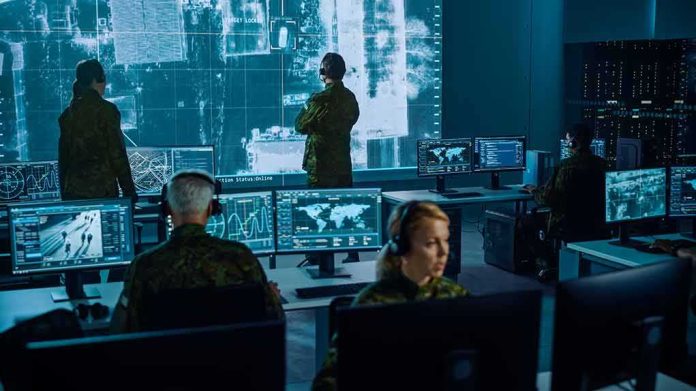
The modern ad-tech economy has turned phones carried by U.S. troops into off-the-shelf beacons; adversaries don’t need to hack military networks when they can simply buy precise location traces and infer where American forces live, gather, and move.
At a Glance
- U.S. Central Command told lawmakers it received multiple threat reports that adversaries exploited commercial location data to target or surveil U.S. personnel in theater.
- A bipartisan warning from Sen. Ron Wyden and Rep. Pat Harrigan pressed the Pentagon for stronger protections, calling the brokered-data market a force-protection risk.
- Reuters characterized CENTCOM’s disclosure as the first official confirmation of targeting in an active war zone.
- Military branches responded by disabling mobile advertising identifiers across managed devices, signaling the risk was treated as operationally real.
What changed: the market made surveillance easy
For years, national-security professionals worried that commercial data exhaust—especially precise geolocation gathered by mobile apps and ad networks—could be reassembled into “patterns of life” around sensitive people and sites. That concern is no longer theoretical. In unclassified correspondence shared with Congress, U.S. Central Command said it had “received multiple threat reports concerning adversary exploitation of commercial location data to target or surveil U.S. personnel in theater,” a formulation that dispenses with euphemism and treats the ad-tech supply chain as an operational vector. Reuters, which reviewed the materials, described that disclosure as the first official confirmation of targeting in an active war zone.
Mechanically, the risk is straightforward. Many smartphone apps embed third-party software development kits that collect device identifiers and geolocation events; those events flow into data brokers, are aggregated, and can be resold. With enough points, an outsider can infer base perimeters, staging areas, and commuting routes. Lawmakers summed up the consequence crisply: commercially purchased location data can reveal where U.S. troops congregate and their routines—insight an adversary could exploit for drones, missiles, roadside bombs, or counterintelligence.
The official record: warnings and mitigations
On May 28, a bipartisan letter to Pentagon Chief Information Officer Kirsten A. Davies accused the department of failing to take basic steps against a “serious counterintelligence and force protection threat” posed by data brokers selling personal information—including cell phone location data—linked to service members. The next day, Reuters reported CENTCOM’s written acknowledgment of threat reports concerning adversary exploitation of commercial location data, elevating the issue from analyst concern to on-the-record operational risk.
Services then moved to harden endpoints. By early September, Reuters reported the Air Force had disabled advertising identifiers on devices under its control, Special Operations Command had done so on Windows devices, and the Army said mobile advertising IDs had been disabled by default since at least February—modest settings changes in technical terms, but consequential because they narrow a key pathway brokers use to stitch movement profiles. The steps span multiple branches, underscoring that this is a force-wide exposure, not a niche anomaly.
How the ad-tech pipeline turns into an intelligence feed
Adversaries do not need privileged access to exploit this ecosystem. Brokers legally buy and resell “commercially available information” (CAI), a category the U.S. intelligence community has spent years parsing because of its scale and sensitivity. Once precise location is packaged and marketed, foreign entities can obtain it via front companies and intermediaries; the challenge for defenders shifts from breach response to market governance and device-level risk reduction. The frictionless nature of this commerce—machine-to-machine auctions, bulk feeds, permissive licensing—lowers the bar for targeting. A determined buyer can acquire historical traces around known military installations, filter for specific device identifiers, and infer home addresses and unit congregation points with trivial tooling.
Three attributes make this powerful. First, density: billions of events can be purchased, then sliced geographically or temporally to surface routines. Second, persistence: devices broadcast long enough to connect off-base life to on-base presence. Third, linkability: advertising IDs and ancillary metadata (Wi-Fi SSIDs, IPs) allow cross-dataset correlation. None of this requires violating a server; it monetizes the very signals consumers and developers trade for “free” apps and targeting.
Where the public record is tight—and where it is thin
The core facts are clear and uncontested in published reporting: CENTCOM received multiple threat reports about adversary exploitation of commercial location data against U.S. personnel; bipartisan lawmakers sounded formal alarms; Reuters framed this as the first official confirmation of targeting in an active war zone; and services implemented mitigations across managed devices. Those points establish both motive and means—and that the military treated the risk as real.
What remains outside public view are the raw threat reports, specific adversary identities, and the broker-to-battlefield chain of custody. CENTCOM’s language references “adversary exploitation” without naming a state actor in the disclosed text, and the documents made public do not enumerate which apps, SDKs, or broker platforms were implicated. That is common in this domain: the intelligence needed to attribute a dataset purchase to a specific actor and then to a specific attack pathway is often classified, while the operational fix—turning off identifiers and tightening policies—can proceed without public forensic detail.
They don’t need to kick in your door anymore.
They already live in your phone.
Your face, your location, your searches, your children’s biometrics. All this and much more harvested, sold, and mapped while foreign money writes the ads that tell you what to fear. The… pic.twitter.com/aXXyiXrnHJ
— Of The People By The People For The People (@_OTP_BTP_FTP_) September 17, 2026
Consequences for force protection and policy
Two implications follow. First, device hygiene is mission security. Disabling advertising identifiers, restricting background location sharing, controlling app installs, and segmenting government-issued from personal devices are no longer convenience settings; they are force-protection controls. The response already underway inside the services suggests this posture is becoming standard, not exceptional.
Second, the strategic problem outlives any single deployment. As long as U.S. law permits broad collection and sale of precise location, foreign buyers can route around sanctions and export controls through affiliates and shell companies. That is why congressional oversight has increasingly focused on the commercial data market itself—not because advertising is malign per se, but because scale and accessibility transform consumer telemetry into operational intelligence at trivial marginal cost. In that environment, even perfect compliance by every service member’s government phone cannot neutralize leakage from personal devices, family members, contractors, or nearby civilian phones whose pings outline base activity.
What competent defense looks like from here
A durable approach blends three layers. At the edge, lock down devices: enforce mobile application management, default-deny background location, rotate identifiers, and treat personal-device use in theater as a managed exception with explicit risk tradeoffs. In the enterprise, collapse ad-tech exposure wherever possible: disable advertising IDs across form factors, audit installed SDKs on sanctioned apps, and require vendors to attest—contractually and technically—that they do not exfiltrate precise location. In the market, align policy with risk: define government-related location data as a protected class, require broker licensing and auditable customer vetting, and bar the sale of precise geolocation tied to known or inferable government personnel without affirmative, revocable consent backed by enforcement teeth.
The military has already moved on the first two layers. The third depends on civilian legislation and regulatory follow-through. Until the commercial location economy is constrained, adversaries will continue to treat it as a standing collection platform. CENTCOM’s warning made that reality explicit; the services’ mitigations showed it was taken seriously; and the pathway to reducing exposure is hiding in plain sight—turn off the beacons, shrink the market, and stop pretending consumer telemetry is harmless when lives are on the line.
Sources:
youtube.com, reuters.com, defenseone.com