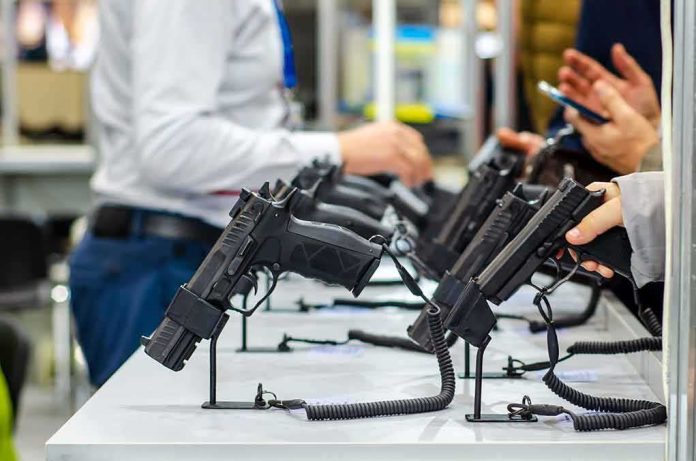
The most durable shift in the under‑21 handgun debate is not a headline or a court skirmish; it is the Department of Justice’s formal conclusion that the federal dealer ban cannot be squared with the Supreme Court’s text‑and‑history test—an institutional pivot that reshapes enforcement nationwide even as appellate courts continue to disagree.
At a Glance
- The Justice Department’s Office of Legal Counsel (OLC) concluded that 18 U.S.C. § 922(b)(1) and § 922(c)(1) are unconstitutional as applied to law‑abiding 18‑ to 20‑year‑olds seeking to buy handguns and handgun ammunition.
- DOJ’s view controls federal criminal enforcement: licensed dealers cannot be prosecuted under these provisions for selling to otherwise eligible adults ages 18–20.
- Federal appellate courts are split, reflecting the broader post‑Bruen fight over which historical analogues define a “tradition” of firearm regulation.
- The long‑term outcome will turn on how courts weigh Founding‑era practice against later 19th‑century age‑based limits—and on whether the Supreme Court resolves the circuit conflict.
What DOJ actually changed: enforcement posture, not the statute book
Start with the mechanism. Congress enacted 18 U.S.C. § 922(b)(1) and § 922(c)(1) to bar federally licensed firearms dealers from selling “any firearm other than a shotgun or rifle” (and related ammunition) to individuals under 21. Those provisions remain on the books. But inside the executive branch, the Office of Legal Counsel functions as the attorney general’s in‑house court of last resort; its written opinions bind the Department absent contrary presidential or attorney general direction. In a published opinion, OLC concluded that applying these sections to law‑abiding 18‑ to 20‑year‑old purchasers violates the Second Amendment. That conclusion means DOJ will not bring criminal cases against licensed dealers solely for such sales, reshaping day‑to‑day enforcement even before the Supreme Court has the final word.
Two points follow. First, the opinion is as‑applied: it speaks to sales to law‑abiding young adults, not to possession by minors or other prohibitors (felonies, domestic‑violence bars, and the like). Second, it is executive guidance, not a judicial decree. Private civil suits and state regulatory regimes can still create friction, and the federal statutory text has not been repealed. But for federal criminal liability of dealers, DOJ’s posture is dispositive in practice.
Why now: the Bruen framework pushed age limits onto the historical anvil
The OLC opinion did not arise in a vacuum. In 2022, the Supreme Court in New York State Rifle & Pistol Association v. Bruen rejected interest‑balancing and instructed lower courts to decide Second Amendment challenges by asking two questions: does the Amendment’s text cover the person’s conduct, and, if so, is the regulation consistent with the nation’s historical tradition of firearm regulation. Age‑based limits have since become a proving ground for that test. Competing scholarly and litigation briefs marshal rival histories—some emphasizing Founding‑era militia obligations on 18‑to‑20‑year‑olds and the lack of categorical purchase bans; others pointing to 19th‑century enactments treating young adults as a distinct regulatory class. The dispute is not about statistics or modern policy efficacy but about which era and which analogues properly define “tradition” under Bruen.
That methodological pivot explains the diverging outcomes in the courts. In recent years, a Fifth Circuit panel struck down the federal dealer‑sales ban for 18‑ to 20‑year‑olds under the Bruen test; contemporaneous reporting stressed the novelty of an appellate court invalidating the federal restriction on historical grounds. But the Fourth Circuit, reading the same Supreme Court instructions, upheld the federal scheme, rooting its analysis in what it described as a regulatory tradition permitting limits on sales to those under 21—a view that treats Reconstruction‑era enactments as probative tradition. The opinion’s bottom line: § 922(b)(1) “fits squarely within this tradition” and is constitutional. The split is real and substantive.
How OLC reached its bottom line: text, “the people,” and analogical limits
OLC’s analysis begins at step one: adults aged 18 to 20 are among “the people” whose right to keep and bear arms is protected, and the act of acquiring a commonly used class of arms from licensed dealers is covered conduct. Step two then asks whether a categorical prohibition on dealer sales to that covered class is consistent with historical tradition. On that historical question, OLC reads the Founding record as lacking broad categorical purchase bans for 18‑ to 20‑year‑olds and views later 19th‑century measures as poor analogues—more targeted in scope (e.g., weapon types like Bowie knives), narrower in effect (e.g., carry restrictions), or too temporally remote to define the original scope of the right. That interpretive posture tracks the strand of post‑Bruen decisions emphasizing Founding‑era baselines over Reconstruction‑era expansions when federal law is at issue.
Crucially for enforcement, OLC also addresses the statute’s commercial‑sale framing. Some courts have characterized age limits as mere “conditions on the commercial sale of arms,” a category Heller suggested might be presumptively lawful. OLC rejects the idea that this label ends the inquiry; under Bruen, the government still must show a historical analogue of comparable burden and justification. A blanket age‑based sales bar that functions as a near‑categorical denial of handguns—still the “quintessential” self‑defense arm—fails that test in OLC’s view.
Where the disagreement truly lies: era, generality, and justification
Proponents of the federal age limit emphasize congressional findings about violent crime and argue that the law is a safety‑driven categorical restriction—legitimate as a matter of both policy and tradition. Earlier Fifth Circuit precedent, decided before Bruen’s historical‑tradition mandate, upheld the statutes on reasoning that framed them as such safety‑based conditions; that opinion cited a legislative record focused on reducing youth violence and characterized the laws as constitutional under then‑prevailing doctrine. Post‑Bruen, however, those same justifications must be translated into historical analogues, not means‑end balancing—a move that has fractured appellate panels considering which sources of “tradition” count and at what level of generality.
The upshot is not that one side claims public safety while the other ignores it; rather, Bruen channels both sides into historical argument. One camp foregrounds militia obligations and the absence of Founding‑era purchase bans for legal adults. The other mines Reconstruction‑era statutes and common‑law conceptions of “infancy” extending to age 21 to argue there is a tradition of treating young adults as a distinct class for weapons access. OLC chose the former path for federal enforcement; several courts have adopted the latter in adjudication. Until the Supreme Court resolves the methodological rift, expect the split to persist.
Practical implications for dealers, buyers, and states
For federally licensed dealers, DOJ’s position is straightforward: the Department will not prosecute sales of handguns or handgun ammunition to otherwise eligible 18‑ to 20‑year‑old adults under § 922(b)(1) and (c)(1). That does not dissolve all legal risk. State laws may still bar such sales; private civil exposure, while unlikely in a standard retail transaction, is governed by separate liability regimes; and federal prohibitions unrelated to age (e.g., felony convictions, domestic‑violence restraining orders) remain fully enforceable. Dealers should update compliance policies accordingly but continue robust age and prohibitor screening under the National Instant Criminal Background Check System (NICS).
For young‑adult buyers, the doctrine does not create a free‑for‑all. The OLC opinion is not a judicial order compelling dealers to sell; it removes federal criminal exposure for the dealer under the cited provisions. Retailers retain discretion; supply chains and insurer requirements may lag; and state‑level purchase bans can still block transactions. Expect a transitional period in which availability varies by jurisdiction until the appellate conflict is settled or Congress revisits the statutory framework.
What to watch: Supreme Court resolution and legislative recalibration
Enduring settlement will require either Supreme Court clarification or legislative change. If the Court affirms the Founding‑era baseline as the controlling tradition for federal constraints, categorical age‑based dealer bans will be difficult to defend nationwide. If it credits Reconstruction‑era analogues as sufficiently probative, especially for commercial‑sale conditions, under‑21 restrictions may survive in some form. Meanwhile, Congress could convert categorical age bans into narrower, historically grounded conditions—targeted training or supervised acquisition regimes for young adults—which some courts might view as better analogues than outright prohibitions. In the interim, DOJ’s enforcement stance is the concrete fact on the ground: for federal criminal law, the under‑21 dealer ban is off the table as applied to law‑abiding 18‑ to 20‑year‑olds.
🚨BREAKING 2A NEWS!
The DOJ's Office of Legal Counsel has concluded that the federal ban on handgun sales to 18-20 year olds is unconstitutional.
Since 1968, it has been a federal felony for a licensed dealer to sell a handgun to an adult under 21. Up to five years in prison.… pic.twitter.com/rdgXs8yDn5
— National Association for Gun Rights (@gunrights) September 18, 2026
Bottom line
This is a doctrinal fight housed inside a practical decision. The doctrine—what counts as America’s firearm “tradition”—is contested and will stay that way until the Supreme Court speaks. The practical decision—DOJ’s refusal to prosecute dealers for sales to legal adults under 21—already changes how the federal government treats millions of potential transactions. For those who must operate in the real world of compliance and rights, both truths matter.
Sources:
washingtonexaminer.com, ndtvprofit.com, reason.com, supremecourt.gov, cnn.com, usnews.com