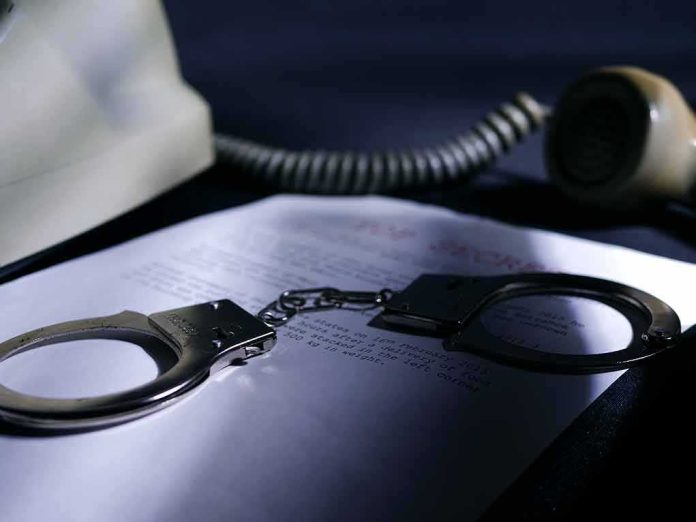
Forging judicial authority is not a quirky species of fraud; it is an attack on the operating system of the courts, and prosecutors increasingly treat it that way—especially when the forgery is leveraged to short-circuit custody, criminal liability, or public records.
At a Glance
- Two recent strands of cases illustrate the same core harm: forging a judge’s signature or impersonating federal authority to force an outcome.
- Federal law criminalizes both acts independently: forging a federal judge’s signature (18 U.S.C. § 505) and impersonating a federal officer (18 U.S.C. § 912).
- Allegations span from a counterfeit “Supreme Court order” in Indiana to purported sham orders in a California custody dispute; in both, the aim was to compel officials to act.
- Courts and juries focus on mechanism and use: did the document purport to carry real judicial force, and was it used to obtain a concrete advantage?
What forged judicial power looks like in practice
In one widely reported federal case out of the Northern District of Indiana, a grand jury returned a five-count indictment against a defendant accused of filing an “Order of Dismissal With Prejudice” that bore a counterfeit seal of the U.S. Supreme Court and the forged signature of Chief Justice John Roberts. The filing, sent to an Indiana trial court in Grant County, purported to command dismissal of the defendant’s state criminal case. Prosecutors say the same defendant also claimed to be a “Special Master enforcing orders of the United States Supreme Court,” and even an NSA official—conduct they framed as a broader scheme rather than a one-off stunt.
Those details matter because they map directly onto the elements of two separate federal crimes. Under 18 U.S.C. § 505, forging the signature of a federal judge “for the purpose of authenticating any proceeding or document” is a felony; crucially, courts have long read the statute not to require proof of a separate intent to defraud beyond the act of forging for that authenticating purpose. And under 18 U.S.C. § 912, false personation of a federal officer becomes criminal when coupled with an overt act consistent with that assumed role—issuing demands, sending directives, or otherwise acting “as such.” Pattern instructions and appellate decisions emphasize exactly this pairing of impersonation and action.
Why counterfeit orders sometimes “work”—and how investigators unwind them
Sham court orders succeed when they exploit the trust and tempo of legal administration. A document with the right caption, seal, signature block, and tone can momentarily overwhelm a clerk’s or agency caseworker’s skepticism—especially if it arrives with bureaucratic urgency and references to higher authority. The most effective forgeries copy the dispositive forms that terminate proceedings—dismissal “with prejudice,” custody transfer, or warrant quashal—because those commands, once believed, trigger immediate operational steps. Investigations typically retrace that chain: confirm whether the document appears on the originating court’s docket, compare the signature to verified exemplars, and test the seal or watermark against official production. When a document purports to carry federal judicial force, the absence of any corresponding entry on the Supreme Court or federal docket is itself powerful evidence of fakery, and agencies will escalate to federal prosecutors quickly.
These mechanics are not confined to federal courts. In California, public reporting describes a separate matter in which a couple allegedly filed a fake court order, bearing a forged judge’s signature, to force the return of children from custody. The judge reportedly confirmed she neither issued nor signed the document; investigators also said they recovered an additional sham filing that used a counterfeit local court seal. The defendant, according to one account, denied creating the forgery, but surveillance footage reportedly showed him serving documents before the order was flagged.
The legal architecture: impersonation and forgery as distinct, compounding offenses
The law treats these cases as two intersecting wrongs. First, you may not hold yourself out as a federal officer and then act in that assumed capacity—whether by demanding data, threatening “federal consequences,” or instructing state officials to alter records. The overt act is the fulcrum; it proves the impersonation is not theater but an attempt to exercise governmental power. Second, you may not forge a federal judge’s signature to authenticate a proceeding or document; the statute targets the gravamen of the harm—the counterfeit judicial imprimatur—without layering on a freestanding intent-to-defraud requirement. In practice, prosecutors frequently charge both when a forged “order” travels with a story about federal authority. Each count captures a different slice of the same audacity: stolen office and stolen authority.
Appellate caselaw reflects this structure. Courts have sustained § 912 convictions where the defendant not only adopted the trappings of office but took concrete steps consistent with it—letters, demands, or directives that caused people to treat the impersonation as real. They have also recognized that proof of related acts can be admissible to show a pattern or plan of impersonation, which juries understand intuitively: people who forge orders often also speak in the voice of the office they claim to occupy.
Where the skepticism belongs—and where it does not
Healthy doubt belongs to the evidence, not to the category of crime. In the Indiana matter, newsroom summaries rely on the indictment and prosecutor statements rather than publishing the alleged forged order itself or the docket image; that is common in early stages of federal cases. The absence of a public scan does not weaken the statutory theory—only the eventual trial record can do that—but it does counsel readers to separate what the indictment alleges from what a jury will find. The same is true in the California custody reports: they present a prosecutor-framed narrative that, if proved, fits the same pattern, but defense accounts and forensic analysis will ultimately decide the facts. The consistent through-line across both: the alleged documents mimicked authoritative judicial commands and were deployed to compel action.
One more boundary matters. Forgery law is about authenticating power, not typographical polish. Reported misspellings in a fake order can be a tell, but what criminalizes the act is the counterfeit signature or seal presented to validate the paper as a court’s command. That is why dockets, certification practices, and clerk verification procedures—not aesthetic critique—anchor these prosecutions.
Practical consequences: resilience for clerks, agencies, and the public
For court administrators and agency staff, the remedy is procedural muscle memory. Treat out-of-channel directives—especially those invoking extraordinary authority—with a verification reflex: check the docket; call the issuing chambers; confirm the seal. Many jurisdictions now train frontline staff to spot red flags in captions, file stamps, and certificate language, and to route anything purporting to bind the court from “above” for immediate legal review. That friction is not bureaucratic fussiness; it is the immune system that prevents forged power from moving real people and property.
For the rest of us, the lesson is simpler but no less urgent. The justice system runs on trust in signatures, seals, and routines. When someone counterfeits those to spring a case, reclaim children, or erase records, the target is not just a particular prosecutor or social worker; it is the shared belief that a court speaks only through its own processes. The statutes that criminalize impersonation and forged judicial signatures exist to defend exactly that belief—and, when enforced well, they do.
Sources:
pjmedia.com, nypost.com, legalaiinsights.com, abajournal.com, timesofindia.indiatimes.com, npr.org, us.headtopics.com, justice.gov