When a single strike can sideline a pipeline that was built to blunt the world’s most precarious oil chokepoint, you are looking at a structural vulnerability, not a one-off scare. The East–West “Petroline” is Saudi Arabia’s insurance policy against the Strait of Hormuz; when it goes down, energy security calculus changes immediately and everywhere.
At a Glance
- Saudi Arabia’s East–West pipeline is the kingdom’s principal bypass of the Strait of Hormuz; disruptions ripple across global oil logistics and pricing.
- Armed drones have repeatedly targeted the line and pumping stations, forcing precautionary shutdowns and throughput cuts documented by Saudi and international reporting.
- Attribution has varied by incident: Houthis publicly claimed a 2019 strike; more recent attacks were attributed by Riyadh and Baghdad to launches from Iraq.
- The strategic point endures: pipeline attacks weaponize logistics, not just barrels, magnifying impact beyond immediate damage.
What the East–West Pipeline Is, and Why It Exists
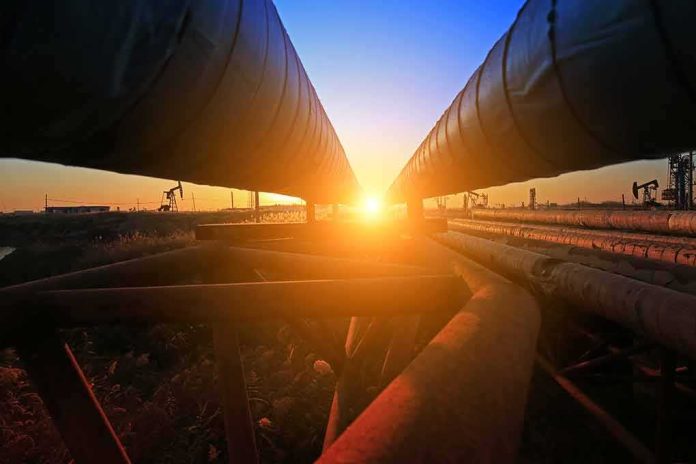
Saudi Aramco’s East–West Crude Oil Pipeline, often called the Petroline, is a roughly 1,200-kilometre artery running from Abqaiq in the Eastern Province to Yanbu on the Red Sea. It was commissioned during the Iran–Iraq tanker war with a singular mission: keep Saudi exports moving if the Strait of Hormuz is contested. In plain terms, it is the kingdom’s main Hormuz-bypass route, enabling large volumes to reach the Red Sea and European markets without threading the Persian Gulf’s narrow mouth. That design decision—invest in redundancy to offset a chokepoint—has defined Gulf energy strategy for four decades and explains why any hit on the line commands market attention.
Capacity figures vary by era and segment constraint, but government statements and analyst estimates consistently frame the Petroline’s role as consequential: its flow reductions in recent attacks were reported in the hundreds of thousands of barrels per day, and temporary closures were ordered as a precaution while damage was assessed and contained. Even short-lived outages can tighten prompt supply in the Red Sea basin and distort tanker scheduling across the Suez route.
How the Attacks Unfolded and What Was Confirmed
The public record shows two patterns that matter. First, the 2019 incident near Riyadh was promptly attributed to armed drones, with Saudi authorities tying responsibility to Houthi forces and emphasizing Iranian backing in the broader conflict narrative. The Houthi movement, for its part, openly claimed those strikes and cast them as retaliation in the Yemen war. Second, more recent disruptions involved multiple drone attacks that both Riyadh and Baghdad said originated from Iraqi territory; Saudi officials temporarily shut the pipeline as a precaution and reported injuries and damage while investigations proceeded.
This is where evidence discipline matters. The 2019 strike has a clear public claim of responsibility by the Houthis, alongside Saudi assertions about Iranian support. The later Iraq-origin incidents rest on official Saudi and Iraqi attribution, satellite imagery of fires, and throughput cuts and shutdowns reported by state and international outlets; no credible group claim surfaced in the cited material for those particular strikes. The through-line is not who takes credit; it is that inexpensive, long-range drones have repeatedly penetrated infrastructure defenses and forced Saudi operators to throttle or halt a line built to mitigate a different risk entirely.
Mechanism: Why Drones Change the Risk Math
Pipelines are linear targets; pumping stations and valve yards are fixed assets with known coordinates. Cheap, expendable drones carrying small warheads can ignite fires, damage electrical systems, or crater access that takes days to reconstitute. The physical damage may be modest, but the operational response is necessarily conservative: shut flows, isolate segments, purge, vent, dispatch repair teams under uncertain threat, and only then recommission at reduced rates before ramping. As Saudi officials and international reporting described, those operational imperatives translated into temporary closures and throughput reductions on the Petroline—exactly the kind of logistics shock that cascades through a tight market.
Two additional multipliers are at work. First, the Petroline does not just move crude; it anchors an export program, storage balance, and tanker lineup on the Red Sea coast. Second, it is a system-level hedge against Hormuz. Take it offline and you do not merely lose a conduit; you lose optionality—your ability to re-route, smooth cargoes, and arbitrate geography. Analysts called it the market’s “main workaround” for a Hormuz crisis; when that workaround is threatened, risk premia expand quickly.
Attribution, Claims, and What We Can Say with Confidence
Attribution in infrastructure warfare is rarely tidy. In 2019, the Houthis publicly said they struck the pipeline with drones; Saudi officials emphasized Iranian backing and accused Tehran of ordering the assault. In later episodes, Saudi and Iraqi authorities said the drones came from Iraq, where Iran-aligned militias operate; reporting noted the absence of an immediate group claim for those particular attacks. For energy security analysis, the key is to separate two questions. Who pulled the trigger shapes deterrence and diplomacy. But the core risk to markets—the demonstrated ability to intermittently disable bypass infrastructure—stands independent of perfect forensic resolution. The verifiable facts are enough: strikes occurred, damage and injuries were reported, throughput fell by hundreds of thousands of barrels per day, and the line was shut as a precaution.
It is also fair to note what these episodes are not: they are not Abqaiq-scale, months-long degradations of Saudi processing capacity. The Petroline has been repaired and returned to service after prior attacks. Yet the recurrence risk, the ease of replication, and the signaling value to adversaries mean each strike resets the baseline expectation of continuity. That is why even transitory outages have outsize influence on forward curves and freight behavior.
Consequences for Markets, Insurance, and Strategy
When the Petroline is constrained, barrels that would have loaded at Yanbu must either wait, be reallocated, or push eastward toward Hormuz—each option with cost and risk. Storage buffers on the Red Sea can bridge short gaps, but they are finite; prolonged repairs threaten to exhaust those cushions and force production slowdowns upstream, a point several analysts have raised across recent disruptions. In parallel, insurers and charterers recalibrate exposure. Premiums on Red Sea liftings can jump, alternative routing via the Cape becomes a live discussion for some grades, and refinery planners hedge yields in anticipation of heavier or less predictable crude slates.
Strategically, the Gulf producers’ decades-old bet on partial bypass capacity looks prescient but insufficient when adversaries deliberately target the bypass itself. Saudi Arabia and the UAE have both invested in pipelines that route oil away from Hormuz; those lines, by design, carry only a fraction of aggregate export capacity. They were meant to bleed off pressure for days or weeks in a crisis—insurance, not replacement. That logic works until the insurer is the one being robbed. The answer is not simply hardening fences at pump stations; it is layered air defense optimized for small UAVs, rapid repair doctrine, segmented operations that minimize downtime after a hit, and diplomatic architectures that complicate proxy launch from neighboring territories.
What Endures After the Headlines Fade
The lesson hardened by these strikes is straightforward. Energy security in the Gulf no longer hinges solely on the navigability of Hormuz; it hinges on the resilience of the workarounds built to dilute Hormuz’s leverage. In this landscape, small drones can have strategic effects, not because they collapse capacity for months, but because they repeatedly force operators to choose safety over flow, eroding confidence in the reliability of what was supposed to be the system’s fail-safe. Markets price that reliability. So do adversaries.
Sources:
apnews.com, spa.gov.sa, middleeasteye.net, cnn.com, aljazeera.com, reuters.com, abc11.com, thenationalnews.com, gulfnews.com, fdd.org, stout.com
Everybody is reading Iran’s strike on Saudi Arabia’s East-West pipeline wrong. This is not about whether Riyadh can restore oil movements. It is about something far bigger: an Iranian-backed group just struck the very project Saudi Arabia was betting on to offset the Iran war.…
— Abishur Prakash aka "Mr. Geopolitics" (@abishurprakash) September 16, 2026