When a federal agency tries to rewrite election rules on the eve of voting, courts do not treat it as housekeeping; they treat it as a separation‑of‑powers problem. That is why the Supreme Court’s refusal to let the Postal Service police mailed ballots stands as a clear reaffirmation of who runs American elections—states and Congress, not executive-branch agencies.
The Short Version
- The Postal Service’s 2026 “Ballot Mail for Federal Elections” rule would have conditioned delivery of ballot mail on state compliance with new envelope standards, barcodes, and voter‑list uploads.
- Multiple federal courts concluded USPS lacks statutory authority to impose election procedures or refuse otherwise lawful ballot mail; a Supreme Court order left those blocks in place for the midterms.
- Judges emphasized both law and logistics: late-stage changes risk widespread disenfranchisement and yield little in fraud prevention.
- The case illustrates the Elections Clause baseline: Congress may set federal-election mechanics and states administer them; executive agencies deliver the mail, they do not regulate voting.
What the blocked USPS rule would have done—and why it mattered
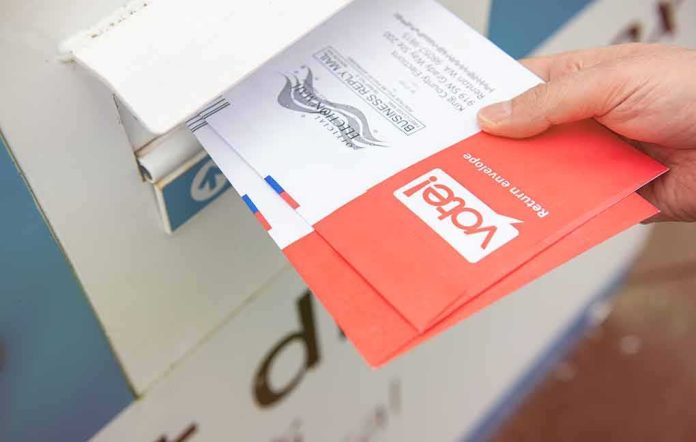
The Postal Service finalized a rule in August 2026 that sought to redefine how election mail moved through its network. It required states to submit recipient lists of mail voters to a federal portal and to use USPS-approved outbound and return envelopes containing unique barcodes and precise design features. Ballots not meeting those conditions—or addressed to individuals not matching uploaded lists—risked refusal or non-delivery under the rule’s terms. A Congressional Research Service brief captured the mechanism succinctly: outbound federal ballot mailings out of compliance with design standards or unlinked to provided voter lists would not be treated as valid ballot mail within USPS’s workflow.
That framework is not a marginal tweak. It conditions delivery—the Postal Service’s core function—on state adherence to new, federally dictated prerequisites. In effect, USPS would have operated as a gatekeeper: no barcode, no ballot; no match on the list, no delivery. The agency pitched this as an election-integrity measure built on its general authority to manage the “collection, handling, transportation, [and] delivery” of mail. Opponents, including states, civic organizations, and postal workers, saw something else: an election-administration rule masquerading as mail logistics, announced weeks before ballots were to go out.
The legal fault line: statutory authority and the Elections Clause
Federal courts focused first where experts would expect—on who has the keys. Congress created USPS to move the mail, not to run elections. District judges examining the final rule repeatedly found that the Postal Reorganization Act does not authorize the Postal Service to impose new election procedures on states, build a federal registry of mail voters, or refuse the transmission of otherwise lawful mail that fails novel agency checks. One widely cited articulation put it plainly: Congress empowered USPS to move mail, “not to force states to enroll mail voters in a federal portal or to refuse ballots that fail its checks.”
That separation-of-powers reading is anchored in the Elections Clause allocation: states set the “Times, Places and Manner” of federal elections, subject to Congress’s paramount override. Agencies in the executive branch do not get there by implication. Bipartisan amici, election-law scholars, and institutional litigants stressed the same point—no statute delegates this authority to USPS, and the executive cannot infer it from general postal powers. The Supreme Court’s docket filings reflected that consensus, with briefs arguing that no law authorizes the Final Rule’s election rules.
The operational reality: late changes and inevitable disenfranchisement
Courts did not stop at constitutional structure. They weighed timing and feasibility. Emergency election litigation comes with a familiar caution: last-minute changes breed confusion that harms voters. The appellate record here is blistering on that score. An appeals court agreed with the district judge that letting the rule take effect would likely disenfranchise millions while providing “minimal—if any—gains in combating voter fraud.” The American Postal Workers Union, representing the people who would have to implement the regime, told the Supreme Court the plan was practically infeasible before the midterms and risked “catastrophic” non-delivery to wide swaths of voters—because the portal was untested, the workforce untrained for voter‑matching tasks, and the timelines impossible.
This is the difference between theory and plant‑floor reality. Barcode uniformity and recipient-list verification can sound like neutral quality control; in practice, a single envelope misprint can misroute thousands of pieces at once, and a list‑matching hiccup can stall entire mail streams. Against that backdrop, judges treated the government’s assurance—trust us, logistics only—with skepticism, particularly given the rule’s enforcement teeth: refusal or non-delivery of ballots failing USPS checks. Multiple courts concluded that combination of novelty, timing, and consequence pointed to irreparable harm if the rule took effect.
What the Supreme Court actually did
In the weeks before ballots were to be mailed, the administration asked the Supreme Court to lift lower-court injunctions and let USPS proceed. The Court declined. As is common in emergency posture, the order was brief; its effect was not. The status quo held: the Postal Service could not condition ballot delivery on new barcodes, designs, or list uploads for the approaching election. That result tracked the lower courts’ statutory holding (USPS lacks the authority it claimed) and their pragmatic assessment (the rule would sow confusion and disenfranchise voters if turned on days before voting).
Dissents argued that USPS’s reading of its postal powers was not “patently” wrong and that emergency relief might be warranted; the majority was unpersuaded. On the core legal question—who writes election rules—the Court signaled continuity with past shadow‑docket election decisions: do not upend settled administration close to an election without clear congressional warrant and operational readiness.
How we got here: integrity rhetoric versus administrative design
The broader trend line clarifies the clash. Since 2020, states have generally expanded, not constricted, mail-voting eligibility. A recent assessment by MIT’s Election Lab found no state curtailed absentee/mail eligibility between 2020 and 2022; if anything, access increased. The Postal Service rule pushed in the opposite direction—imposing federal conditions that, if unmet, would block ballots from moving—without a statute to lean on and without time to build a reliable system to execute it.
There is a legitimate policy conversation about secure, trackable election mail. Many jurisdictions already use intelligent barcodes, standardized envelopes, and ballot tracking to good effect; those are chosen and implemented by states within existing law. The lesson from this episode is not that barcodes are bad or that logistics cannot help; it is that chain‑of‑custody features must be authorized by the right lawmaker and built on a timeline that does not sacrifice voters to theory.
🚨 BREAKING: Trump’s push to restrict mail-in voting just suffered ANOTHER major courtroom defeat.
A second federal judge has BLOCKED the USPS plan that could have allowed mail ballots to go undelivered in states that failed to meet new federal requirements.
But this fight is…
— Chris Wick (@ChrisWickNews) September 15, 2026
What it means going forward
Nothing in these rulings prohibits Congress from legislating election‑mail standards or funding USPS‑state collaboration on durable, tested barcode and tracking systems. Quite the opposite: if national uniformity is the goal, Congress is the constitutionally proper actor to set it. In the absence of such a statute, the Elections Clause leaves choices about envelope design, barcoding, and list management where they have long sat—state election offices—while USPS remains the carrier, not the regulator.
Sources:
washingtontimes.com, cnbc.com, reuters.com, supremecourt.gov, aclu.org