Whether you view it as necessary security policy or an overreach that chills dissent, the U.S. terrorist designation of Palestine Action is a case study in how modern counterterrorism law blurs the line between violent extremism and coercive protest—and why that definitional line now carries the full weight of sanctions, speech rights, and transatlantic law enforcement.
The Short Version
- OFAC designated Palestine Action as a Specially Designated Global Terrorist entity under Executive Order 13224, triggering sweeping U.S. sanctions.
- The move aligns Washington with London: U.K. authorities have proscribed the group; courts have upheld the ban, even as some expert critiques persist.
- Supporters argue the campaign is nonviolent direct action; the U.N. human rights office called the U.S. designation a disproportionate restriction on expression.
- The fight is ultimately over definition and scope: when does high-disruption protest aimed at defense targets cross into terrorism in sanctions law?
What the U.S. actually did—authorities, mechanics, and consequences
The U.S. Department of the Treasury, through its Office of Foreign Assets Control (OFAC), named Palestine Action a Specially Designated Global Terrorist (SDGT) under Executive Order 13224, as amended. In practical terms, that classification blocks any property and interests in property of the group in the United States or in the possession or control of U.S. persons; it also broadly prohibits dealings by U.S. persons with the designee and exposes non-U.S. parties to secondary enforcement risk if they provide material support. Treasury framed the action as a response to alleged support for terrorism since 2020, situating the group within an expanding sanctions architecture aimed at cutting financial and logistical lifelines to extremist networks.
Sanctions designations under E.O. 13224 operate preventively; they do not turn on criminal conviction and do not require public release of the full evidentiary record. The legal threshold is “material support” or association with designated terrorism, a capacious standard that gives OFAC room to move quickly and disrupt networks. Administrative law scholars have long noted that this discretion is by design—network denial is the strategy—but it can also sweep broadly in the protest space when targets operate through decentralized cells, affinity groups, and logistics webs that resemble, at least structurally, the networks sanctions are built to sever.
Why this target—and why now: transatlantic alignment and the U.K. backdrop
Washington’s decision does not sit in isolation; it mirrors the U.K. government’s proscription of Palestine Action and leverages the political legitimacy that comes from allied convergence. The U.S. release explicitly identified the group as U.K.-based and already proscribed there, a detail that both signals deference to British assessments and reduces Washington’s need to publish a fresh standalone evidentiary narrative. Allied harmonization of terror lists is common: once one government brands a group as terrorist, others can justify matching action as continuity of counterterrorism policy rather than a novel judgment—especially when the group’s principal campaigns target defense and aerospace assets implicated in Middle East conflicts.
Legally, the British context is contested but consequential. The U.K. Court of Appeal upheld the government’s designation, keeping the proscription in force. Yet the policy debate in Britain has not quieted: U.N. special rapporteurs warned London against using terrorism laws to criminalize protest that damages property without intent to harm persons, and separate reporting has suggested that much of the group’s activity would not meet the core terrorism definition under ordinary criminal law, highlighting the distance between protest policing and terror proscription in statutory practice. That tension—judicial deference on national security listings coexisting with expert concern about definitional creep—forms the stage on which the U.S. acted.
The definitional fight: protest, sabotage, and the terrorism boundary
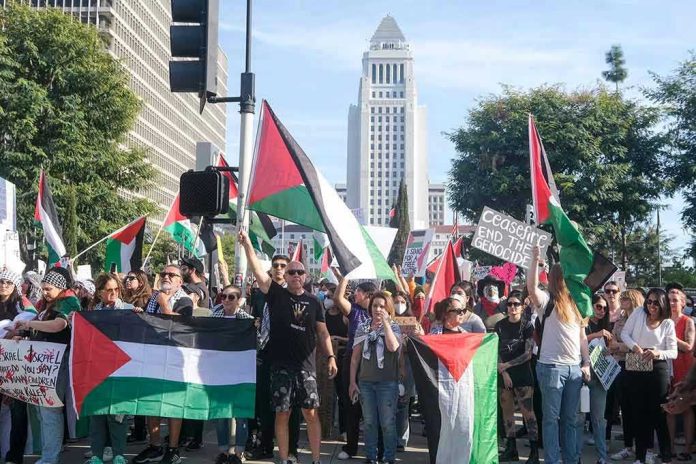
At the center is definition, not sympathy. Palestine Action built its strategy around direct disruption of firms tied to Israel’s defense supply chain: occupations, blockades, site invasions, and property damage designed to impose costs and halt operations. Proponents describe this as nonviolent civil resistance aimed at preventing complicity in war. The U.N. human rights office criticized the American designation as a disproportionate and unnecessary restriction on expression, assembly, and association—arguing it expands “terrorism” in a way likely to chill lawful dissent. U.N. experts have framed a bright line: protest that damages property but lacks intent to injure or kill should not be treated as terrorism.
U.S. authorities took a different view, emphasizing the group’s violent and disruptive conduct and alleging support for terrorism rather than merely unlawful protest. In sanctions law, the operative question is not only what activists did at a given facility; it is whether the organization provides material support, services, or other facilitation to designated terrorist actors or engages in terrorism under U.S. definitions—standards that broaden exposure beyond the spectacle of a rooftop banner drop to the infrastructure that enables sustained campaigns. This is why sanctions actions frequently appear asymmetric to protest narratives: they target the “how” and “who they enable,” not just the “what happened at the gate.”
What the designation does in the real world
Designation is not a press release; it is a set of tripwires. The SDGT label instantly turns banks, payment processors, insurers, landlords, and logistics providers into risk-calculators. U.S. persons must block property and cease transactions; foreign partners weigh secondary risk and reputational exposure. Fundraising becomes precarious; travel and coordination with allied groups trigger enhanced scrutiny. And because E.O. 13224 attaches liability to provision of material support or services, gray-zone actors—law firms, media vendors, web hosts—tighten compliance in ways that can starve a group’s operations even where the conduct would not sustain a domestic criminal terror case. That is the point: preventive disruption over after-the-fact prosecution.
The allied echo effect amplifies the squeeze. With London’s proscription intact and Washington’s sanctions in place, information sharing and mutual legal assistance become easier, and commercial gatekeepers in third countries often mirror the most restrictive regime to simplify compliance. For movements that rely on transnational solidarity—funding across borders, mirrored tactics, and digital infrastructure—this alignment can be strategically decisive.
Where principled disagreement remains—and what to watch next
Two principled disagreements will not resolve soon. First, the moral question: should destructive, high-disruption protest aimed at defense supply chains be ethically categorized with terroristic violence when it is not designed to injure people? International human rights authorities have staked out a narrow answer—no—arguing that conflation dilutes the terrorism category and chills democratic dissent. Second, the legal-operational question: is sanctions law, with its material-support and association hooks, the right instrument to manage movements that straddle criminal damage and political protest? Administrative law analysis shows why states use it—speed, reach, and preventive leverage—but also why civil liberties groups fear it: process opacity and powerful collateral consequences.
Expect three trajectories. One, litigation and advocacy will continue in the U.K., probing the evidentiary basis and proportionality of proscription even as courts defer to security assessments. Two, in the U.S., the designation will propagate through the compliance ecosystem—debanking, service refusals, algorithmic risk flags—regardless of whether new public evidence emerges. Three, allied coordination will likely widen: once a group sits on a major partner’s sanctions or terror list, multilateral fora and bilateral dialogues tend to socialize that status, nudging others to harmonize.
Bottom line
The United States treated Palestine Action not as unruly protest but as a node in a terror-support ecosystem—and used the most potent non-kinetic tool it has to disrupt it. Critics see definitional overreach with civil liberties costs; officials see a preventive strike at the enablers of extremist violence. In the era of networked activism and networked counterterrorism, that argument is not going away; the definition of “terrorism” will keep doing the legal work, and sanctions will keep doing the practical work.
Sources:
thegatewaypundit.com, wsws.org, oann.com, aljazeera.com, ohchr.org, abc.net.au, assets.recordedfuture.com, spcommreports.ohchr.org, aclu.org, sanctionslist.ofac.treas.gov