

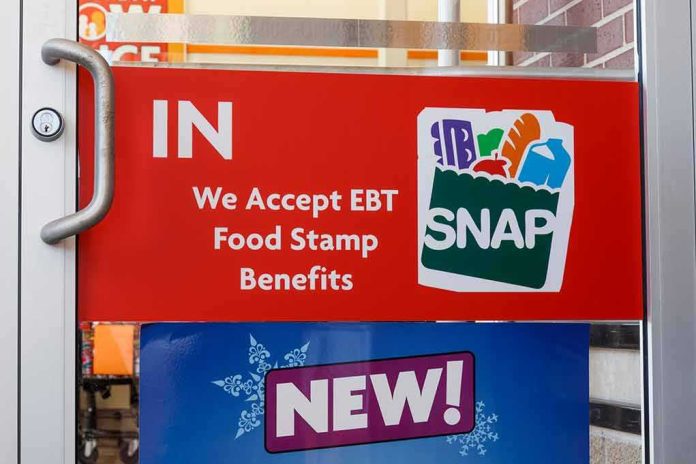
The fight over “welfare for non-citizens” is not a new argument; it is the latest round in a three-decade project to define who counts as part of the American safety net, and Senator Rand Paul’s End Welfare for Noncitizens Act (S.3670) pushes that boundary farther than any major federal statute since 1996.
The Short Version
- S.3670 would bar federal funds for TANF, SNAP, Medicaid, and other federal benefits to refugees, asylees, and unauthorized immigrants; it is written as a sweeping funding prohibition, not a narrow eligibility tweak.
- Current law already excludes unauthorized immigrants from most federal benefits, but it treats refugees and asylees as “qualified” for specific programs; S.3670 would reverse that long-standing carveout.
- The bill sits squarely in the post-1996 welfare architecture (PRWORA), but goes beyond it by rescinding access for humanitarian categories Congress has traditionally protected.
- Advocacy groups warn the bill would sever access to food aid and medical coverage for people fleeing persecution; supporters frame it as fiscal discipline and immigration deterrence.
What S.3670 actually does
The bill’s text is unambiguous: “Notwithstanding any other provision of law, no funds shall be appropriated or otherwise made available” to provide TANF, Medicaid, SNAP, or “any other Federal benefit (including cash and tax benefits), subsidy, or service” to “any refugee or asylee or any alien who is present in the United States without legal status.” That is a categorical funding bar aimed at two groups: unauthorized immigrants and, critically, refugees and asylees—humanitarian entrants whom Congress has historically permitted to access certain benefits upon arrival. The bill was introduced on January 15, 2026, and referred to the Senate Finance Committee, which has jurisdiction over these programs.
Two design choices matter. First, the “notwithstanding” clause is a preemption tool; it tells agencies and courts that this bar overrides contrary provisions scattered through program statutes. Second, the catch-all phrase “any other Federal benefit” widens the aperture beyond the three flagship programs. In practice, if enacted as written, S.3670 would require agencies to withhold federal dollars that finance benefits otherwise available to refugees and asylees today. That is the point of the bill and the source of its controversy.
How today’s system works—and what would change
Since 1996, the Personal Responsibility and Work Opportunity Reconciliation Act (PRWORA) has been the backbone of noncitizen eligibility. PRWORA draws a bright line: unauthorized immigrants are generally ineligible for federal public benefits; “qualified aliens”—a term that includes refugees and asylees—may be eligible for certain programs, often with waiting periods or program-specific rules. Emergency Medicaid remains available regardless of status; some states choose to use state funds to supplement coverage or aid within federal guardrails.
Against that baseline, S.3670 is not a routine tightening. It would eliminate, at the funding source, access for refugees and asylees to programs they have long been allowed to use. Under current rules, unauthorized immigrants already cannot enroll in SNAP, SSI, or non-emergency Medicaid; refugees and asylees, by contrast, can qualify under tailored provisions Congress has reaffirmed for decades. The bill’s mechanism—defunding, not just redefining eligibility—signals an attempt to prevent agencies from relying on residual discretion or cross-cutting authorizations to keep benefits flowing.
The advocates’ challenge and the legal architecture they confront
Refugee and resettlement organizations argue the policy would sever “literal lifelines”—nutrition assistance and medical coverage—at precisely the stage when humanitarian entrants are stabilizing in a new country. Their letters and briefings contend that proposals in this vein would exclude these populations from Medicaid and SNAP, harming people who fled violence and persecution and undermining resettlement outcomes. Their critique is moral and practical: refugees arrive lawfully through a vetting process Congress designs; cutting off baseline supports, they argue, increases destitution rather than fostering integration.
Supporters of S.3670 counter—implicitly through the bill’s structure and explicitly in political rhetoric—that federal benefits serve as a pull factor and a fiscal burden. They seek to make access to the American welfare state synonymous with citizenship, or at least to exclude noncitizens categorically from federal subsidies; some also frame the bill as closing gaps where mixed-status households or program administration allow indirect benefits. Those arguments draw energy from a long-running public perception that noncitizens receive “welfare,” even though unauthorized immigrants are already barred from most such programs under federal law.
Where the real policy disagreement lives
The dispute does not turn on whether unauthorized immigrants are eligible for federal benefits; they are not, with limited exceptions like emergency Medicaid. Nor does it turn on whether states can extend some help using state dollars; they can, within PRWORA’s framework. The fulcrum is refugees and asylees—legal humanitarian entrants historically treated as “qualified” for select programs. S.3670 would, as a matter of federal appropriation, end that access. That is a meaningful departure from the bipartisan settlement that has guided refugee policy since the late 20th century, even as Congress otherwise narrowed immigrant eligibility in 1996.
The legislative stakes are therefore twofold. Substantively, would removing federal nutrition and health coverage for refugees and asylees reduce costs or merely shift them to emergency care, local governments, and private charity? Institutionally, should Congress maintain a separate track for humanitarian entrants—consistent with their legal status and resettlement goals—or collapse them into a general noncitizen exclusion?
Implementation realities and potential downstream effects
If enacted, S.3670 would force agencies to reprogram eligibility systems, re-issue guidance, and unwind current enrollments. Because the instrument is a funding bar, agencies could not simply rely on legacy authorizations for humanitarian categories. Litigation would be likely—both statutory (conflicts with specific program statutes) and constitutional (equal protection or due process challenges)—though PRWORA’s structure gives Congress broad latitude to define noncitizen eligibility for federal programs. Meanwhile, hospitals would still face EMTALA obligations for emergency care, which shifts, rather than eliminates, certain costs if coverage disappears.
At the household level, the largest immediate effects would fall on newly arrived refugees and asylees who today rely on time-limited cash, food, and medical support during resettlement. The proposed change would also pressure state budgets: some states might substitute state-funded programs; others would not, creating geographic disparities in basic supports for lawful humanitarian entrants. Program administrators would face complex questions about mixed-status households and benefit units, long a flashpoint in public debate even when underlying law is clear.
How to assess the bill on its own terms
Measured against existing law, S.3670 is a clarity bill in one sense—the authors want as little administrative discretion as possible—and a reversal bill in another—it retracts access Congress has preserved for refugees and asylees through multiple administrations. The case for it rests on a normative judgment that federal welfare should track citizenship more tightly than PRWORA already arranged. The case against it rests on the equally clear judgment that humanitarian entry, by design, warrants a narrow window of federally supported stabilization to make resettlement viable and humane.
Reasonable people can disagree about immigration levels and fiscal priorities. But it is analytically wrong to treat this as a generic “stop illegal immigrants from getting welfare” measure; unauthorized immigrants are already excluded from most federal benefits. The live policy question is whether to end federal support for refugees and asylees via a categorical funding cutoff. That is where the argument belongs—and where Congress, if it takes up S.3670 in earnest, will have to decide.
Bottom line
S.3670 would not tidy up a loophole; it would redraw the map. It takes the PRWORA-era frame—strict exclusion for the unauthorized, targeted inclusion for humanitarian entrants—and replaces it with a near-total federal ban that includes refugees and asylees. The choice before lawmakers is explicit: preserve a limited, longstanding safety net on-ramps for people admitted on humanitarian grounds, or eliminate them in pursuit of a citizenship-linked welfare state. Whichever path Congress chooses, clarity about what the law already does—and who would actually be affected—should lead the debate.
Sources:
redstate.com, congress.gov, paul.senate.gov, thecentersquare.com, wispolitics.com