

When a homicide intersects with a police household, the investigation runs on two tracks at once: the urgent hunt for a suspect and the disciplined, slower machinery of major-crime procedure. Worcester’s case shows how those tracks work—and why public communication looks the way it does.
At a Glance
- An off-duty Worcester police officer, Kurt Solomon, 57, was found dead in his Wildwood Avenue home shortly after 5:28 a.m.
- Police named his wife, Karen Solomon, 58, as the subject of an intensive, multi-agency search and warned she may be armed and dangerous.
- Authorities released surveillance video and public safety advisories as the search extended into parks and waterfront areas; an arrest warrant followed as the probe progressed.
- The restrained flow of investigative detail is typical of domestic-homicide cases, where parallel criminal and victim-safety imperatives shape disclosure.
The established facts: what investigators have said and done
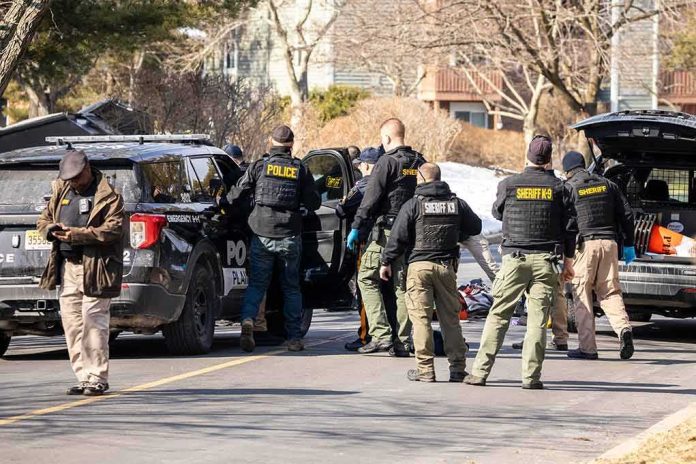
Worcester police responded to a report at the Solomons’ home on Wildwood Avenue at about 5:28 a.m. and found Officer Kurt Solomon, a 31-year veteran of the department, deceased. Authorities promptly identified his wife, Karen Solomon, as the person they were seeking in connection with his death and cautioned the public that she might be armed and dangerous. The search drew in state and federal partners, with officers canvassing neighborhoods, closing access to nearby parks, and publishing stills and surveillance video to refine sightings and timelines. As the search entered day four, city leaders and police reiterated public-safety guidance while focusing operations around bodies of water and wooded areas consistent with the last known movements reported by witnesses and cameras.
Naming a search subject and pushing targeted, time-stamped visuals into the public domain serve two purposes that are routine in major cases: they channel tips and reduce noise. Video frames—what the person was wearing, how they moved, where they were last seen—anchor the public’s memory to verifiable detail in a way that generic descriptors cannot. In parallel, the department leveraged traditional press and social channels to keep the advisory current and specific, then operationalized the leads with closures and directed searches at locations such as Coes Pond and adjacent green spaces.
Mechanics of a manhunt: how multi-agency searches are structured
Once a suspect is identified and assessed as a potential risk to the public, search operations follow a layered plan: expand the investigative perimeter; fix the timeline with cameras, license-plate readers, and witness canvasses; then constrain the terrain. That is why residents see park and waterfront closures, command posts, K-9 deployments, and dive teams as the hours pass. The aim is to convert uncertainty into ground truth—last confirmed location, probable direction of travel, and logistical constraints (on foot versus vehicle, access to cash or aid). Public-facing moves, like releasing surveillance video, are synchronized with nonpublic steps such as technology queries and forensic sweeps to prevent contaminating evidence or spooking potential helpers who may not realize the gravity of what they saw.
Internally, every breadcrumb is logged against a major-incident action system, where taskings, outcomes, and negative results carry equal weight; a reported sighting that proves false is as informative as a confirmed one because it sharpens the search map and prevents duplication. This disciplined record-keeping—codified across modern major-crime manuals—guards against tunnel vision and preserves a reliable chain for prosecutors later on, when defense counsel will probe how decisions were made and why certain leads were prioritized.
Why official details remain sparse early in a domestic-homicide case
To the outside observer, the early cadence of information can feel asymmetric: abundant appeals for tips, very few forensic particulars. That asymmetry is by design. Domestic-homicide guidance and major-crime protocols emphasize careful sequencing of disclosure during active investigations, particularly pre-charge, to protect the integrity of statements, preserve digital and trace evidence, and minimize the risk that an at-large suspect adjusts behavior in response to what police reveal. Agencies are expected to retain and account for all relevant material while calibrating what can be shared publicly; guidance frameworks spell out the interplay between investigators, prosecutors, and coroners during this stage.
The incentive structure is straightforward. Police frame the situation as urgent to mobilize the public and reduce risk, but they hold back specifics that could compromise interviews, contaminate witness recollection, or telegraph investigative blind spots. In the domestic-violence context, that restraint is reinforced by review regimes that later evaluate agency performance and decision-making; premature or unnecessary disclosure can damage both an eventual prosecution and the accountability process meant to learn from it.
The human context: a veteran officer, a well-known advocate, and a grieving department
Officer Solomon’s death reverberated through a department and a union family that knew him over three decades of service. Colleagues described him as steady and unflappable; union statements and local reporting traced the mourning rituals that follow a line-of-duty community loss—notifications, honor details, and compressed funeral planning while detectives continue their work. The case also carries a jarring biographical twist: Karen Solomon was known publicly for advocacy on police family mental health, a reminder that profiles and public roles do not immunize any household from crisis. That juxtaposition does not alter the investigative obligations or the evidentiary standards the case must meet; it does explain the intense attention from both law-enforcement circles and the broader public.
Funeral announcements and union memorials proceed on a track separate from criminal charging decisions. That separation matters. It allows the department to meet its pastoral duties to its own while insulating the investigative team from pressures—internal or external—that could skew analytic judgment. The same walling-off principle applies to public affairs: tributes and timelines can coexist, but case theories belong in interview rooms and evidence labs until prosecutors are ready to speak in the language of charges and affidavits.
Search continues near pond for woman in connection with death of Worcester police officerhttps://t.co/jn76MFPnwy
— 7News Boston WHDH (@7News) August 22, 2026
What comes next: from search to charging, and why patience serves justice
In a search-led case, milestones are predictable even if their timing is not. First, containment: fix the suspect’s location or confirm a credible last-known corridor. Second, custody: effect a safe arrest or recover the individual if deceased. Third, consolidation: reconcile witness statements with digital forensics—phone records, surveillance tracks, ballistics or sharp-force analysis, and scene reconstruction—then translate that record into prosecutable counts with a coherent narrative that will withstand cross-examination. Only then does the public typically see the fuller story, in sworn documents rather than press podium shorthand.
For communities watching closely, the best contribution is disciplined attention to official advisories and a healthy skepticism toward rumor. For institutions—from media to advocacy groups—the discipline is different: report the confirmed, contextualize the procedural, and resist the temptation to fill silence with speculation. The Worcester investigation is following the architecture that modern major-crime work prescribes. That architecture is not theatrics; it is how urgency and due process coexist in the hardest kind of case.
Sources:
facebook.com, nbcnews.com, wbur.org, nepba.org, telegram.com, nbcboston.com, youtube.com, nytimes.com, yahoo.com