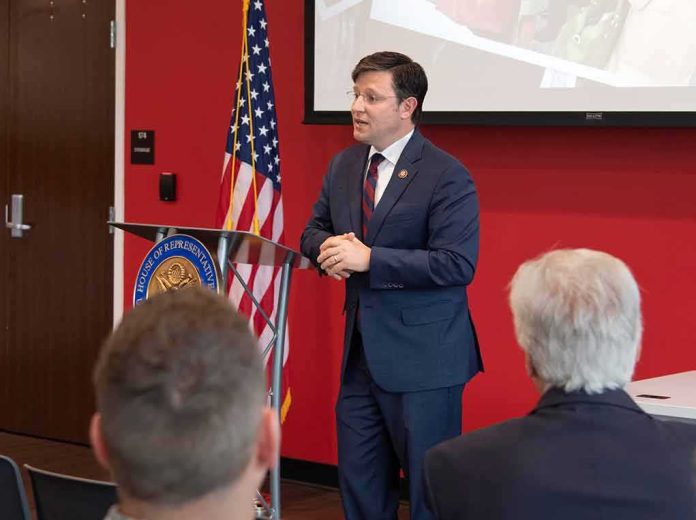
Congressional ethics cases live in a narrow channel between workplace law and political accountability; the Jimmy Gomez inquiry shows how much turns on one hard question—consent inside a power-imbalanced workplace—and how House processes try, imperfectly, to resolve it.
At a Glance
- The House Ethics Committee has formally opened a review into allegations that Rep. Jimmy Gomez engaged in sexual misconduct involving a staffer; the committee’s statements confirm an active, rule-18(a) review.
- Gomez denies violating law or House rules, characterizing his past conduct as consensual and pledging cooperation with Ethics investigators.
- Attorneys for a woman interviewed by the committee dispute Gomez’s description, alleging sexual harassment and assault and asserting the conduct was not consensual with respect to their client.
- The case unfolds amid a broader trend: since 2017, the Ethics Committee has initiated roughly 20 sexual-misconduct inquiries and published a historical list of such matters back to 1976, reflecting increased scrutiny of workplace conduct on Capitol Hill.
What the Ethics Committee is actually doing—and why that matters
When the House Committee on Ethics announces a review under Rule 18(a), it signals a threshold determination: allegations exist that warrant preliminary investigation by the bipartisan panel. In Rep. Jimmy Gomez’s case, the committee publicly acknowledged its review, a step it does not take lightly and one that places the matter on a formal track for fact-gathering, interviews, and potential next steps including an Investigative Subcommittee if the evidence supports it. This is not a finding; it is the process that precedes findings. But in congressional practice, the mere opening of such a review reshapes political, legal, and workplace stakes—staffers gain a defined avenue to be heard; the member faces institutional scrutiny; and leadership, donors, and voters recalibrate expectations.
The committee’s remit is not to adjudicate criminal liability; it enforces House rules governing member conduct, including sexual misconduct and abuse of power. Its tools are familiar to administrative investigators—subpoenas, interviews, document review—yet its constraints are political as well as procedural. Cases can end with public reports and sanctions, with admonitions, or with “loss of jurisdiction” if a member departs before disposition. Still, the committee emphasizes that when it substantiates sexual misconduct, it makes those findings public, an important commitment in a domain where secrecy erodes trust.
The competing narratives: consent vs. coercion in a hierarchical workplace
Gomez has framed his conduct as consensual and outside his marriage, denying violations of law or House rules and stating he will cooperate fully with any inquiry. That narrative preserves a key legal and ethical distinction: consensual adult relationships, however personally regretted, are not per se violations of the House code. It signals contrition toward his family while insisting on compliance with the rules that govern his office.
The counter-narrative, put forward by named attorneys representing a woman interviewed by Ethics investigators, is starkly different: they say Gomez sexually harassed and assaulted their client and that his conduct was not consensual in her case. They further predict the committee will reach the same conclusion. These are on‑record statements by counsel, not anonymous rumor, and they squarely challenge the core claim of consent that anchors Gomez’s defense. At this stage, the committee—not commentators—must reconcile these accounts through evidence.
How these cases proceed: evidence, credibility, and the power-imbalance lens
Allegations of sexual misconduct in Congress typically hinge on three evidentiary pillars: contemporaneous records (texts, emails, calendar entries, security logs), corroboration (witnesses who observed behavior, disclosures made at the time, patterns), and credibility assessments (consistency, motive, detail). The power-imbalance question threads through each pillar. Relationships between a member and staff—whether direct or across offices—carry inherent asymmetry: the member wields influence over careers, access, recommendations, and assignments. That asymmetry does not erase the possibility of consent, but it complicates both its meaning and proof; what appears voluntary may be shaped by implicit pressure or fear of retaliation.
House investigators have developed a playbook around these dynamics, refined by a surge of cases since 2017. The committee has said it launched about 20 sexual‑misconduct probes in that span and, unusually, published a historical chart listing publicly disclosed matters back to 1976. Roughly half of those cases cluster in the last decade—evidence of stronger reporting norms and more aggressive oversight rather than a sudden behavioral shift. The public‑facing policy commitment is clear: when the committee substantiates sexual misconduct, it releases findings so the workplace—and ultimately voters—can see what happened and how it was addressed.
What outcomes look like—and what they mean
Ethics matters yield a spectrum of outcomes. In some, the committee issues a public report and sanctions or disapproval; in others, it imposes remedial measures or refers evidence elsewhere. A significant share of cases in the historical list ended without final findings when the committee lost jurisdiction after a member resigned or left office—an outcome that resolves the panel’s authority but not necessarily the underlying facts. In the subset where allegations were substantiated, the committee’s practice of publishing findings is now well established, which is the key accountability lever the House controls absent criminal prosecution or civil litigation.
For an incumbent like Gomez, the practical consequences arrive before the committee rules. Campaigns face donor hesitation, staff turbulence, and opponent messaging calibrated to the uncertainty. That is not unique to this case; it is how reputational risk functions in public life. The committee’s job is to cut through that noise, test the claim of consensual conduct against specific evidence, and evaluate whether workplace rules were breached. If the attorneys’ assertions of non‑consent are borne out, the path points toward formal findings and potential sanction; if not, the record should say so plainly, for the sake of the institution as well as the individuals involved.
Rep. Jimmy Gomez, House Democrat is accused yet again.
A woman interviewed in the House Ethics Committee probe into his conduct says the encounter was not consensual.
Gomez has acknowledged “mistakes” outside his marriage but maintains they did not break the law or House… pic.twitter.com/zEh04mhCXC
— Gina Beana Fofina (@Ginasassyass) August 19, 2026
Why the Gomez case is a test of institutional credibility
Capitol Hill has been reshaping its approach to misconduct for a decade: more transparent Ethics communications, better reporting channels, training that addresses retaliation and generational norms, and a public commitment to publish substantiated findings. The Gomez inquiry will measure whether those reforms translate into timely, even‑handed adjudication of a contested consent claim inside a hierarchical workplace. The committee has set expectations—start the review, gather facts, and speak clearly when the evidence is sufficient. For staffers and members alike, that clarity is the point of the system.
What to watch next
Three developments will indicate trajectory. First, whether the committee escalates from a preliminary Rule 18(a) review to an Investigative Subcommittee, a move that typically signals more than threshold evidence. Second, whether corroborating materials—documents, contemporaneous reports, or third‑party accounts—surface through the process to support either consent or coercion. Third, the committee’s cadence: extended delays sap confidence; crisp procedural steps, followed by a public report when warranted, build it. Gomez has invited scrutiny by pledging cooperation. His accuser’s counsel has raised the stakes by asserting non‑consent unequivocally. The institution now has to do its work—thoroughly, and in public at the end.
Sources:
cbsnews.com, cnn.com, ethics.house.gov, en.wikipedia.org, npr.org, nypost.com, podcasts.apple.com