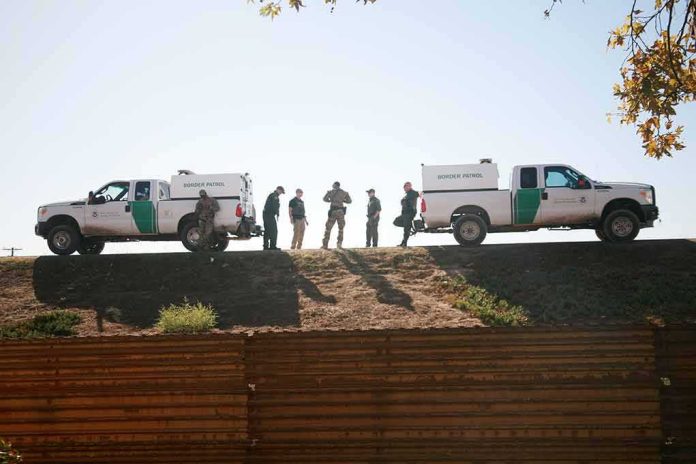
The northern border is not “quiet”—it is elastic. Encounters can surge to historic highs within weeks, collapse after enforcement surges, and then reconfigure as networks adapt. Treat it as static and you’ll misread both the risk and the remedy.
At a Glance
- FY2024 brought a clear surge in northern-border encounters, with peaks in late spring and early summer.
- CBP cut those encounters sharply after targeted operational surges, underscoring how quickly flows respond to capacity and posture.
- The Swanton Sector was the epicenter of the spike, with diverse nationalities and dangerous terrain multiplying operational risk.
- “Record crossings” headlines rest on encounters data; they reflect activity CBP detected, not undetected unlawful entries.
What the data actually show: a real surge, then a sharp retreat under pressure
U.S. Customs and Border Protection’s own reporting leaves little room for dispute: northern-border activity rose markedly in FY2024, with Border Patrol encounters between ports of entry climbing through the spring and peaking in late May and June. Nationwide encounters tables show northern-border apprehensions hitting roughly the 3,400–3,600 range in May and June 2024—levels that exceeded prior-year baselines and reset expectations for the 5,500‑mile frontier’s operational tempo.
CBP then drove those numbers down. The agency’s September 2024 update attributed a 50% drop in northern-border encounters from June to September to expanded enforcement efforts; by December, CBP reported an over 85% reduction from the June peak. The arc is instructive: capacity and posture matter, and when CBP surged resources, flows fell quickly.
Where the surge concentrated: the Swanton Sector and the problem of terrain
Surges are rarely uniform across 49th-parallel geography; they cascade into chokepoints defined by terrain, cover, and roads. In FY2024, the Swanton Sector—spanning parts of New York, Vermont, and New Hampshire—became that focal point. Congressional materials cataloged successive sector records early in the fiscal year, reflecting concentrated pressure rather than a diffuse, equal‑opportunity increase across all sectors.
Operationally, Swanton is unforgiving. The “slash”—the cleared line along the boundary—grows over fast, blocking sightlines and limiting aerial and camera coverage unless crews continually cut it back. Agents there report that dense brush and harsh winter conditions amplify both concealment for smugglers and life‑safety risks for migrants; record activity in that landscape is not just a counting story but a rescue, exposure, and response‑time story.
Why the encounter metric cuts both ways
It is tempting to turn encounter counts into a security verdict: higher equals “open,” lower equals “secure.” That collapses a complex reality into a single imperfect gauge. Encounters and apprehensions are detections that reach physical control or processing—proof of activity and enforcement, not an audit of what CBP missed. They are essential for trend reading and resource planning, but they cannot, on their own, answer the critical denominator questions about evasion, reattempts, or the split among asylum seekers, guided smuggling events, and inadvertent incursions.
For FY2024’s northern spike, the denominator problem matters. The same dataset that underwrites “record” headlines also shows steep declines after targeted operations; the narrative you take away depends on which month you look at and whether you treat encounters as the whole of border security. The more defensible conclusion is narrower but sturdier: flows spiked, CBP responded with expanded measures, and encounters then fell materially—evidence that posture and resourcing changed outcomes rather than a binary “open” or “closed” border.
Between ports of entry: why “where” matters as much as “how many”
CBP’s enforcement statistics separate activity at official ports from apprehensions between ports of entry. That distinction is operationally significant. A meaningful share of FY2024 northern activity occurred away from ports, demanding agent patrols, sensors, air and marine support, and rapid coordination with state, local, tribal, and Canadian partners. Between‑port patterns stress the parts of the system least cushioned by fixed infrastructure; they are also the environments where weather, vegetation, and distance most distort response times.
When critics describe the border as inadequately secured, this is often what they mean: sustained activity in tough ground away from ports requires a different, more labor‑intensive toolkit. Encounters rising in those spaces do not prove a failure of control—but they do demonstrate where control is most expensive and fragile.
I’m headed to the U.S.-Canada border to meet with Border Patrol and local law enforcement about what they’re seeing along our northern border.
What do you want me to ask them?
(And as always, no taxpayer dollars were harmed in the making of this trip) pic.twitter.com/DzzaKLffQP
— Andrew Ireland (@AndrewIrelandIN) August 18, 2026
How the spike compared to recent years: magnitude, not a blip
Context matters for claims of “record” conditions. Oversight materials drawing on CBP data noted that FY2024 northern-border encounters were dramatically higher than FY2021 and FY2022 levels—by several‑fold on some measures—and, in aggregate, exceeded FY2021 and FY2022 combined. That is the difference between noise and signal: even after allowing for seasonality and policy cycles, FY2024’s spring and summer marked a genuine break from the prior near‑term baseline.
This magnitude does not, by itself, identify cause. The public record here does not provide a full accounting of sector staffing, overtime, sensor uptime, and patrol‑to‑mile coverage across the northern line. Without those inputs, causal claims—policy changes versus smuggling adaptation versus displacement from the southwest border—remain hypotheses rather than conclusions. But the scale of FY2024’s increase is well‑documented in the government’s own data.
What turned the tide: enforcement elasticity and the limits of easy narratives
CBP’s statement that expanded enforcement cut northern encounters by half from June to September—and by more than 85% by December—should shape how we talk about “open borders.” If the system were functionally open, raising enforcement pressure would not so rapidly depress detected crossings. Instead, flows moved in response to additional personnel, targeted operations, and tighter coordination, especially in the most stressed sectors. The episode reads as an elasticity test: raise the price of entry—probability of detection, probability of removal, time in custody—and attempted crossings fall measurably.
That does not make the problem trivial or permanently solved. It does argue for steady investment in the parts of the border that are hardest to police: long stretches of forest and water, winter terrain that shreds electronics and endurance, and gaps where technology outpaces staffing—or vice versa. Those are fixable problems, but they are resource problems first.
Where the debate goes astray: sanctuary rhetoric and the northern reality
Sanctuary‑policy debates often get folded into border‑security arguments. Whatever one thinks of those local policies, they do not—and cannot—bar federal agents from enforcing immigration law. By design, such policies limit how local resources are used; they do not prevent ICE or CBP from operating in a jurisdiction, conducting raids, or running checkpoints. They may affect interior cooperation; they do not dissolve federal authorities at the line or between ports of entry.
That distinction matters in the northern context. The FY2024 spike was a border‑environment phenomenon first—terrain, detection, smuggling adaptation—not a municipal policy shock. If policymakers want to argue interior rules shape repeat attempts or evasions, the evidence would need to connect those dots. The record summarized here does not.
What a serious audit would add
Three gaps keep public debate from maturing beyond snapshots. First, sector‑level staffing and overtime, including Law Enforcement Information Systems Specialists who keep surveillance technology running, to understand whether the hardest miles have the right mix of people and sensors. Second, incident‑level detection data—agent sighting, fixed tower, mobile camera, aircraft, partner tip—to quantify what is working where. Third, disposition data that distinguishes first‑time crossers, asylum presentations, organized smuggling events, and reattempts, especially in winter‑risk corridors such as Swanton.
CBP and GAO have both flagged elements of these measurement and staffing gaps in prior work. Closing them would let Congress and DHS target dollars where they buy the most control—marginal miles in remote sectors—rather than where headlines are loudest.
The bottom line for policy and operations
Two propositions are well supported by the record. One, the northern border is capable of sudden, sector‑concentrated surges that overwhelm routine staffing and technology postures. Two, those surges can be suppressed quickly when enforcement scales up in the right places with the right mix of tools. Neither supports fatalism, and neither justifies complacency. The practical path is boring and proven: staff to the risk, keep the sensors powered and maintained, modernize ports to prevent displacement, and preserve the ability to surge—fast—when the graph turns vertical.
Sources:
youtube.com, homeland.house.gov, cbp.gov, foxnews.com, voz.us, bostonglobe.com